REVIEW · NEW YORK CITY
Midtown Manhattan Art and Architecture Walking Tour
Book on Viator →Operated by Manhattan Unlocked Historical and Architectural Walking Tours · Bookable on Viator
You can read Midtown like a living textbook. This walking tour connects art and architecture to the real rules that shaped Manhattan, from Times Square’s zoning quirks to the civic ambition of Rockefeller Center. You’ll move through major modern landmarks while also seeing public art tucked into the everyday spaces most people rush past.
What I like most is the way the guide turns building design into something you can actually understand. Two standout strengths for me: you get ultra-intimate group size (max five) and you also get a deep focus on the mechanics behind the skyline, especially through POPS (Privately Owned Public Space) and evolving zoning laws.
One consideration: it’s a lot of walking with frequent quick exterior-and-lobby stops, so if you want long museum-style time in one place, you might prefer a slower plan or a follow-up visit to your favorites.
In This Review
- Key highlights you’ll feel right away
- Midtown Manhattan Art and Architecture: Why this route works
- The small group factor: max five people, real conversation energy
- Times Square to Eighth Avenue: history through architecture shifts
- Worldwide Plaza to the CitizenM zone: zoning becomes a skyline story
- Brill Building and the cultural engine behind Midtown
- From corporate lobbies to art-and-architecture storytelling
- The 6 1/2 Avenue quirk: the kind of street oddity Midtown is good at
- UBS Art Gallery: modern art in a place that looks ordinary
- Time and Life building stop: modern classic materials and Mondrian lineage
- Sixth Avenue and Rockefeller Center: where you see the style shift happen
- Radio City, Roxy, and the Rockefeller family politics
- Rockefeller Center’s rink and the outside art moment
- St. Patrick’s Cathedral: Fifth Avenue told through architecture choices
- Park Avenue evolution: from train tracks to corporate power
- Christie’s Sculpture Garden and the best “keep walking but take a break” moment
- Philip Johnson’s POPS, IBM’s popular public spaces, and how Midtown finishes strong
- Is $59 good value for a 2–3 hour Midtown art walk?
- Tips to get the most out of it (without over-planning)
- Should you book this Midtown tour?
- FAQ
- How long is the Midtown Manhattan Art and Architecture walking tour?
- How many people are on this tour?
- What is the price per person?
- What language is the tour offered in?
- Where does the tour start and end?
- Is admission required for the stops?
- What if the weather is poor?
Key highlights you’ll feel right away
- Tiny group size (5 or fewer) means more questions and less feeling like you’re in a crowd
- POPS everywhere: you see how zoning created public access inside private buildings
- Art in motion with the architecture: sculpture, murals, and modern installations tied to specific sites
- Big Midtown anchors with context: Rockefeller Center, Radio City, St. Patrick’s, and Park Ave explained in plain language
- Modern art meets corporate interiors: major names and works show up in lobbies you can reach
- Strong end-of-tour skyline payoff: Billionaire’s Row views at the finish near Tiffany’s area
Midtown Manhattan Art and Architecture: Why this route works
Midtown can feel like one long rush. This tour gives you a way to slow your brain down without slowing your feet. Instead of treating landmarks like isolated postcards, you connect the dots between design choices, land-use rules, and the culture that came out of all that building pressure.
A big theme is zoning—not as a dry chart, but as the reason certain arcades, plazas, and rooftop-like setbacks exist. The guide also frames art as part of how these spaces perform. In other words: the skyline isn’t just a collection of buildings. It’s a system, and the art is one of the language tools the system uses.
The route also makes smart “sightline” sense. You’re not stuck only looking straight ahead. You get chances to scan upward for towers, then turn your attention to lobbies, passageways, and public plazas where you’d normally never linger.
You can also read our reviews of more tours and experiences in New York City.



The small group factor: max five people, real conversation energy
At $59 for a 2 to 3 hour walk, the price only makes sense if the experience actually uses that time well. The tour’s big advantage is the group size capped at five. That matters because so many stops are “quick but specific.” When the guide calls your attention to a detail—like a zoning-designed setback or an artwork placed exactly where you can see it—more people means more “I hope I can catch what you’re pointing at.”
With a smaller group, you’re more likely to get answers instead of a polite nod. Reviews also point to a guide who listens and adjusts with the group. If you’re the type who likes asking why a building looks a certain way, this format tends to fit you.
Practical tip: even with a small group, expect a walking schedule where you’re standing and moving most of the time. Wear comfortable shoes. Bring water. And if you’re someone who wants a restroom whenever your brain says so, plan to use breaks when the guide offers them.
Times Square to Eighth Avenue: history through architecture shifts
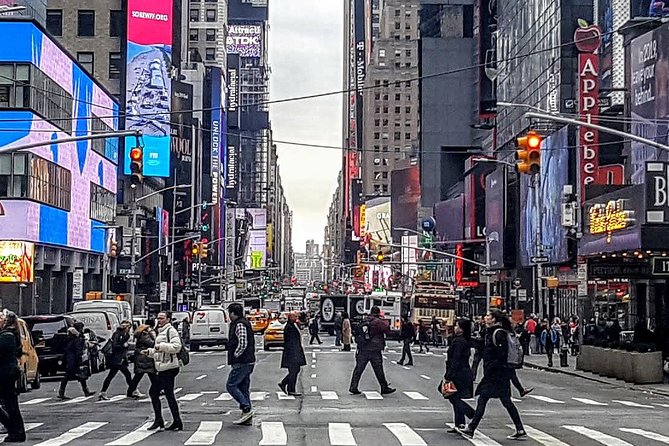
The tour begins on Eighth Avenue at the boundary of Hells Kitchen and Times Square. Right away, you’re given a road map for how Midtown “moved uptown” over time—and what that meant for architecture styles. You’ll hear about the shift from overblown Beaux Arts to more streamlined modern skyscraper approaches, and you’ll get vocabulary for spotting those changes on the street.
A key thread here is academic architecture across time periods, followed by the Modern era’s move toward ornament-free design. That matters because Midtown often gets described as all one style. This tour corrects that quickly.
You’ll also encounter works tied to the POPS concept, including pieces by Sidney Simon and Matt Mullican. The point isn’t to memorize artist names. The value is learning how public access got woven into private development, and why those decisions show up as art placements, plazas, and street-level behaviors.
Worldwide Plaza to the CitizenM zone: zoning becomes a skyline story

Moving east through Midtown, you spend a few minutes in places that show how zoning law evolves on the ground. One stop focuses on 350 W 50th St, where a subway station area below Worldwide Plaza includes incised granite by Matt Mullican.
Then you head toward the citizenM New York Times Square Hotel, where the guide connects large-scale wall art and skyline scanning. This segment is built for people who like looking up. You’re invited to spot major Midtown signals like Hearst Tower and the New York Times Building while you also look at how contemporary art sits in the middle of older commercial patterns.
This part can be a quick burst of sensory input. If you’re prone to information overload, it helps to pick one thing to focus on while you walk: either the art placement or the skyline geography. The guide’s job is to connect both, but your job is to choose what your eyes will catch first.
Brill Building and the cultural engine behind Midtown
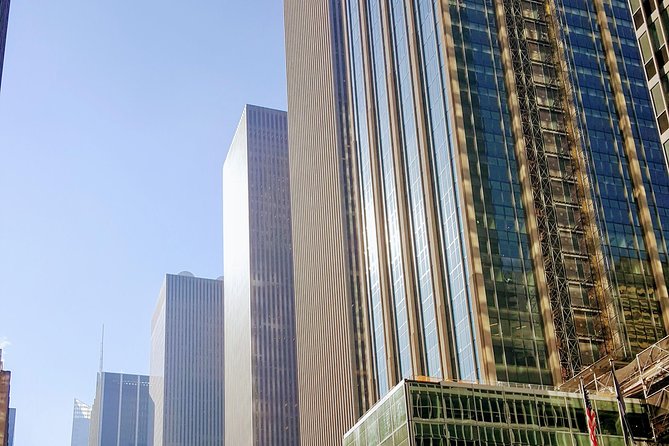
The Brill Building stop adds a cultural spine to the route. You’ll talk about how Times Square and much of today’s Midtown served as a near monopoly on American culture—music, theater, radio, television, magazines, newspapers, advertising, and even automobiles.
This is where the tour feels different from a generic architecture walk. Buildings aren’t treated as art objects only. They’re treated as infrastructure for media and entertainment. That’s the “why” behind all those signs, studios, and corporate offices that used to drive Midtown’s energy.
If you like pop culture history but want it tied to something physical, this segment works well. If you only care about pure design detail, you might wish it spent a little longer on building form here—but the cultural framing helps you connect later corporate art and lobbies back to the same Midtown machine.




From corporate lobbies to art-and-architecture storytelling
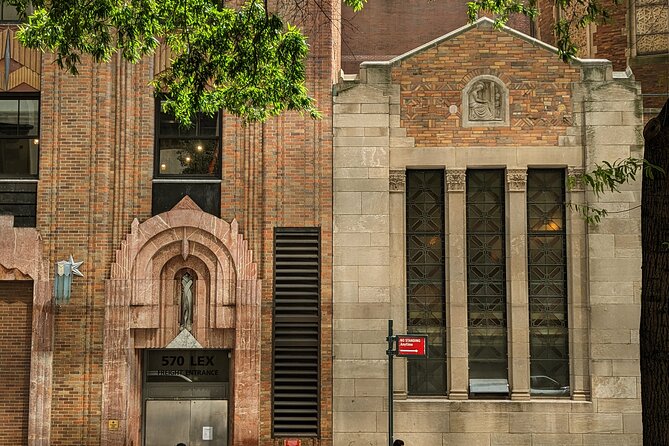
As you transition deeper into private corporate territory, the tour gets more satisfying if you enjoy “inside look” spaces—lobbies, passageways, and POPS where public life meets corporate money.
One highlight here is the area associated with BNP Paribas, and the context around nearby sites like the Winter Garden, the Taft Hotel, and the building that inspired MONY MONY. The guide uses these to explain how commercial Midtown brand power and architecture grew together.
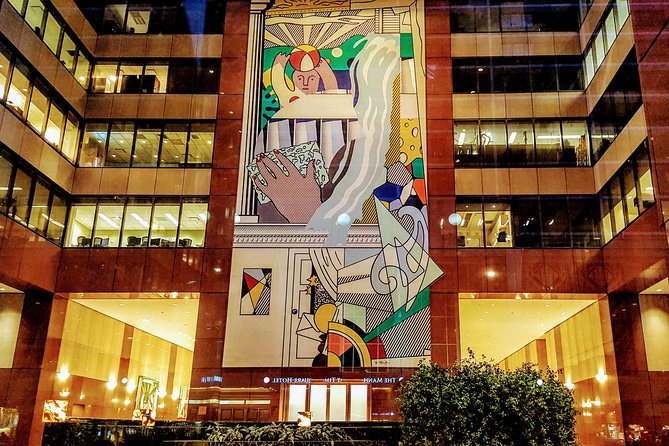
Then you’ll see major art placed in corporate lobbies and linked to the original building openings and design intentions. A standout is Roy Lichtenstein at the 787 7th Avenue complex, with the work Mural with Blue Brushstroke—described as painted in place before the building opened. You also get mention of outdoor or adjacent POPS works by Sol Le Witt and Barry Flannagan.
This is one of those rare “you’ll never find it alone” parts, because corporate lobbies can look plain from the sidewalk. The tour teaches you where to look and why.
The 6 1/2 Avenue quirk: the kind of street oddity Midtown is good at
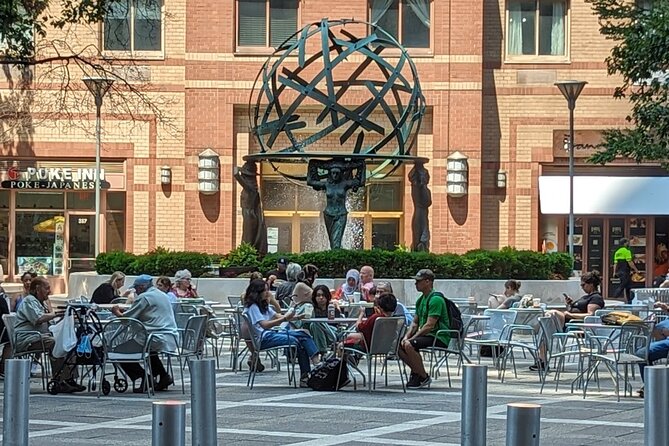
Midtown hides surprises. 6 1/2 Avenue is one of them: a mid-block arcade that doesn’t fully connect Times Square with Central Park. The tour treats it as a zoning artifact you can literally walk through in your mind: a small odd shape in the grid that tells you how land-use pressure created messy-but-functional public access.
It’s a short stop, but it’s valuable for anyone who likes city texture. You’ll see how urban planning constraints and real estate strategies can produce spaces that feel accidental—until you realize they’re the outcome of rules.
UBS Art Gallery: modern art in a place that looks ordinary
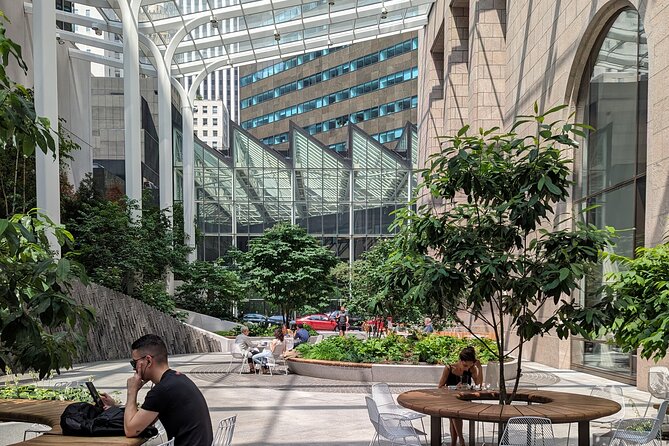
Next up is the UBS Art Gallery. The guide notes that it has a world-renowned collection, and the lobby experience is split between temporary and permanent exhibits. You’ll hear names like Frank Stella and Sarah Morris tied to what you might see there.
Even if your art tastes are more street-level than museum-level, this stop is useful because it shows a pattern: high-profile corporate Midtown increasingly treats art as part of the customer experience, not an afterthought. And the tour helps you notice how that shift changes the vibe of the city block by block.
Time and Life building stop: modern classic materials and Mondrian lineage
At 1271 Avenue of the Americas, you’ll get a closer look at the Time and Life building. The guide highlights stainless steel panels and a terrazzo floor, then connects large wall art by Fritz Glarner, described as a student of Mondrian.
This segment is ideal if you enjoy design details: material choices, clean geometry, and how modern art sensibilities matched the architecture’s streamlined look. It’s also a reminder that Midtown’s “corporate” can still mean “design-forward,” not just “boxy office.”
Sixth Avenue and Rockefeller Center: where you see the style shift happen
A big leap in the walking plan brings you toward Sixth Avenue (Avenue of the Americas), where you’ll pause at the McGraw Hill building (1221) to look for a work by Mark Bradford.
Then comes the visual contrast across “Skyscraper Alley,” described as some of the worst outcomes of zoning law—followed by the deliberate design ambition of Rockefeller Center. This is one of the most important interpretive moments in the entire tour: you’ll learn how Rockefeller Center helped define Art Deco style, and how subtle changes unfolded as the project progressed after the passing of Raymond Hood.
It’s easy to call Rockefeller Center beautiful. The real payoff here is understanding how it became coherent through decisions made under pressure. You’re not just admiring. You’re reading.
Radio City, Roxy, and the Rockefeller family politics
At Radio City Music Hall, you get origin story context behind the name Roxy, tied to the entertainment culture that made Midtown run. The tour also discusses the politics of the day and the Rockefeller family dynamic as part of the bigger art-and-building story.
Another thread connects the story of radio and David Sarnoff to the same corporate-and-media engine that shaped Midtown’s rise. This is the kind of backstory that makes later stops make more sense.
If you like city history but hate long lectures, this portion keeps it moving. You’re getting the important links without getting buried in dates you’ll never use again.
Rockefeller Center’s rink and the outside art moment
Outside, the tour reaches an emotional high point—especially if you visited or dream of visiting during winter. The guide talks about the annual Christmas tree and the Rink at Rockefeller Center story, including holdouts and the famous connection to Diego Rivera and the Rockefellers.
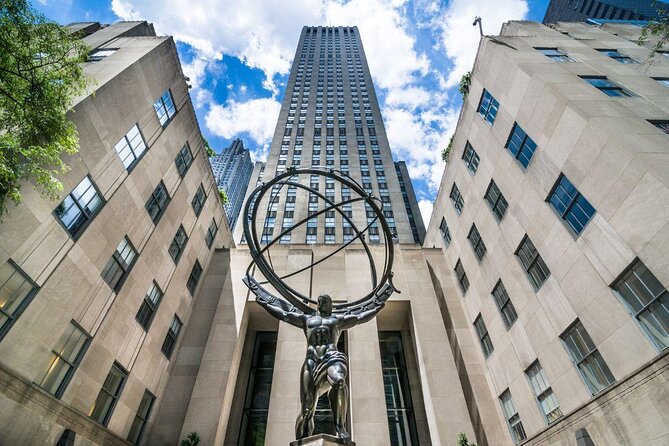
Then you move into the International Building. The lobby gets treated as a work of art in its own right, with Light and Movement by Michio Lhaza as wall pieces and Atlas by Lee Lawrie outside facing St. Pat’s.
This is where the tour’s title matters. Art and architecture aren’t separate here. They’re paired like a duet. And the guide gives you enough context that you’ll look at these works longer than you would on a casual stroll.
St. Patrick’s Cathedral: Fifth Avenue told through architecture choices
You finish this major Midtown chapter at St. Patrick’s Cathedral. The guide frames Fifth Avenue’s history through its buildings, which helps you see the avenue as a timeline rather than a line of famous addresses.
This stop works especially well at the end of the Rockefeller section because it gives you a “civic anchor” feeling. After corporate art, signage, and modern lobbies, you get a landmark that has a different kind of permanence.
Park Avenue evolution: from train tracks to corporate power
As you move toward Park Avenue, you’ll get quick but meaningful juxtapositions of Modern and Beaux Arts. You’ll also pass examples like the Villard Houses, now part of the Palace Hotel story.
At Park Avenue, the tour lays out an evolution: open train tracks, then high-end residential, and then the heavy corporate era. The guide specifically names key buildings, including:
- The Health and Racquet Club (1918)
- St. Bart’s (1919)
- The New York Central Building (1929)
- The Waldorf Astoria (1931)
- The GE Building (1931)
- Lever House (1952)
- The Seagram Building (1958)
- The Met Life Building (1963)
This section is for you if you like seeing the skyline as an argument. Park Avenue’s story is about shifting value systems—what Manhattan decided was important, and where money and power wanted to live.
Christie’s Sculpture Garden and the best “keep walking but take a break” moment
At Christie’s Sculpture Garden on 535 Madison Avenue, you get a three-way win: architecture, zoning logic, and art by three French artists across about 20 years—Léger, DuBuffet, and François-Xavier LaLannes.
Even if you only stop for a few minutes, this is one of the easiest “pause points” on the walk. You can look at sculpture within an outdoor setting without needing to buy a ticket to a museum.
Then the tour adds a practical real-world angle at Papillon Bistro & Bar. It’s described as a successful holdout in high-pressure real estate. Translation: it’s a reminder that old-school local spaces can survive when the city changes.
If you’re hungry, it’s a smart place to plan lunch or dinner after you’ve walked off your jet lag.
Philip Johnson’s POPS, IBM’s popular public spaces, and how Midtown finishes strong
Near the end, you’ll encounter a Philip Johnson-associated building with a redesigned outdoor POPS described as likely among the most spectacular in the city. If there’s time, the guide may show you Solid Sky by Alicia Kwade.
You’ll then reach the IBM Building’s POPS, described as regularly among the highest-rated. The tour references Applefest pieces here—another example of how brand, technology, and corporate space sometimes merge with public art.
Finally, the walk exits onto 57th Street, ending beneath Billionaire’s Row at about 244 5th Ave. You’ll be set up for views of the newest “skin” of the Manhattan skyline—skinny residential towers climbing to astronomical heights and prices.
It’s a clean landing after a tour that has been teaching you to see the city as a construction system, not just a photo set.
Is $59 good value for a 2–3 hour Midtown art walk?
For $59, the value comes from three things you can feel in real time.
First, you’re paying for a guide who makes fast stops actually meaningful. Midtown is full of interesting sites, but it’s also full of noise. This tour picks landmarks and uses them to explain patterns—especially zoning and POPS—so you leave with a framework you can apply to the rest of the city.
Second, the experience leans on places where access is practical. The tour notes free admission at listed points, which means you’re not stacking a bunch of museum tickets on top. You get art and architecture exposure in lobbies, passageways, and public spaces.
Third, you’re paying for the small-group format. At max five people, you’re more likely to get clear answers and a pace that doesn’t leave you chasing the group like you’re in a sprint.
If you’re short on time in New York but want to understand Midtown beyond icons, this feels like a strong deal.
Tips to get the most out of it (without over-planning)
- Wear shoes built for sidewalks. This is mostly moving, with short moments to look closely.
- Bring a phone with enough battery. You’ll want to snap skyline angles and artwork details.
- Pick your preference in the moment: art detail, or skyline zoning geometry. You can’t fully do both at once on a moving schedule, but you can choose what your eyes catch first.
- If you’re going during a heavier holiday period, know that outdoor conditions matter. The tour notes it operates in all weather conditions, but if poor weather cancels it, you’ll get a different date or a full refund.
Should you book this Midtown tour?
Book it if you want to understand Midtown like a system: zoning → architecture → art → culture. It’s especially good for first-timers who feel overwhelmed by Midtown’s scale and for repeat visitors who are tired of just taking pictures without knowing why buildings look the way they do.
Skip it if your ideal day is slow, long museum time. This tour is designed for momentum, quick interpretation, and multiple sites in one session. You’ll likely want to follow up afterward at one or two places that really grabbed you—especially Rockefeller Center, St. Patrick’s, or the sculpture garden.
If you’re paying for one Midtown experience and you care about art-and-architecture connections, this is the kind of $59 plan that can change how you see the city for the rest of your trip.
FAQ
How long is the Midtown Manhattan Art and Architecture walking tour?
It runs about 2 to 3 hours.
How many people are on this tour?
The group is limited to a maximum of 5 travelers.
What is the price per person?
The price is $59.00 per person.
What language is the tour offered in?
It’s offered in English.
Where does the tour start and end?
It starts at 810 8th Ave, New York, NY 10019. It ends at E 57 St & 5 Av, near Tiffany’s on 57th Street.
Is admission required for the stops?
The tour lists free admission at the included stops.
What if the weather is poor?
The tour requires good weather. If it’s canceled due to poor weather, you’ll be offered a different date or a full refund.