REVIEW · NEW YORK CITY
New York Soho and the Village Art and Architecture Tour
Book on Viator →Operated by Build Tours · Bookable on Viator
Architecture makes Manhattan make sense. In 2 hours, you’ll get an easy reading of SoHo and the Villages while a guide keeps you moving and your questions answered, and personal headsets make every explanation clear even on busy sidewalks. I love how fast the tour turns random building facades into something you can interpret.
I also like the guide attention level. When Ivan leads, it feels intimate: you stay in a tight group (max 15), you can ask questions, and the route stays focused on what you care about—so you’re not just collecting dates, you’re learning how to see.
One possible drawback: this is a short walk with multiple stops that are mostly exterior viewing with brief time at each place, so if you want long museum-style sessions, you’ll probably still want to add your own time after.
In This Review
- Key points you’ll feel right away
- Why SoHo and the Villages click on a 5:30 pm walk
- Small-group comfort and clear audio with professional headsets
- Stop by stop: Cooper Union to 40 Bond St (why the route starts strong)
- Cooper Union Foundation Building (about 10 minutes, admission listed free)
- 40 Bond St (about 5 minutes, residences by Herzog and deMeuron; admission listed free)
- New Museum, PUBLIC Hotel, and Capitale: modern form next to historic purpose
- New Museum of Contemporary Art (about 5 minutes, by SANAA; admission listed free)
- PUBLIC Hotel (about 5 minutes, admission listed free)
- Capitale (about 5 minutes, former Bowery Savings Bank, by McKim, Mead & White, 1895)
- The Little Singer Building, Aldo Rossi’s Scholastic Building, and a stop at the old cathedral
- Little Singer Building (visit stop)
- Scholastic Building by Aldo Rossi (pass by)
- NY’s old cathedral (visit stop)
- NYU along Houston Street and Silver Towers’ art + public space
- NYU Main Campus (about 5 minutes, new additions along Houston Street and around Washington Square)
- Silver Towers (about 10 minutes, buildings plus public spaces and art)
- Inside Bobst Library and ending at Washington Square Park under the Arch
- Bobst Library (about 5 minutes, visit and enter)
- Washington Square Park under the Arch (about 10 minutes, finish point)
- Price and value: is $49 worth it for architecture lovers?
- Who should book this tour (and who might want something else)
- Should you book this SoHo and Village Art + Architecture tour?
- FAQ
- How long is the New York SoHo and the Village Art and Architecture Tour?
- Where does the tour start and end?
- What time does the tour begin?
- What’s included in the ticket price?
- Is admission included at the stops?
- Does the tour run in any weather?
Key points you’ll feel right away
- Headsets for everyone so you hear the guide clearly the whole way
- Small group size (max 15) for more personal attention and easy questions
- Free-admission stops listed at several major sites, so you can focus on the buildings
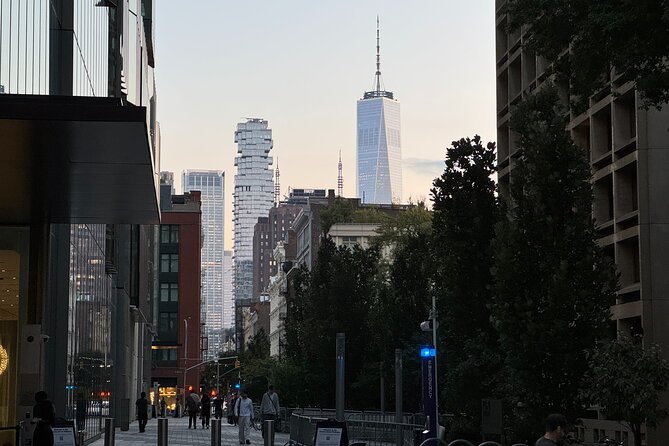
- Neighborhood logic, not just sightseeing: SoHo, West/East Village, Lower East Side all connect
- Ends at Washington Square Park under the Arch, a perfect wrap-up point
Why SoHo and the Villages click on a 5:30 pm walk
This tour starts at 5:30 pm, which matters more than you’d think. Early evening gives you enough daylight to read details on facades—cornices, window grids, brick patterns—without the all-day fatigue that comes from doing the whole city on your own.
The route makes sense because it stitches together different parts of downtown that many people treat separately. SoHo has its own design language, the Villages change in texture block by block, and the Lower East Side brings you close to communities and institutions you might otherwise miss on a midtown-only trip.
Also, the timing is realistic. It’s about 2 hours, and travel time is included in that window. You can do this right before dinner plans or after you’ve already explored earlier in the day, instead of treating architecture as a half-day project.
You can also read our reviews of more tours and experiences in New York City.



Small-group comfort and clear audio with professional headsets
The biggest practical win here is the sound setup. Everyone gets professional individual headsets, and that changes the experience. You’re not competing with traffic noise or losing half the story because someone’s blocking your view.
The group stays under 15 people, which keeps the pace friendly and questions manageable. On a bigger tour, you tend to overhear or hurry along. Here, you can actually linger for the parts you care about—especially when the guide points out what to look for.
You also get a mobile ticket, so you’re not fumbling with printed passes on a corner. And since the tour runs near public transportation, it’s easier to drop in without turning your day into a logistics puzzle.
Stop by stop: Cooper Union to 40 Bond St (why the route starts strong)
You begin at Cooper Square (near Cooper Square) and quickly move into one of the city’s classic “pay attention here” zones.
Cooper Union Foundation Building (about 10 minutes, admission listed free)
This is a strong opener because it’s an anchor institution. You’re not just seeing an attractive structure; you’re learning how major educational buildings shaped the identity of the area around them. The time is short, but the goal is to get you into the right mindset: look at how the building presents itself to the street, then ask what role it plays in the neighborhood.
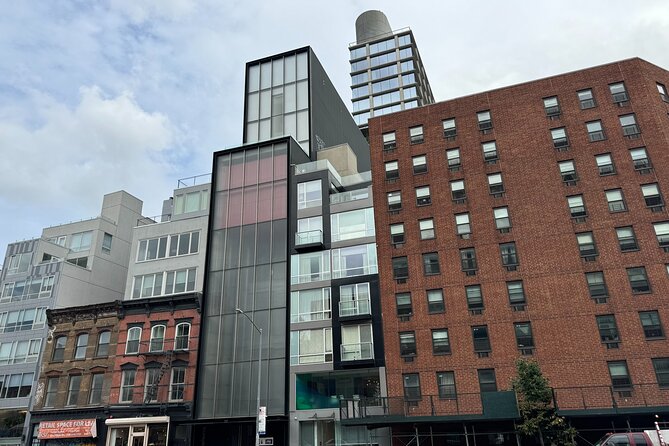
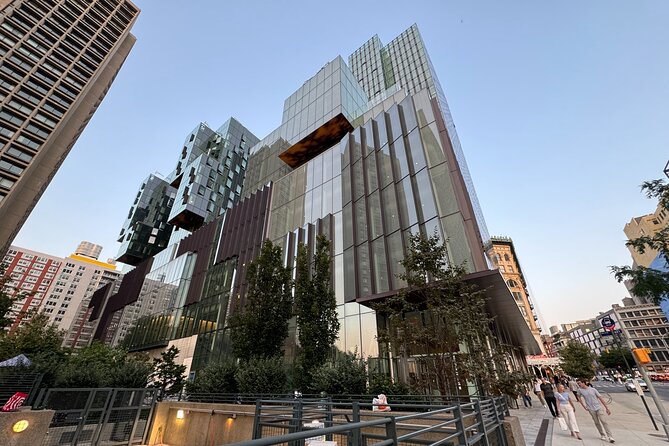
40 Bond St (about 5 minutes, residences by Herzog and deMeuron; admission listed free)
Next comes 40 Bond St, tied to architecture powerhouse Herzog and deMeuron. Even in a brief stop, the guide can help you notice how residential design speaks to the street and how the building’s presence feels different from a civic or academic structure.
If you’ve ever looked at a striking building and thought, I like it but I don’t know why, these early moments are designed to fix that. You start learning a quick skill: spotting the design cues that explain the building’s choices.





New Museum, PUBLIC Hotel, and Capitale: modern form next to historic purpose
After the institutional start, the tour shifts into contemporary and adaptive reuse territory. This is where you start seeing downtown as a timeline instead of a random set of landmarks.
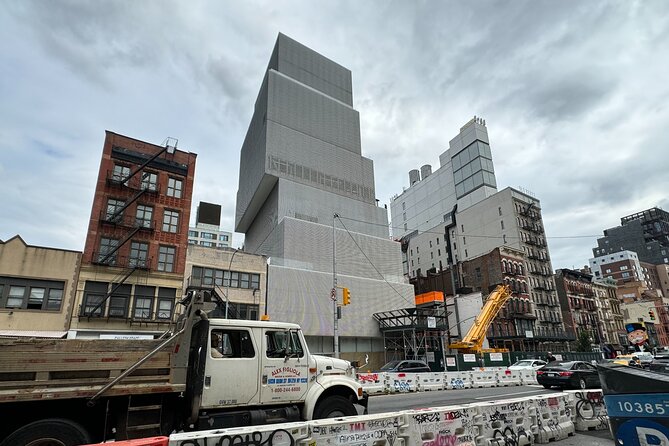
New Museum of Contemporary Art (about 5 minutes, by SANAA; admission listed free)
The New Museum, designed by SANAA, is a great place to learn how contemporary architecture can feel both bold and calm. With a short visit window, you won’t be doing a long interior tour, but you will get help reading the structure and understanding how the museum’s design fits the neighborhood around it.
PUBLIC Hotel (about 5 minutes, admission listed free)
You then see the PUBLIC Hotel. Hotels can be design case studies because they’re built to interact with the street and create a public face. The quick stop format means you’ll focus on external cues and the urban impact—how the building handles the sidewalk edge and what that suggests about the area’s evolution.
Capitale (about 5 minutes, former Bowery Savings Bank, by McKim, Mead & White, 1895)
Then comes Capitale, the former Bowery Savings Bank (designed by McKim, Mead & White, 1895). This stop is a reminder that downtown isn’t only about new construction. It’s also about reuse—when a historic building’s original identity is repurposed while its architectural language remains visible.
What I like about this cluster is the contrast: contemporary art architecture, a hospitality building, then a 19th-century bank. You start to recognize patterns in design choices across time.
The Little Singer Building, Aldo Rossi’s Scholastic Building, and a stop at the old cathedral
This middle stretch is where the tour’s storytelling approach really pays off. Even without long stays, you get a sense of how architectural references show up in the skyline and how different eras overlap.
Little Singer Building (visit stop)
The Little Singer Building is a quick stop that helps you notice how smaller-scale structures can still carry big personality. It’s the kind of place you might skip if you’re just walking for photos, but the guide usefully frames it as part of a larger urban pattern.
Scholastic Building by Aldo Rossi (pass by)
You’ll also pass by the Scholastic Building by Aldo Rossi. A “pass by” stop is only useful if someone teaches you what to see—and this tour does that by focusing your attention on the design signature tied to Rossi.
NY’s old cathedral (visit stop)
Finally, you get a visit to NY’s old cathedral. This adds a spiritual and civic layer to the tour’s architecture focus. After modern institutional buildings and commercial adaptations, a cathedral helps you connect design to community life and long-term neighborhood identity.
By the time you leave this section, you’re less likely to walk past major buildings thinking, That’s neat, and more likely to think, What story is this block telling?
NYU along Houston Street and Silver Towers’ art + public space
As the route heads toward the university area, the tone shifts again: from historic and institutional landmarks into modern civic campus design and public-space planning.
NYU Main Campus (about 5 minutes, new additions along Houston Street and around Washington Square)
At NYU’s Main Campus, you’ll discover new additions along Houston Street and around Washington Square. The value here isn’t only the architecture you see; it’s learning how campuses expand in ways that affect the street life around them.
A short stop is enough to plant the key idea: university growth changes foot traffic, street edges, and the feel of nearby public spaces.
Silver Towers (about 10 minutes, buildings plus public spaces and art)
Next come the Silver Towers. This part stands out because the guide doesn’t treat the buildings as isolated objects. You learn about the public spaces and art around them, which helps you understand how design and community amenities work together.
If you’ve ever seen a residential complex and wondered why the area around it feels planned, this is the stop that teaches you that relationship.
Inside Bobst Library and ending at Washington Square Park under the Arch
Most of the tour is outdoors, but the closing stretch gives you at least one “step inside” moment.
Bobst Library (about 5 minutes, visit and enter)
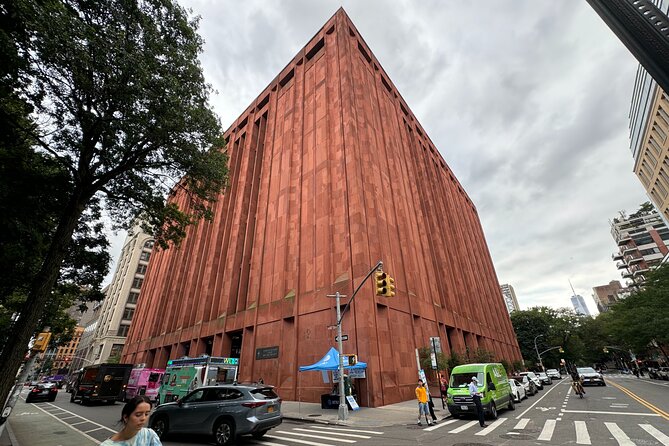
At Bobst Library, you actually get to enter. Even with a short time window, stepping inside a major library changes your perspective. You start seeing how architecture shapes behavior: where you naturally look, how the space organizes movement, and how quiet interior design feels compared to the street outside.
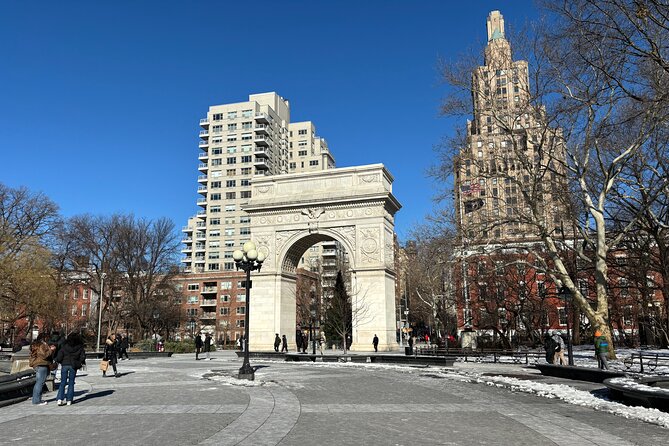
Washington Square Park under the Arch (about 10 minutes, finish point)
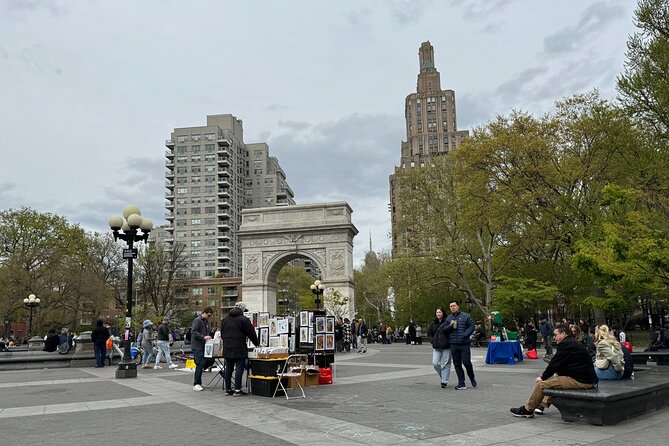
The tour ends at Washington Square Park, specifically under the Arch. Ending here is smart because the Arch is a natural focal point and the park itself is a “people watch” payoff for your architecture walking. You’ve just spent time training your eyes—now you get to observe how public space brings the neighborhood together.
Price and value: is $49 worth it for architecture lovers?
At $49 per person for a roughly 2-hour guided walk, this is priced for people who want a structured way to see downtown without heavy planning.
Here’s what makes it feel like value rather than just a guided stroll:
- You get an in-person guide and personal headsets for each guest.
- All fees and taxes are included.
- Several stops list admission ticket free, so you aren’t nickel-and-dimed for entry at key points.
Tips aren’t included, so you’ll want to plan for that. But compared to paying for separate museum tickets or spending a day piecing together self-guided visits, this format gives you a focused education in a small window.
It’s also a good deal because the group size stays small enough that the guide can respond to what you’re noticing. In the feedback I saw, Ivan’s style is consistent: he can tailor the focus and keep the walk from turning into a lecture you tune out.
One more note: the tour averages being booked about 71 days in advance, so if your dates are fixed, don’t wait until the last minute.
Who should book this tour (and who might want something else)
This tour is a strong fit if you:
- love architecture and want to learn how to see it, fast
- want to understand how neighborhoods develop instead of just collecting photos
- like the idea of a short evening walk that doesn’t swallow your whole day
- want a guide who can explain the why, not only the what (Ivan’s approach is built around clarity and questions)
It may not be the best match if you:
- expect long museum-style time at indoor sites
- want a fully immersive, one-building-per-hour pace (this is intentionally brisk)
Should you book this SoHo and Village Art + Architecture tour?
Yes—if you want your NYC walking to feel intentional. The combination of small group size, clear headset audio, and a route that moves across institutions, adaptive reuse, university expansion, and planned public spaces gives you a quick education you can carry into the rest of your trip.
If you’re the kind of person who sometimes walks past buildings thinking, I’m impressed, but I don’t understand, this tour is built to fix that. And if you already know a bit about design, you’ll likely leave with new ways to read the street the next time you’re in SoHo or around Washington Square.
FAQ
How long is the New York SoHo and the Village Art and Architecture Tour?
It lasts about 2 hours (travel time included).
Where does the tour start and end?
It starts at Cooper Square (Cooper Sq, New York, NY 10003) and ends at Washington Square Park under the Arch.
What time does the tour begin?
The start time is 5:30 pm.
What’s included in the ticket price?
You get an in-person guide, professional individual headsets for each guest, and all fees and taxes.
Is admission included at the stops?
For the listed stops, admission ticket is listed as free, and the tour includes all fees and taxes overall.
Does the tour run in any weather?
It requires good weather. If canceled due to poor weather, you’ll be offered a different date or a full refund.