REVIEW · WASHINGTON DC
Historic Georgetown Architectural Walking Tour
Book on Viator →Operated by DC Design Tours · Bookable on Viator
Georgetown has layers, and this tour maps them. I like the small-group pace and the fully narrated storytelling, which makes all those different neighborhoods feel connected instead of random. You get an easy orientation to Georgetown’s architecture and landmarks while a local guide ties the buildings to the people who shaped Washington, DC.
One thing to weigh: it’s about 2 miles of walking in around 2 hours, with some cobblestones and stairs (including the Exorcist Steps). If your feet or knees aren’t great with uneven pavement, you’ll want to plan for slower moments and good footwear.
In This Review
- Quick hits before you go
- Georgetown in two hours: what this walking tour does well
- Starting at Baked & Wired: a practical kickoff in the right neighborhood
- Old Stone House: the short interior stop that gives you context fast
- Francis Scott Key Memorial Park: mansions, churches, and the human stories
- The C&O Canal and Georgetown University: how the tour connects commerce to campus
- The signature Georgetown buildings: houses, churches, and the premium row-house vibe
- Volta Laboratory, Georgetown Prep, and Healy Hall: academics with personality
- Campus “nightlife” landmarks and the Car Barn: old infrastructure, new life
- Ending at Cady’s Alley and the Georgetown Waterfront
- How much you’re paying (and why it can be worth it)
- Who this tour suits best (and who should skip it)
- What guides are like on this route
- Should you book the Historic Georgetown Architectural Walking Tour?
- FAQ
- How long is the Historic Georgetown Architectural Walking Tour?
- About how far will I walk?
- What does the tour cost?
- Where do I meet the guide?
- What time does the tour start?
- Where does the tour end?
- Is the tour narrated?
- How big is the group?
- Is Old Stone House included?
- Is the tour suitable for everyone physically?
- Can I bring a service animal?
Quick hits before you go
- Meet at Baked & Wired (1052 Thomas Jefferson St NW), so you can grab a snack before you start.
- A true orientation loop through Georgetown, from the C&O Canal down toward the waterfront.
- Small group, capped at 20, so you can ask questions without shouting.
- Old Stone House interior stop, letting you see the oldest building in Washington DC.
- Georgetown University highlights like Healy Hall, the library area, and campus landmarks tied to nightlife.
- Car Barn and the renovated streetcar depot, a smart way to see how the neighborhood reuses old infrastructure.
Georgetown in two hours: what this walking tour does well
This is the kind of tour that helps you stop guessing. Georgetown can feel like a patchwork—row houses here, churches there, a university campus that looks separate, then the canal and waterfront. This walk stitches it together with a guided narrative, so you finish with a mental map and a sense of why certain buildings ended up where they did.
You’ll walk at a leisurely pace (about 2 miles / 3.2 km), and the tour stays tightly focused: not just a list of stops, but a run of stories. That’s the real value for most visitors. You can read about Georgetown later, sure. But during this walk, you’re standing right in front of the architecture while someone explains what you’re looking at and why it matters.
Local guides drive the experience, and you’ll often hear the same theme across guides: Georgetown isn’t only pretty. It’s political, academic, and commercial. One past guide named Brian was praised for connecting Georgetown history to DC in general, including iconic names and the role of the C&O Canal in linking communities and markets.
You can also read our reviews of more tours and experiences in Washington DC.



Starting at Baked & Wired: a practical kickoff in the right neighborhood
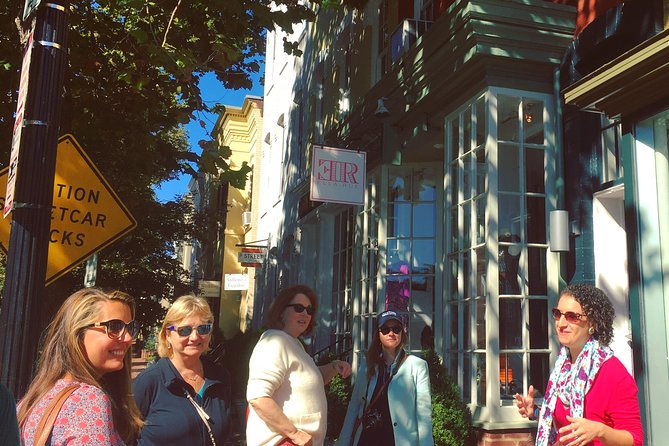
Your meet-up point is outside Baked & Wired at 1052 Thomas Jefferson St NW, Washington, DC. The timing is set for a 10:00 am start, and you’ll begin with the simple idea that works: grab a coffee or a quick dessert if you want, then head out.
I like this kind of starting point because it’s not some generic street corner. It’s in the heart of Georgetown life, so the tour begins in the real vibe—not the tourist-portal vibe. If you want to make the most of the morning, this is also a good moment to top off energy before the walking begins.
From there, you start with an overview tied to the Chesapeake & Ohio (C&O) Canal, the connection point that mattered historically. The canal linked Potomac River communities with markets and goods, which helps explain why Georgetown developed the way it did—commerce first, charm second.
Old Stone House: the short interior stop that gives you context fast
One of the best early moments is Old Stone House. You’ll peek inside, and it’s described as the oldest building in Washington DC. That’s a quick, high-impact stop. You’re not spending half a day in a museum. You’re stepping into a real structure and getting immediate scale: stone, narrow spaces, and a sense of how early Georgetown life would have felt.
The tour also keeps you moving off the main drag afterward. That matters because Georgetown’s busiest streets can drown out the finer details. Here, you get that first “oh, this is why the neighborhood looks like this” feeling.
Francis Scott Key Memorial Park: mansions, churches, and the human stories
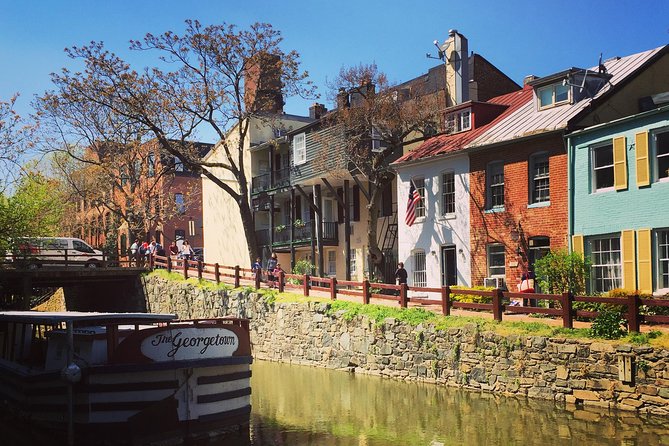
Next up is Francis Scott Key Memorial Park. Expect cobblestone streets and a stroll that mixes famous names with neighborhood texture.
You’ll hear about homes and notable figures such as Jackie Kennedy and Ben Bradley, plus the kind of behind-the-scenes social stories that make Georgetown feel less like a postcard and more like a real place with real characters. The tour also mentions an older establishment once described in more salacious terms, which helps explain how quickly the area’s image has changed over time.
Then you cross Wisconsin Avenue to the west side of town. That crossing is useful in a very literal way: it reinforces where Georgetown’s center of gravity shifts as you move through different pockets of the neighborhood. Even if you don’t remember every name, you’ll remember the geography.
The C&O Canal and Georgetown University: how the tour connects commerce to campus
The canal segment continues into the Chesapeake & Ohio Canal National Historical Park, and then the walk threads toward Georgetown University.
You’ll move over toward the university area and down the Exorcist Steps. That’s one of those Georgetown specifics you can’t really recreate on your own unless you already know where to look. It also breaks up the walk with a visual “scene change,” which keeps the narrative from becoming one long street-level scroll.
This is where the architecture tour angle stays grounded. You’re seeing buildings and institutions, but you’re also seeing how the area’s functions evolved—from canal-driven activity to academic and civic presence. Even the small shifts in street layout and building style start to make sense.




The signature Georgetown buildings: houses, churches, and the premium row-house vibe
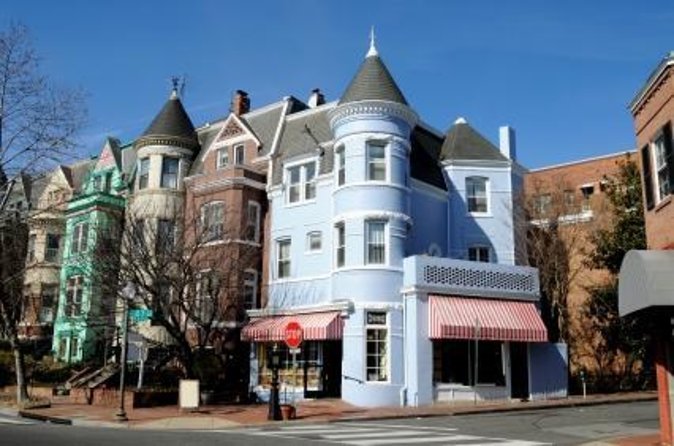
A big reason this tour feels satisfying is the range of built landmarks you cover, especially in the “row-house and residential elegance” zone. The walk includes (among other sights):
- Laird-Dunlop House
- Newton D. Baker House
- Lydia English Seminary School for Girls (a boarding school that served the upper class)
- Grafton Tyler Double House
- Christ Episcopal Church
- Hyde-Addison School
- Yellow Tavern, also called the White Horse Tavern
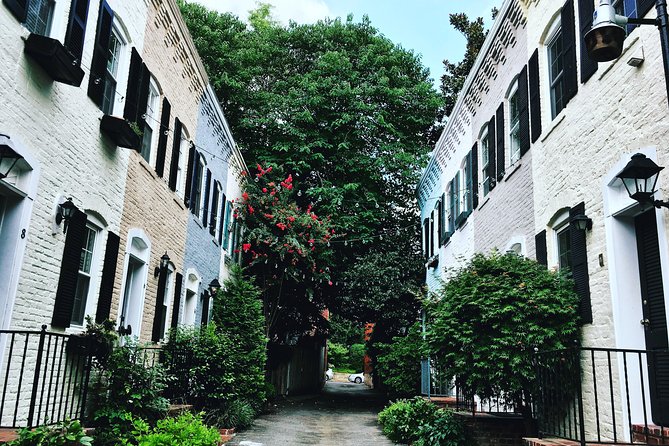
- Pomander Walk, lined with tiny pastel-hued row houses
Here’s what these stops do for you as a visitor. They show Georgetown’s “layers” without needing you to know architectural terms. The houses and schools explain how the neighborhood served different social levels. Churches give you a sense of older community structure. And Pomander Walk is the kind of place where you get that immediate wow, because the scale is so small and so deliberate.
One practical note: row-house areas can mean tighter sidewalks. If you travel with anyone who gets tired easily, just move at the front or back of the group and ask your guide for an extra breather when you need it.
Volta Laboratory, Georgetown Prep, and Healy Hall: academics with personality
As you head into the Georgetown University stretch, you’ll see a run of academic landmarks, including Healy Hall, the University Library, and Georgetown Preparatory School.
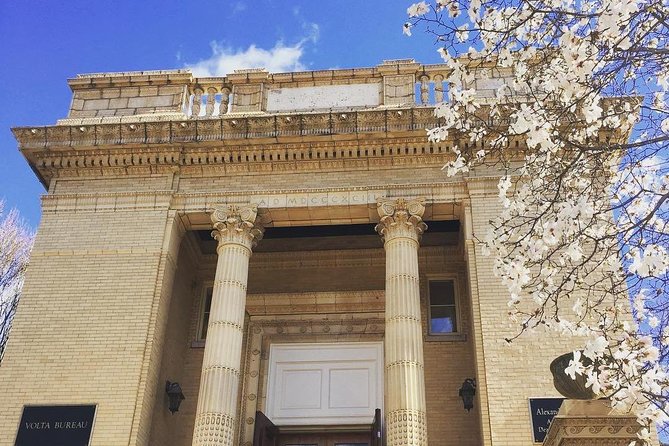
You also get a stop tied to science history: Volta Laboratory, where Alexander Graham Bell founded the lab. For many people, Georgetown University is just a big campus to walk through. This turns it into a story about innovation sitting inside a very old neighborhood.
The best part is how the tour handles these stops with momentum. You’re not stuck staring at one building for ages. You get enough detail to understand what you’re looking at, then you keep walking.
Campus “nightlife” landmarks and the Car Barn: old infrastructure, new life
The tour includes The Tombs, referenced here as campus nightlife, plus Georgetown Car Barn, a renovated streetcar depot. Those two stops do something clever: they show that Georgetown isn’t only preserved like a historic stage set. It’s used. It changes.
Even if you’re not a nightlife person, The Tombs gives you a sense of how campus culture shows up in the built environment. And Car Barn is a reminder that cities don’t only build new landmarks. They reuse the old ones, which is why this part of Georgetown can feel both timeless and surprisingly modern.
Ending at Cady’s Alley and the Georgetown Waterfront
As the tour winds down, you’ll visit Francis Scott Key Memorial, then walk through Cady’s Alley, and finally reach the Georgetown Waterfront, where the tour concludes at Georgetown Waterfront Park (3303 Water St NW).
Cady’s Alley is one of those hidden-feeling passages that makes Georgetown feel like a place with secret corners. Then the waterfront ending is a smart finish, because it gives you a calmer final scene after campus and residential streets.
If you want a good next step after the tour, this is where you can loosen up. Your walking mission is done, and you’ve got easy access to places to sit, snack, and keep exploring at your own pace.
How much you’re paying (and why it can be worth it)
At $48 per person, this is not a bargain tour. It’s also not overpriced for what you get. You’re paying for a local guide, a fully narrated walking format, and a compact route that hits major Georgetown themes in about 2 hours.
What helps the value equation:
- You’re walking roughly 2 miles on a guided route, which saves you time planning and hopping around.
- A key stop includes seeing the Old Stone House interior, and at least some stops are listed with free admission.
- The group size stays small (maximum 20), which makes the guide’s storytelling feel more personal than a large-bus style experience.
If you’re the type who likes architecture, neighborhood context, or simply getting bearings fast, this price can feel fair. If you’re only after a quick highlight reel and don’t care about narration, you might prefer a self-guided walk. But if you do care about meaning behind the buildings, the guide element is where the money goes.
Who this tour suits best (and who should skip it)
This tour is a strong fit if you:
- Want a clear orientation to Georgetown without overplanning
- Like history told through places you can see immediately
- Can handle a moderate walking pace, roughly 2 miles with some uneven ground and stairs
It’s also a good match for middle school age and up, based on guide-style feedback from past guests who appreciated the storytelling angle.
I’d be cautious if you:
- Struggle with cobblestones or stairs and can’t do the Exorcist Steps comfortably
- Prefer long museum-style stops over steady walking
What guides are like on this route
You’re in good shape here because the experience leans hard on narration and pacing, not just pointing. Past guides named Brian, Kim, Caroline, Sam, Christine, and Ellie were described as engaging and professional, with a good balance of history and local color.
One practical benefit that shows up in real experiences: guides often share useful local tips beyond the route, like food ideas nearby after the tour. If that’s your style, ask what they recommend for a quick bite once you arrive at the waterfront.
Should you book the Historic Georgetown Architectural Walking Tour?
Yes, if you want a guided Georgetown “first map.” This tour gives you a lot of high-signal stops for the time, especially the combo of canal history, row-house architecture, and Georgetown University landmarks. The small-group format and the fully narrated approach make it feel more like a conversation with a local than a lecture.
You might skip it if your goal is only a few top photos and you don’t care about stories. Also, if walking on cobblestones and stairs is a problem for you, plan for careful footwear and take it slow.
If your schedule allows, book ahead. On average, this tour is commonly reserved about 12 days in advance, and the group size is capped at 20.
FAQ
How long is the Historic Georgetown Architectural Walking Tour?
It runs for about 2 hours.
About how far will I walk?
Plan on about 2 miles (3.2 km) total during the tour.
What does the tour cost?
The price is $48.00 per person.
Where do I meet the guide?
The tour starts outside Baked & Wired, 1052 Thomas Jefferson St NW, Washington, DC 20007.
What time does the tour start?
The start time is 10:00 am.
Where does the tour end?
The tour ends at Georgetown Waterfront Park, 3303 Water St NW, Washington, DC 20007.
Is the tour narrated?
Yes. It is described as a fully narrated walking tour in English.
How big is the group?
The tour has a maximum of 20 travelers.
Is Old Stone House included?
Yes. You’ll get to peek inside Old Stone House, and the stop is listed with free admission.
Is the tour suitable for everyone physically?
It’s recommended for people with moderate physical fitness, since you’ll do about 2 miles of walking and some stairs/cobblestones are part of the route.
Can I bring a service animal?
Yes. Service animals are allowed.