REVIEW · PRAGUE
Private Prague Art Nouveau and Cubism Walking Tour
Book on Viator →Operated by Insight Cities · Bookable on Viator
Prague has a style change around 1900. This private tour turns the city into a design textbook, with Art Nouveau flourishes and Cubist angles you can spot on real façades and interiors. I especially like how the guide points out small signature details, like curvy signage and even the oriental hint of ginkgo biloba leaves, then ties them to the bigger story of Czech modern life. The main catch: this is still a walking tour, so it can feel like a lot of pavement for mobility issues.
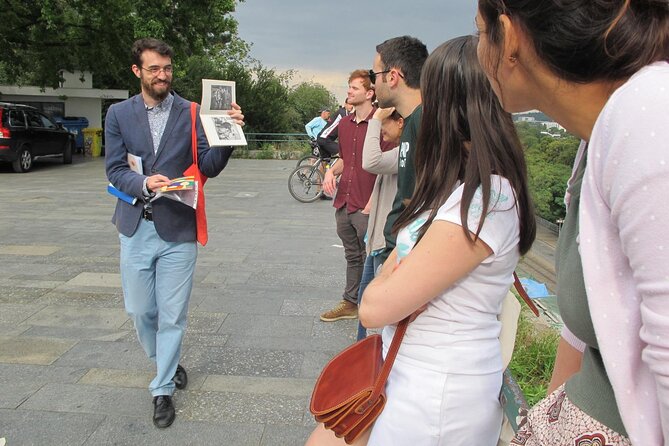
What I like next is the format. It’s private, built for up to 10 people, and led by a historian guide, which means you get answers instead of a rapid-fire script. I also enjoy the pacing: you stop often, then move on, instead of spending the whole time staring at one spot.
You should think about whether you want architecture you can see up close. This route hits places that are visually busy and story-heavy, like Café Imperial and the Czech Cubist banking interior, so it’s less for people who mainly want postcard views and less for those who dislike interiors. If you do enjoy buildings as culture, you’ll have a great time.
In This Review
- Key Things to Know Before You Go
- Why Art Nouveau and Cubism Belong on Your Prague Walk
- What the $396.46 Private Price Actually Buys You
- The Route Pace: How to Dress and Walk Smart
- Stop 1: House of the Black Madonna and Cubism’s Bold First Impression
- Stop 2: Obecni Dum and the Czech Art Nouveau Moment
- Stop 3: K+K Hotel Central Prague, the First Art Nouveau Building
- Stop 4: Café Imperial and Art Nouveau Interior Theater
- Stop 5: Czechoslovak Legion Bank and Cubism with a Purpose
- Stop 6: Praha hlavni nadrazi and the Art Nouveau Dome Inside a Working City
- Stop 7: Wenceslas Square and the Shift Toward Art Deco
- Stop 8: Lucerna Arcade and the Interior Glow of Prague Modern Life
- Stop 9: Upside-Down King Wenceslas and Czech National Revival Symbolism
- How Your Guide Turns Details into Real Understanding
- Who This Tour Fits Best (and Who Might Want Something Else)
- Should You Book It?
- FAQ
- How long is the Private Prague Art Nouveau and Cubism Walking Tour?
- Is this a private tour or a shared group tour?
- How big is the group?
- What language is the tour offered in?
- Where does the tour meet?
- Is hotel pickup included?
- Are there any admission fees at the stops?
- What is included in the price?
- Is there a mobile ticket?
- What is the cancellation policy?
Key Things to Know Before You Go
- Private small-group feel (up to 10) so questions don’t get lost.
- Historian guide who explains design choices, not just dates.
- Stop mix of façades and interiors, including Café Imperial and Lucerna Arcade.
- Art Nouveau and Cubism paired on purpose, showing how Prague changed across styles.
- Most stops are free to enter as listed, so you’re not nickel-and-dimed.
Why Art Nouveau and Cubism Belong on Your Prague Walk
Prague is famous for Gothic towers and Renaissance streets. But the city also had a strong moment of modern optimism in the early 1900s, when artists, designers, and architects started treating the city like a canvas. That’s what this tour is really about: not just styles as labels, but styles as everyday life—signs, light fixtures, bank lobbies, hotel façades, even train-station domes.
Art Nouveau in Prague isn’t only “pretty curves.” It’s a whole visual language: flowing linework, decorative typography, and materials used like mood. Cubism brings the opposite feeling—sharp geometry and bold structure. Seeing them back to back helps you understand how ideas moved fast at the turn of the century, and how Czech designers participated in wider European avant-garde trends.
You can also read our reviews of more tours and experiences in Prague.

What the $396.46 Private Price Actually Buys You
At $396.46 per group (up to 10) for about 3 hours, this is priced like a private specialist route, not a budget group tour. If you’re traveling as a family, a pair of friends, or a small group, the per-person cost can look reasonable fast—especially because you’re paying for a historian guide and a tight route built around specific design features.
You also get a few practical upgrades that matter more than they sound. You have a mobile ticket, you can choose morning or afternoon departure, and pickup is offered (though hotel pickup and drop-off aren’t guaranteed). If you hate wasting time figuring out meeting points, the default guide meeting spot is clearly specified.
The biggest “value” is that you’re not just walking past buildings. The guide helps you read them: why a feature is there, what it suggests about the era, and what Czech modern life looked like when the city felt ready to join a changing Europe.
The Route Pace: How to Dress and Walk Smart
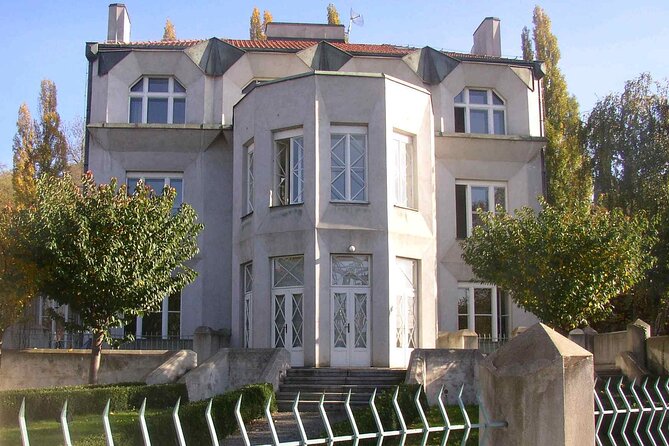
This is a focused 3-hour loop with frequent stops. Expect it to feel like a proper walking tour, not a slow stroller stroll. One guide review notes it involves a lot of walking and is not suitable for the mobility impaired, so wear shoes you’d trust on uneven sidewalks and plan for time on your feet.
I’d also recommend bringing water and wearing layers. Prague weather can swing, and interiors (like Café Imperial and the train-station dome area) can feel cooler than the street.
Stop 1: House of the Black Madonna and Cubism’s Bold First Impression
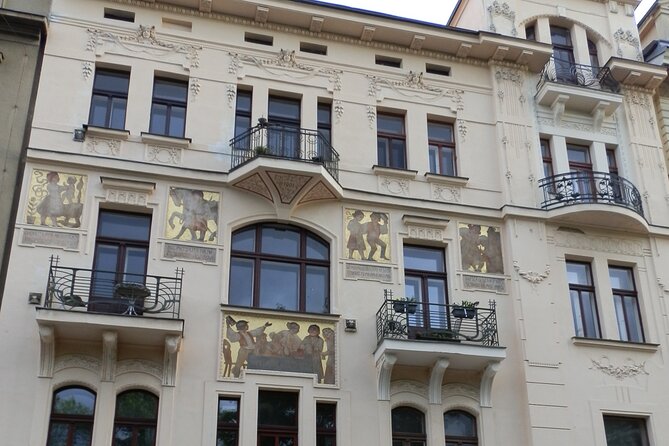
You start at the House of the Black Madonna, known for its Cubist style. This is a strong opening because it sets your mental framework early: Cubism is about structure and angles, not ornament for ornament’s sake.
During the short stop, you’ll want to look at how the building holds shape—how geometry controls the mood. The guide’s job is to help you see that Cubism here isn’t random trend-chasing. It reflects a wider shift in thinking about form, modern identity, and how architecture can express ideas.
Stop 2: Obecni Dum and the Czech Art Nouveau Moment
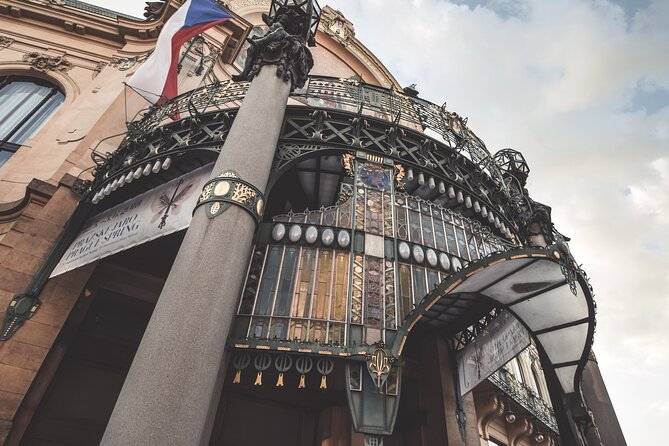
Next comes Obecni Dum, one of Prague’s best-known Art Nouveau landmarks. This stop is short, but it’s iconic in the way it makes you slow down without being told to. It’s the kind of building where you can feel the early-1900s belief that design should improve daily life.
What makes this stop useful for your brain is the way the guide explains specific Art Nouveau features, like decorative details that echo the contemporary look of posters and magazines from that era. You’ll leave with a better eye for typography-like ornamentation—curving lettering and decorative styling that looks like it belongs to print culture, not just architecture.

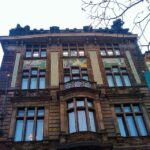
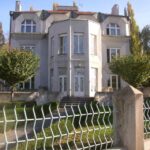
Stop 3: K+K Hotel Central Prague, the First Art Nouveau Building
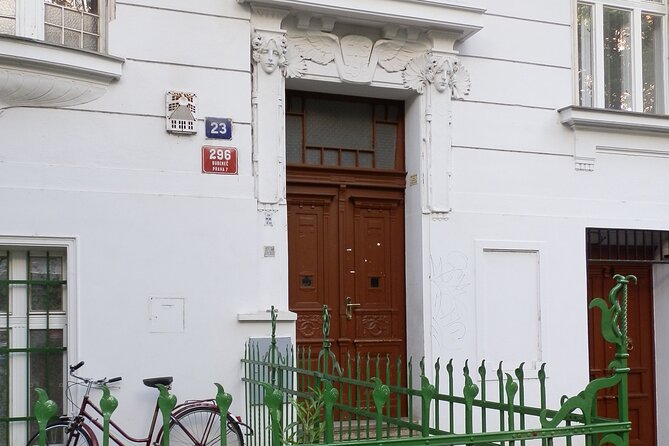
Then you’ll see the K+K Hotel Central Prague, noted as the first Art Nouveau building in Prague. That phrase sounds like trivia until you connect it to what you see. This is where “early” matters: Art Nouveau wasn’t just decorative—it was a statement that Prague was ready to modernize in a European conversation.
The guide typically helps you spot Art Nouveau thinking in a building that still feels practical. Hotels are public-facing, full of travelers and schedules, so design choices become a message to the outside world: Prague is modern, and it knows how to host modern life.
Stop 4: Café Imperial and Art Nouveau Interior Theater
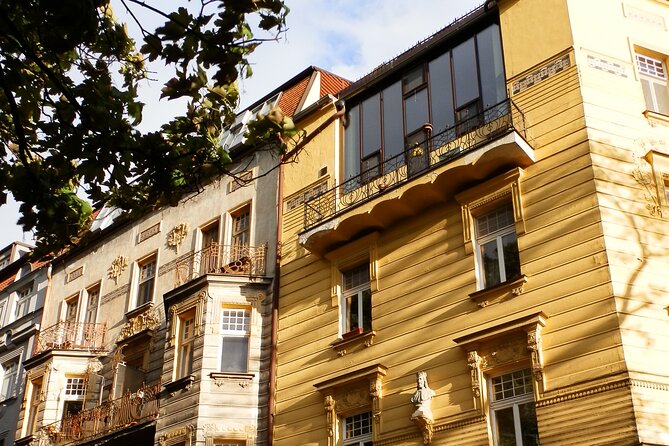
Café Imperial is where the tour turns from outside façades to inside design. The short stop (about 5 minutes) still works because the interior is the point. This is the kind of place where Art Nouveau becomes more than shape—it becomes atmosphere.
Even if you’re not an interior-design person, I think you’ll appreciate the guide’s focus on details. Art Nouveau interiors often use repeating motifs and flowing forms to make the room feel designed as a whole, not decorated in parts. In other words: you’ll start noticing the logic, not just the looks.
Stop 5: Czechoslovak Legion Bank and Cubism with a Purpose
This stop is Czechoslovak Legion Bank, built in Cubist architecture with an interior dedicated to the Czechoslovak Legion of the First World War. That combination is why the stop matters. Cubism might seem like a style choice, but here it’s tied to memory, identity, and national narrative.
The guide helps you connect the visual language to meaning. Cubist design can feel hard-edged, but in a memorial context it can also read as resolve and seriousness—appropriate for war history, not just aesthetic experimentation.
If you like architecture with a reason, this is one of the most rewarding stops on the walk.
Stop 6: Praha hlavni nadrazi and the Art Nouveau Dome Inside a Working City
Then you reach Praha hlavni nadrazi (Prague Main Train Station), known for a magnificent Art Nouveau dome. The stop is about 15 minutes, which gives you time to appreciate why this station is more than transit.
Train stations are public buildings. They’re meant to impress, move people, and signal what a city thinks it is. Seeing Art Nouveau in a massive, functional interior helps you understand that the style wasn’t only for wealthy private spaces. It also belonged to the daily rhythm of travel and commerce.
If you’re the type who wants one “wow” moment that isn’t just a church façade, the dome is your payoff.
Stop 7: Wenceslas Square and the Shift Toward Art Deco
At Wenceslas Square, you’ll talk through how the area mixes design languages, including Art Nouveau and Art Deco. This stop gives you a bigger timeline view. You start to see how style trends evolve instead of staying frozen in 1900.
The guide’s interpretation is what makes this stop land. You’re not just looking at buildings; you’re learning how Czech public space reflected shifting tastes and social ambition as the 20th century approached.
Stop 8: Lucerna Arcade and the Interior Glow of Prague Modern Life
Next is Lucerna Arcade, where you’ll view the Art Nouveau interior of one of Prague’s most celebrated arcades. Arcades are special in cities like this because they’re built for lingering. You’re walking, but you’re also protected from the street and invited to notice shop windows, lighting, and decorative details.
This is also where the story widens beyond design. The tour description brings in the Lucerna Bar, once owned by Václav Havel’s family, which adds a Czech political and cultural layer to what you’re seeing now. It’s a good reminder that Prague modern spaces weren’t just for art lovers—they became part of broader life.
If you like places that feel human-scaled and detailed, you’ll probably want extra minutes here.
Stop 9: Upside-Down King Wenceslas and Czech National Revival Symbolism
The final stop is the Upside-Down Statue of King Wenceslas riding a Dead Horse, and the conversation turns toward symbolism in Czech history, including the Czech National Revival. This is a different kind of architecture lesson: not buildings, but public art as an argument.
The symbolism is the point. The guide helps you connect contemporary sculpture to earlier Czech cultural movements—ideas about identity, resistance, and how a country narrates itself through monuments.
It’s a smart way to close the tour because it connects “design style” to “design meaning.” You leave thinking about how a city expresses itself across decades, not only in one stylistic period.
How Your Guide Turns Details into Real Understanding
One reason this tour gets such strong praise is how the guides bring the design stories to life. I’ve seen guides such as Robert Wesley, who describes himself as Czech-born with a Nigerian father, bring an extra layer of personal context to each building story. That mix of biography and architectural explanation can make the tour feel less like a lecture and more like a walk with someone who actually cares.
Another guide experience includes Bonita, who is noted for weaving together history, culture, art, and architecture into a single flow. Even if you’re only halfway into architecture at the start, this style of guiding makes it click—because you’re constantly told what to look for, then what it meant.
So if you’re deciding whether to bring a camera, do it. But also bring curiosity. This tour rewards people who look closely at signs, edges, and shapes, not only people who frame the biggest façade from a distance.
Who This Tour Fits Best (and Who Might Want Something Else)
This works especially well if you:
- Want to go beyond “old town sightseeing” and see Prague’s early-1900s modern era.
- Love architecture details, typography-like ornament, and design motifs you can actually spot.
- Like tours where the guide explains meaning, not just names and dates.
It may be less ideal if you:
- Want mostly quiet, minimal walking, or need a tour that avoids lots of steps and street time.
- Prefer only outdoor landmarks and don’t care much about interiors.
Should You Book It?
I’d book this if you’re curious about how Prague expressed modern identity through Art Nouveau and Cubism, and you want a guide who can point to specific features and explain why they matter. The price can feel high at first glance, but the private format, historian guide, and the design-focused stops—many with free entry as listed—make it a strong value for small groups who want more than surface-level sightseeing.
If you’re already an architecture fan, this is a clear yes. If you’re on the fence, the easiest test is simple: if you catch yourself zooming in on façades and signs in photos, you’ll enjoy this walk.
FAQ
How long is the Private Prague Art Nouveau and Cubism Walking Tour?
It lasts about 3 hours.
Is this a private tour or a shared group tour?
It is private. Only your group participates.
How big is the group?
The tour is priced per group, up to 10 people.
What language is the tour offered in?
It is offered in English.
Where does the tour meet?
Unless hotel pickup is arranged, you meet 15 minutes before the start time at the default location: Grand Cafe Orient, Ovocný trh 19 Prague 1.
Is hotel pickup included?
Pickup is offered, but hotel pickup and drop-off are not included. If hotel pickup is arranged, it will be handled separately from the default meeting point.
Are there any admission fees at the stops?
The stops listed are marked with admission ticket free.
What is included in the price?
A historian guide is included.
Is there a mobile ticket?
Yes, a mobile ticket is provided.
What is the cancellation policy?
Free cancellation is available if you cancel up to 24 hours in advance of the experience start time for a full refund. If you cancel less than 24 hours before, the amount paid is not refunded.