REVIEW · BERLIN
Karl-Marx-Allee Tour: Life and Architecture in East Berlin
Book on Viator →Operated by Beyond and Beneath Tours · Bookable on Viator
Karl-Marx-Allee tells East Berlin’s story in stone and plans. What makes this walk work is the way it turns big ideas into street-level details: the architecture looks striking up close, but the guide also connects it to power, ideology, and the people living with the results. I love the small-group size for how easy it is to ask questions and actually hear the stories behind what you’re looking at.
The only real catch is that it’s a brisk, 2-hour loop on foot. If you’re sensitive to walking time or want lots of sitting and lingering, you might find the pace a bit tight.
In This Review
- Key takeaways before you go
- East Berlin’s “grand boulevard” is really a political stage
- Frankfurter Tor: the perfect symmetry and the first socialist blueprint
- Laubenganghäuser: Hans Scharoun’s postwar hope, quickly redirected
- Hochhaus an der Weberwiese: a prototype built to impress tenants—and observers
- 17 June 1953: where architecture meets the moment power almost fell
- Café Sibylle: Stalin’s shadow in an everyday meeting place
- Karl-Marx-bustendenkmal: what ideology changed in daily life
- Strausberger Platz: Henselmann’s style, plus the after-Wall story
- The real value: what you gain in two hours for about $30
- Who should book this walk (and who might not)
- Should you book the Karl-Marx-Allee tour?
- FAQ
- What’s the duration of the Karl-Marx-Allee walking tour?
- Is the tour offered in English?
- What’s the group size?
- Where does the tour start and end?
- Do I need to buy entry tickets for the stops?
- Can I get a mobile ticket?
- Is the tour near public transportation, and is it suitable for most people?
- Is weather important for this tour, and what happens if it’s canceled?
Key takeaways before you go
- Small group (max 15) keeps the tour personal and question-friendly.
- English guide makes the political and architectural context click fast.
- Seven major stops trace the arc from early rebuilding plans to the 1953 uprising.
- Free entry points at each stop means you’re not hunting tickets while learning.
- East-meets-West tensions show up in the buildings themselves, not just in lectures.
East Berlin’s “grand boulevard” is really a political stage
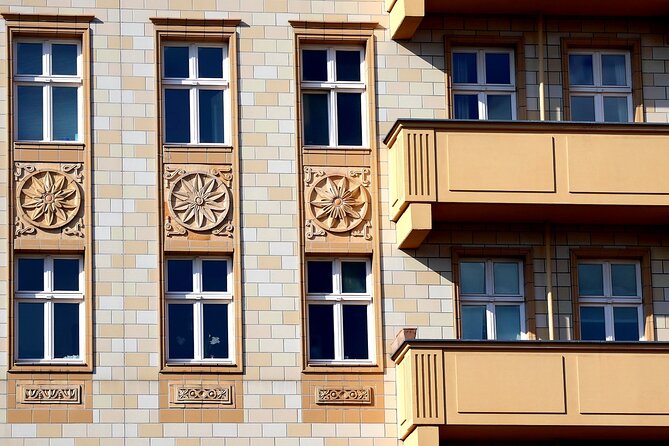
Karl-Marx-Allee (formerly Stalinallee for a chunk of East German history) looks like a statement even if you don’t know the background. That’s what I like most about this tour: you don’t just see impressive façades—you learn what kind of message each one was meant to send, and how real life pushed back.
The guide frames the boulevard as a system. Planning. Building. Housing. Symbol-making. Then the cracks: political shifts, propaganda needs, labor unrest, and the complicated aftermath after the Wall fell. You walk away with a clearer sense of how governments try to shape daily life using city design.
And if you’re the type who likes facts you’d miss on your own, you’ll get exactly that. The tone stays human—practical, story-driven, and even funny at times. One guide I met along this route (Martina) is noted for staying organized and packing in detail without losing the plot.
You can also read our reviews of more tours and experiences in Berlin.

Frankfurter Tor: the perfect symmetry and the first socialist blueprint
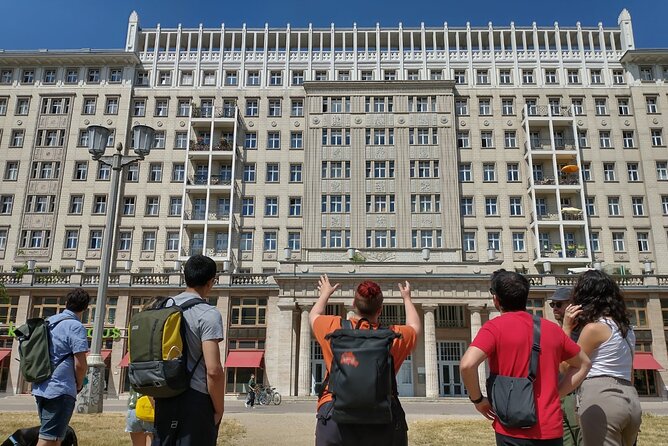
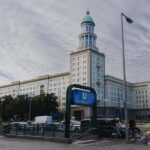
You start at U Frankfurter Tor, right where the street’s ambition is easiest to see. The twin towers of Frankfurter Tor are built by Hermann Henselmann, and the guide points out the symmetry so you understand why this boulevard was designed to feel confident, controlled, and “new.”
From there, the tour shifts from looks to intent. You hear how planners treated this stretch as an early version of Germany’s first socialist street—built with the goals of the early 1950s rebuilding program, including the way thousands of volunteers were mobilized. The detail matters because it explains the vibe: people were supposed to feel part of a collective future.
What to watch for: notice how the buildings feel “composed,” like they’re meant to be photographed and repeated—because that’s part of the message. You’re not just walking through East Berlin. You’re walking through a visual argument.
Laubenganghäuser: Hans Scharoun’s postwar hope, quickly redirected
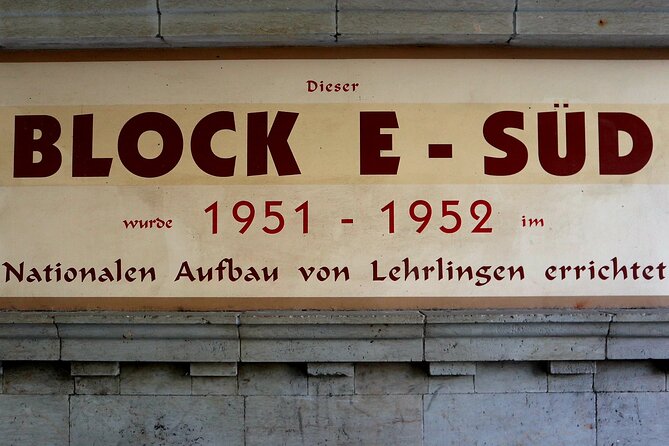
Next comes Laubenganghäuser, where the style turns modernist. Designed by Hans Scharoun, these buildings reflect a set of utopian urban ideas that were born out of Berlin’s destruction. The point isn’t that everyone agreed on the plan. It’s that rebuilding also meant experimenting—at least briefly.
Then the tour makes the political turn. You learn that these ideas didn’t survive long as the East German regime tightened what was acceptable. The design you can still see today becomes proof that architecture can be shaped not only by architects, but by the leadership deciding what counts as the future.
Practical note: this stop is quick, so if you want photos, grab them before the group moves on. Look for the modernist feel and the rhythm of the structure—those are the clues the guide uses to explain what made these plans feel hopeful in the first place.
Hochhaus an der Weberwiese: a prototype built to impress tenants—and observers
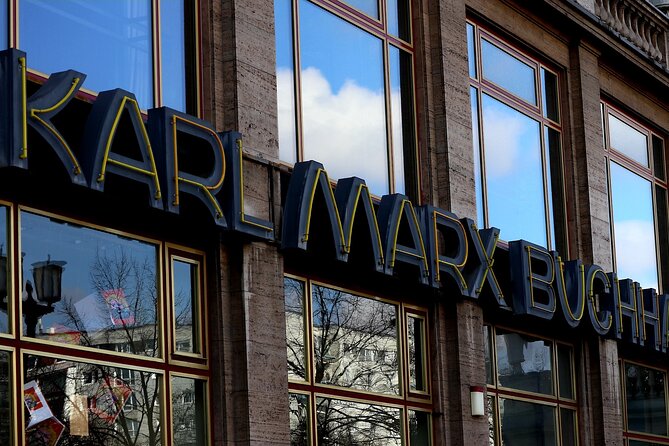
At Hochhaus an der Weberwiese, the tour gets really specific about influence. This building served as a prototype for the wider socialist development of Karl-Marx-Allee, and it’s linked to a surprising detail: its first tenants were offered unprecedented luxury for the time.
That luxury wasn’t just comfort—it was leverage. The guide explains how the project became a propaganda tool, and how it drew attention from Western architects. That’s a key theme for the whole tour: East Berlin wasn’t sealed off. It was in conversation with what the West was doing, even while it tried to sell a different story.
What I’d focus on: pay attention to how impressive the building reads from multiple angles. The guide uses those views to show why it could act like a billboard for the system—housing as proof.
17 June 1953: where architecture meets the moment power almost fell
Then you step into Gedenkstätte Arbeiteraufstand 17 Juni 1953, a stop that changes the mood fast. June 1953 wasn’t just a protest; it was a mass uprising by disgruntled workers that almost toppled the socialist government of East Germany.
The guide also addresses the controversial nature of the monument. That matters because monuments are never neutral. They’re built to guide memory—sometimes to simplify it, sometimes to frame it in a specific direction.
Why this stop is valuable: it prevents the tour from becoming purely aesthetic. If all you learned was style, you’d miss the pressure underneath. Here you learn how quickly political promises could break, and how public dissent could shake a regime built on control.

Café Sibylle: Stalin’s shadow in an everyday meeting place
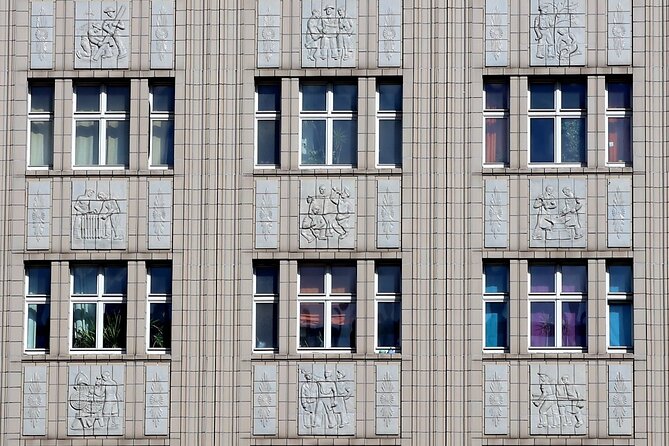
At Café Sibylle, the tour shows how power shows up in places that look ordinary. You learn how one of the more exclusive cafés on Karl-Marx-Allee connects to the statue of Joseph Stalin, which stood nearby until 1961.
This stop works because it links symbols to social life. You’re not staring at a statue behind glass; you’re imagining how it would have felt to sit nearby while the city’s leadership worshipped at the altar of personality and ideology.
If you’re short on time: this is one of the best stops for understanding the atmosphere of the era. It answers a question a lot of people have—how did politics feel in daily routines?—without needing a long lecture.
Karl-Marx-bustendenkmal: what ideology changed in daily life
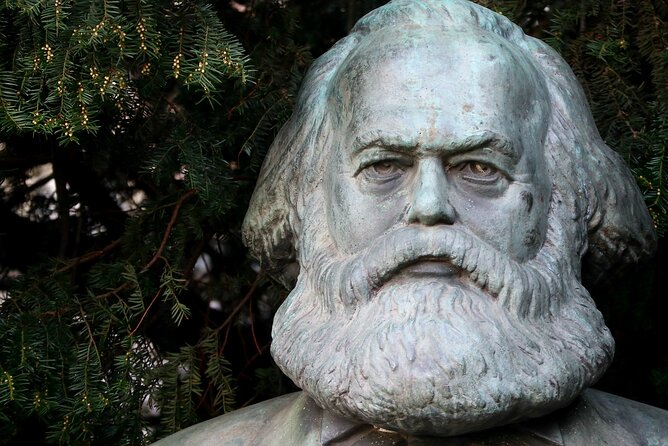
Next is the Karl-marx-bustendenkmal, where the guide brings in the author of the Communist Manifesto—Karl Marx—and explains how socialist ideology shaped everyday life for East Berliners.
This is where the tour turns from “what did the state build” into “what did the state make people live with.” Even if you’re not into politics, you’ll get a clearer idea of how ideology can move from documents and speeches into norms, expectations, and the way people talk about their roles.
What to do as you walk: listen for the shift from buildings-as-statements to buildings-as-modes-of-life. That mental switch is a big part of why this tour feels better than a generic architecture stroll.
Strausberger Platz: Henselmann’s style, plus the after-Wall story
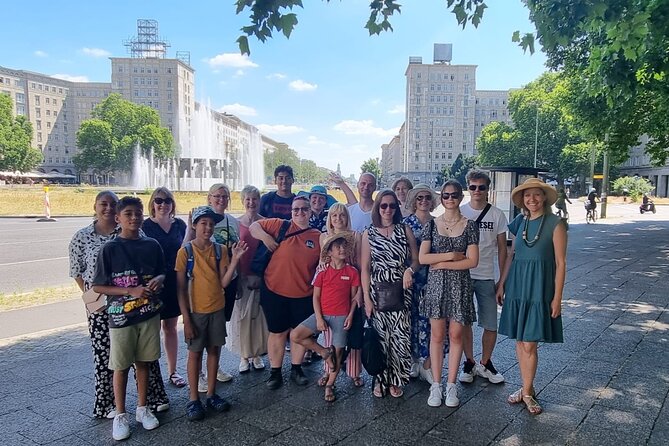
The last stretch ends near Strausberger Platz, finishing at Strausberger Pl., just off the roundabout. It’s a good position because you can connect quickly onward toward Alexanderplatz (the end point is about a 10-minute walk away).
Here, you see another strong example of Hermann Henselmann’s style, and the guide ties it to what happened after the Fall of the Berlin Wall and how the area feels today. Even though the tour focuses on the socialist era, this ending matters because it keeps you from treating the boulevard like a museum set in concrete.
What you’ll likely notice: the street still has presence. The difference is that now the meanings aren’t only imposed—they’re interpreted by whoever walks it.
The real value: what you gain in two hours for about $30
At $30.01 per person for roughly two hours, this is a strong value if you care about context. You’re not paying for entry fees. The stops listed are admission ticket free, so your money mainly buys interpretation—someone guiding what to look at, and where to place each building in the larger story.
This is also one of those tours that’s easier to justify when you have limited time in Berlin. Two hours sounds short until you realize how many layers Karl-Marx-Allee packs in: postwar rebuilding, ideological design rules, propaganda housing, labor unrest, and the shift after 1989.
The max 15 travelers part helps too. When the group is small, the guide can slow down where questions pop up. That makes a difference on a topic as politically dense as this.
Who should book this walk (and who might not)
You’ll enjoy this tour most if you like:
- architecture that has a political backstory
- understanding the “why” behind East German rebuilding
- a tour that tells stories in a clear, structured way
You might want to skip it if you:
- hate walking with limited pauses
- prefer tours that focus only on artistic details with no politics
- want long stops at just one site (this route spreads attention across seven)
Should you book the Karl-Marx-Allee tour?
If your Berlin plans are tight, I’d book it. This is one of the better ways to see the boulevard as more than a set of pretty buildings. You’ll get the feel of the era quickly—how planning, ideology, and propaganda were all welded into the streetscape—and you’ll leave with a mental map of what each stop is trying to say.
If you’re coming specifically for history or architecture, you’ll likely feel like the time flew by. And if your guide happens to be Martina, you’re in for the kind of organized, story-forward talk that makes a complex period feel much more graspable.
FAQ
What’s the duration of the Karl-Marx-Allee walking tour?
It runs for about 2 hours.
Is the tour offered in English?
Yes, this tour is offered in English.
What’s the group size?
The tour has a maximum of 15 travelers.
Where does the tour start and end?
It starts at U Frankfurter Tor (10243 Berlin) and ends at Strausberger Pl. (Strausberger Platz, 10243 Berlin). The end point is about a 10-minute walk from Alexanderplatz.
Do I need to buy entry tickets for the stops?
The listed stops are marked as admission ticket free.
Can I get a mobile ticket?
Yes, the tour uses a mobile ticket.
Is the tour near public transportation, and is it suitable for most people?
It’s near public transportation and most travelers can participate.
Is weather important for this tour, and what happens if it’s canceled?
The tour requires good weather. If it’s canceled due to poor weather, you’ll be offered a different date or a full refund.