REVIEW · BERLIN
Berlin: Karl-Marx-Allee Tour of Life and Architecture in GDR
Book on GetYourGuide →Operated by Beyond and Beneath Tours · Bookable on GetYourGuide
One street in Berlin tells two stories at once. This tour uses Karl-Marx-Allee as a living textbook for Cold War ideology, from postwar rebuilding to how socialism tried to look permanent. I really liked how the architecture itself becomes the explanation, not just a backdrop. The grand housing blocks and their bold “socialist classicism” style can make you feel small fast, in the best way, because you’re reading political intent in stone.
My second big favorite is the way the guide connects pretty façades to uncomfortable reality: the 1953 worker uprising and the Stasi-style suppression built into everyday life. Martina, one of the guides, comes through as an attentive storyteller who answers curious questions without turning the tour into a one-size lecture. One consideration: this is an outdoor, walking-focused experience, so comfortable shoes matter, and it’s not set up for kids under 10.
In This Review
- Quick hits: what you’ll remember most
- Meeting at Frankfurter Tor: getting your bearings fast
- Karl-Marx-Allee’s socialist classicism: reading politics in buildings
- The 1953 uprising: how construction nearly broke the system
- Stasi surveillance, wiretaps, and suppression you can picture
- Spotting film history: The Lives of Others and The Queen’s Gambit
- From socialist boulevard to gentrification debates in today’s Berlin
- Price and value for a 2-hour live architecture and ideology tour
- Who this tour is for (and who should skip it)
- Should you book Beyond and Beneath Tours for Karl-Marx-Allee?
- FAQ
- How long is the Karl-Marx-Allee tour?
- What does the tour cost?
- Where does the tour start and where does it end?
- Which languages are offered?
- Is there a guide the whole time?
- Is the tour wheelchair accessible?
- What should I bring?
- Is it suitable for children?
- What’s the cancellation policy?
Quick hits: what you’ll remember most
- Karl-Marx-Allee as ideology in architecture, from ruins to a national reconstruction showcase
- The 1953 uprising and how building the street almost destabilized East Germany
- Stasi surveillance details you can actually picture, including listening setups in homes
- Poplar trees and hidden design choices, showing what the regime didn’t want passersby to see
- Film-location spotting tied to The Lives of Others and The Queen’s Gambit
Meeting at Frankfurter Tor: getting your bearings fast
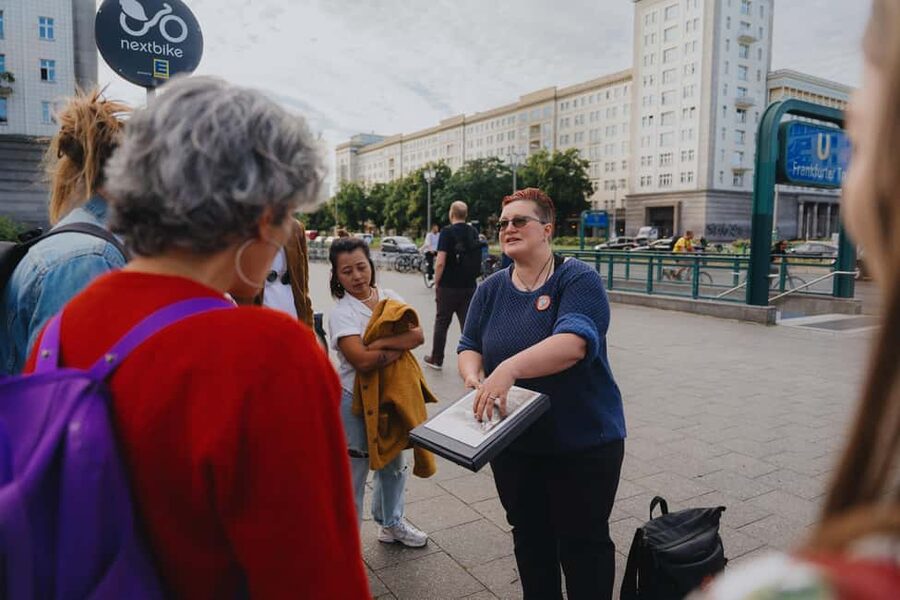
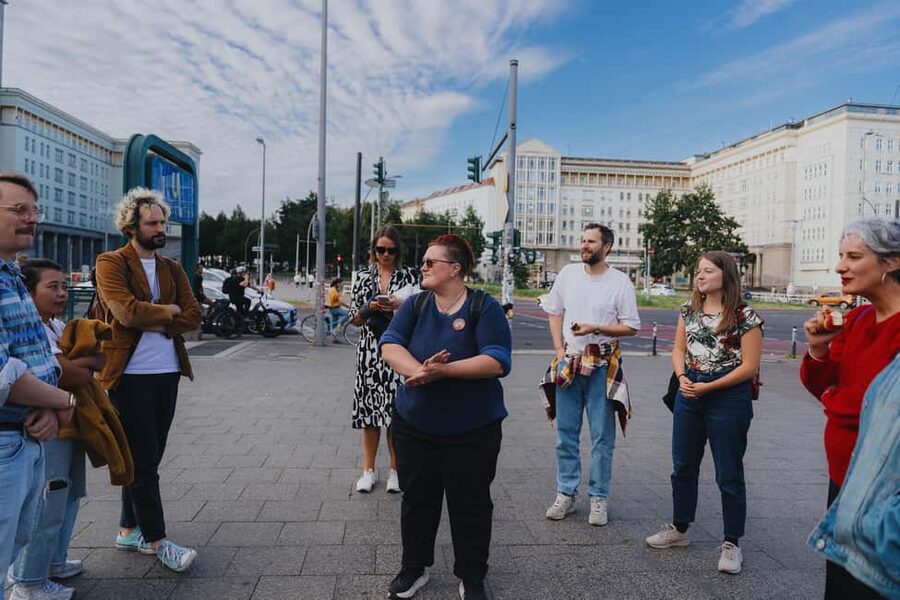
You’ll start outside U Frankfurter Tor underground station, near the southern tower, on the corner of Warschauer Straße and Karl-Marx-Allee. Your guide holds an orange umbrella, so you won’t have to play “where’s the group?” before you even begin.
This start point helps for two reasons. First, it puts you right where the boulevard energy kicks in, so the buildings hit you from the beginning rather than after you’ve already tired yourself out. Second, it sets you up for the tour’s main trick: you’re not just sightseeing. You’re learning how East German leaders wanted people to feel while walking in public space, and how that feeling was engineered.
For me, the best part of starting at a transit hub is that the street doesn’t feel like a historical exhibit behind glass. It feels like Berlin, now, with an overlay of the GDR’s rules and messaging.
You can also read our reviews of more tours and experiences in Berlin.



Karl-Marx-Allee’s socialist classicism: reading politics in buildings
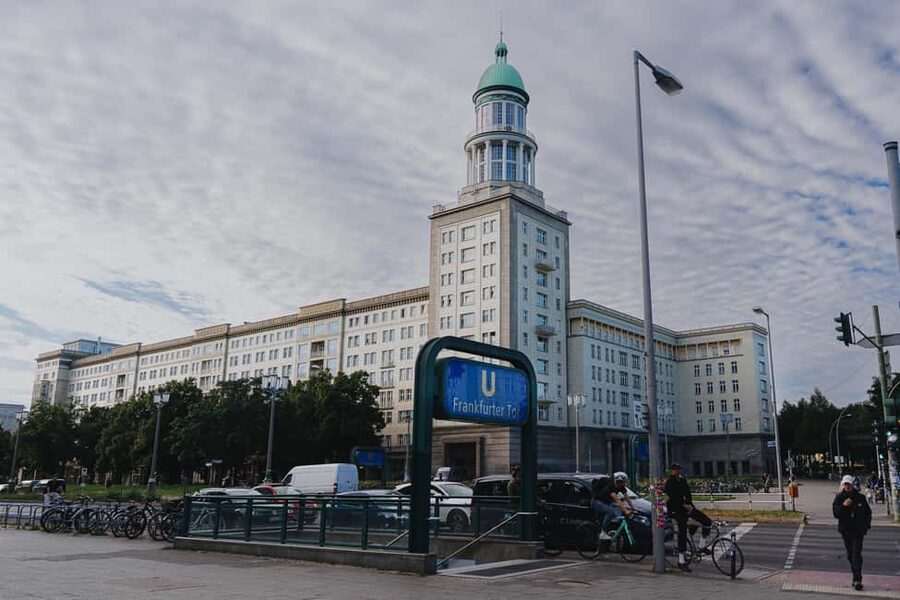
Karl-Marx-Allee is sometimes described as the first socialist street in Germany, and you’ll feel why the moment you see it. The East German project rose out of wartime ruins with help from thousands of volunteers working day and night. You’re standing in the aftermath of destruction turned into a statement: look how organized we are, look how future-proof we are, look how confident our system is.
Architecturally, the tour frames it as socialist classicism—a style meant to be legible, grand, and persuasive. The buildings weren’t designed only for shelter. They were meant to project stability and success, the kind you can photograph, parade past, and point to as proof that socialism delivered.
You’ll also hear how the story of the street stretches back further than the 1950s façades you see today. In the immediate post–World War II years, you get hints of utopian urban-planning ideas born from the ashes of destroyed Berlin. Later on, poplar trees grew fast and were used to hide parts of what was considered undesirable or outdated. That’s a small detail, but it changes your perspective. It’s not just “pretty trees.” It’s a visual policy.
A practical drawback here: if you’re hoping for lots of interior spaces, this isn’t that kind of tour. The value is in looking closely at what’s in front of you—forms, proportions, and the way the street is staged for movement.
The 1953 uprising: how construction nearly broke the system
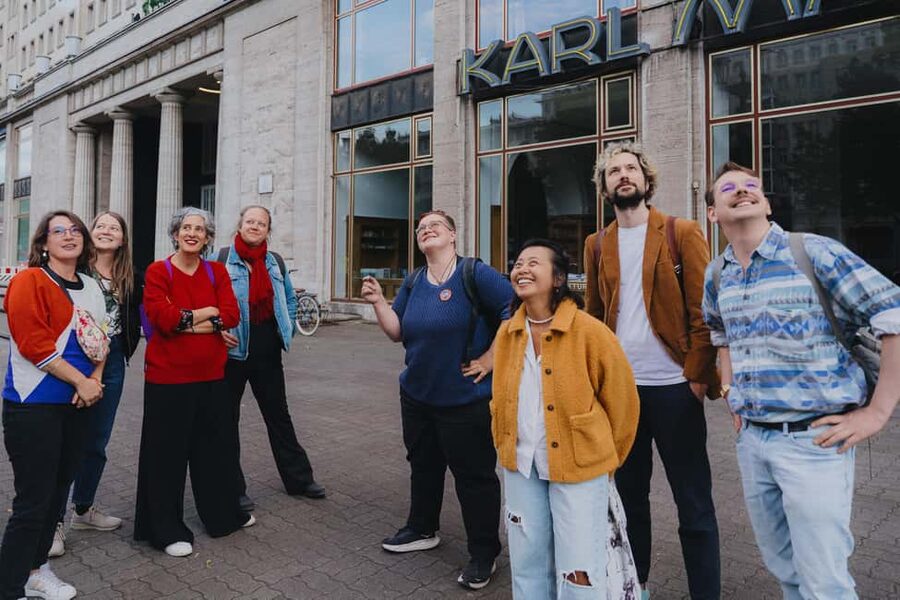
The tour doesn’t treat the street as a smooth success story. It brings in the June 1953 uprising of East German workers, and that’s where Karl-Marx-Allee gets darker.
The street became the main project of East Germany’s national reconstruction programme after WWII, and that mattered politically. Building something massive is expensive. It needs labor, coordination, and constant control. The tour explains how frustration among workers built into a mass uprising that almost toppled the socialist government.
This is one of those moments where the architecture lesson turns into a historical “why.” If you understand that the project was high-stakes for the government, you start noticing the pressure inside the story: a state investing heavily in a symbol while its society strains under the real conditions.
For you, that context makes the street more than a pretty boulevard. It becomes a record of ambition under stress, and it helps connect postwar rebuilding with later attempts to maintain control.
Stasi surveillance, wiretaps, and suppression you can picture

The Cold War wasn’t only about borders and tanks. On this tour, it comes down to daily life and the surveillance state created by the Stasi police.
You’ll learn how the idyllic East Berlin image—cafes, restaurants, and well-stocked shops—was part of the performance. The facade suggested ordinary comfort, the kind that convinces people the system works. But the tour emphasizes that the reality of suppression was hidden where it mattered most: inside apartments and the spaces above them.
A key idea you’ll take away is that wiretaps were used in flats, and listening stations were placed in attics. That detail is chilling because it’s not abstract. It’s about rooms you might live in. It’s about private moments turned into information.
This section can feel intense, but it also gives the street a moral clarity. When you look at the built environment afterward, you’ll probably think differently about who had privacy, who was monitored, and why the government cared so much about public order.
Spotting film history: The Lives of Others and The Queen’s Gambit
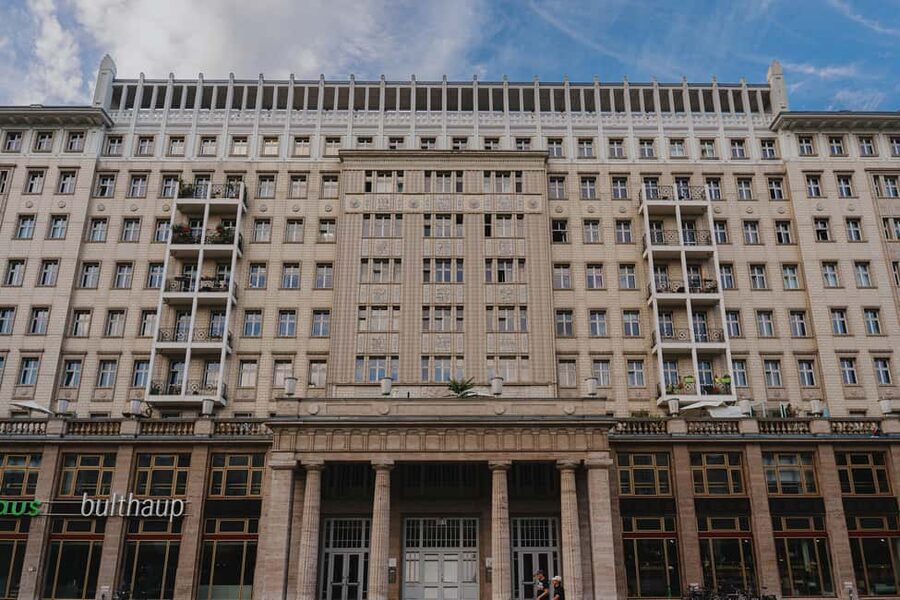
Berlin loves to reuse its own layers, and this tour helps you spot them. You’ll see filming locations connected to The Lives of Others and The Queen’s Gambit, which turns Karl-Marx-Allee into a place where fiction and reality overlap.
Why this is useful: film locations can make you remember what you learned earlier. The Stasi themes, the social atmosphere, the feeling of being watched—seeing those references in the real street setting helps you connect images from screen to the physical geography.
Also, film can serve as a bridge for readers who aren’t sure they want heavy political history. You’ll still get the core facts about ideology and surveillance, but the movie ties give your brain an extra handle.
One note: the tour’s purpose is interpretation, not a cinema tour. If you want long, plot-heavy discussion, you might wish you had more time after the walking ends. But if you enjoy using film as a way to see a place with fresh eyes, this works well.

From socialist boulevard to gentrification debates in today’s Berlin

After the fall of the Wall, the street didn’t freeze into a perfect monument. The tour explains how it slipped toward disrepair and even seemed to disappear into a kind of past-curiosity mood.
Then, as Berlin’s housing crisis sharpened, it pulled attention again. Real estate interest returned, and Karl-Marx-Allee shifted from parade boulevard to something else: a stage for public arguments about gentrification and rising living costs. The same street that once sold a political dream now faces a more modern reality—who gets to live here, and at what price.
For you, this present-day framing matters because it prevents the tour from becoming only nostalgia. Architecture is never only about what happened. It also shapes what’s happening now: social balance, affordability, and who benefits from change.
That’s a big part of why I think this tour lands well. It keeps the meaning of the past connected to the city you’re standing in today.
Price and value for a 2-hour live architecture and ideology tour
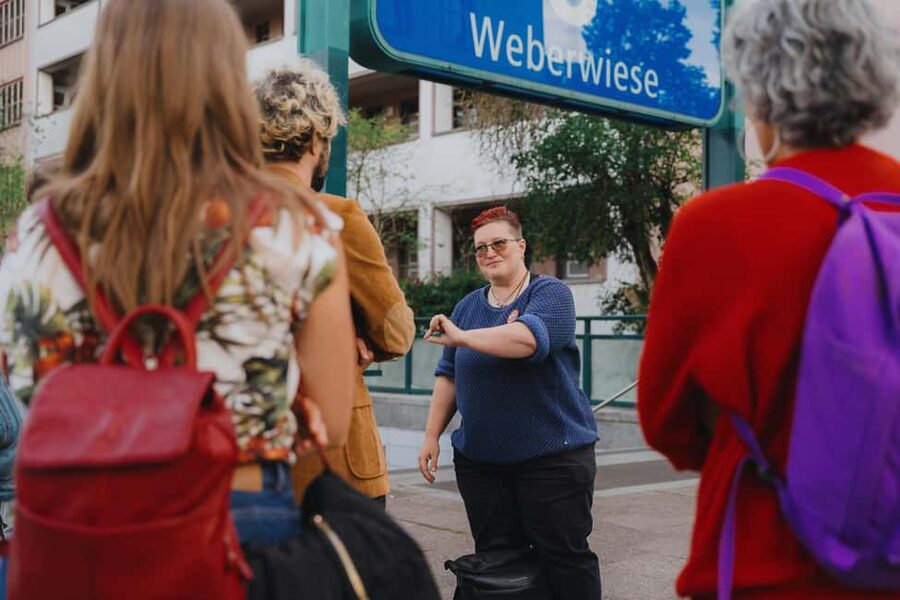
At $29 per person for about two hours, this is a strong value if you like your sightseeing with context. You’re paying for a live guide, English and German narration, and a focused walk along one of Berlin’s most symbolic corridors.
The “value” isn’t only the price tag. It’s the concentration of themes packed into a short time:
- ideology and architecture tied together
- the 1953 uprising given real stakes
- Stasi surveillance described with concrete examples
- film locations used as a memory aid
If you only want a casual stroll, you may find it heavy. But if you want a guided, structured way to understand what you’re looking at, the time-to-learning ratio is very good.
You’ll be on your feet, and the tour is aimed at adults and older teens. It’s also listed as wheelchair accessible, which is a helpful factor if you use mobility support.
Who this tour is for (and who should skip it)

This tour is a great fit if you:
- enjoy architecture that has a story behind it
- want Cold War Berlin explained through what you can see
- like history that connects to surveillance and everyday life
- enjoy spotting film locations as part of your understanding
You might skip it if you’re traveling with very young kids, since it’s not suitable for children under 10. You might also want another kind of option if you don’t enjoy walking or if you prefer museum-style interiors with lots of sitting.
Should you book Beyond and Beneath Tours for Karl-Marx-Allee?
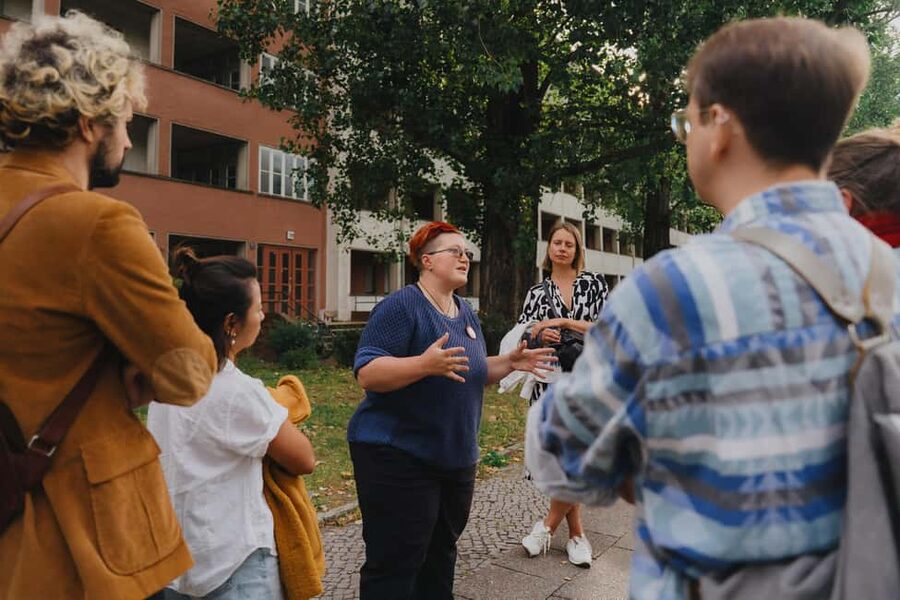
I’d book this if you want Berlin that feels more like interpretation than sightseeing. The tour’s strongest points are the way it turns Karl-Marx-Allee into a lens for Cold War ideology and everyday control, and the way the guide’s storytelling makes the facts easier to hold onto. With Martina in the mix, you also get a human element—responsive, not robotic—so questions don’t feel like interruptions.
If you’re the type who likes to understand what a city is really doing to people—then this street-walk is a smart use of two hours.
FAQ
How long is the Karl-Marx-Allee tour?
The tour lasts about 2 hours, including roughly 1.5 hours of guided time along Karl-Marx-Allee.
What does the tour cost?
It’s priced at $29 per person.
Where does the tour start and where does it end?
You meet outside U Frankfurter Tor underground station, then the tour finishes at U Strausberger Platz.
Which languages are offered?
The live guide offers English and German.
Is there a guide the whole time?
Yes. The tour includes a live guide.
Is the tour wheelchair accessible?
Yes, it is listed as wheelchair accessible.
What should I bring?
Wear comfortable shoes, since this is a walking tour.
Is it suitable for children?
It’s not suitable for children under 10.
What’s the cancellation policy?
You can cancel up to 24 hours in advance for a full refund.