REVIEW · CHARLESTON
Charleston’s Best Highlights: History, Culture & Architecture
Book on Viator →Operated by Charleston Sole Walking Tours · Bookable on Viator
You’ll walk Charleston’s story in real time. This 2-hour historic walking tour strings together architecture and major events in a tight downtown route. You’ll hit landmarks like Old Exchange & Provost Dungeon, Rainbow Row, Dock Street Theater, and St. Michael’s Church with a licensed guide doing the talking.
I love two things right away. First, the guiding style: when Brian or Fin leads, you get clear, lively explanations that connect national moments to what happened right here in Charleston. Second, the pacing is built for seeing details up close, not just snapping photos—especially on the stops that are short but meaningful.
One heads-up: it’s still a walking tour, and a few stops involve separate admissions or entrance depends on availability, so plan for a bit of flexibility.
In This Review
- Key Highlights That Make This Tour Worth Your Time
- Starting at 122 E Bay St: A Small-Group Walk That Gives You Context Fast
- Old Exchange & Provost Dungeon: When Charleston Hosted America’s Big Moments
- Rainbow Row: More Than Pretty Color on the Waterfront
- Old Slave Mart Museum: A Serious Stop With Boundaries (You’ll Stay Outside)
- French Huguenot Church: Gothic Revival and a Rare Living Congregation
- Dock Street Theater: Theater History and Charleston’s Cultural Engine
- Charleston City Hall and the Council Chamber: Civic Power in Plain Sight
- St. Michael’s Church: Original Woodwork, Tiffany Glass, and Constitution Signers
- Nathaniel Russell House Garden: A Federal Townhouse With Merchant Power
- Edmondston-Alston House and the High Battery Wall: Fort Sumter in View
- What Makes the Guiding Style Stand Out (Brian and Fin Are the Proof)
- Admission, Free Stops, and the Real Value of Your Time
- Who Should Book This Charleston Highlights Walk
- Should You Book This Tour?
- FAQ
- How long is the tour?
- Where is the meeting point?
- Is the tour offered in English?
- What group size should I expect?
- Are admission tickets included for every stop?
- Will we enter Old Slave Mart Museum?
- Does the tour include entrance to Dock Street Theater?
- What if the experience is canceled due to poor weather?
- Is free cancellation available?
- Are service animals allowed?
Key Highlights That Make This Tour Worth Your Time
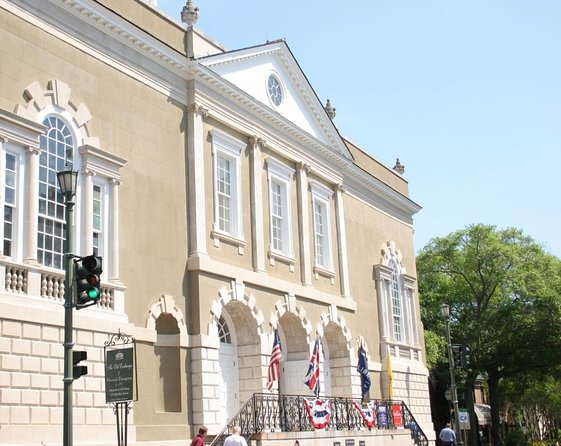
- Old Exchange & Provost Dungeon in about 15 minutes with big national milestones packed into one building
- Rainbow Row’s Georgian storefront past, then a restoration that turned those buildings Caribbean-bright
- Old Slave Mart Museum context without entry, keeping the focus on what the site meant
- Religion, theater, and civic power in one compact downtown loop
- High Battery views toward Fort Sumter, plus Civil War context from the waterfront mansions
Starting at 122 E Bay St: A Small-Group Walk That Gives You Context Fast
The tour begins at 122 E Bay St, right where downtown Charleston is easiest to navigate on foot. It’s an English-language experience built for a maximum group size of 20, which matters because you can actually ask questions and hear the answers instead of yelling over a crowd.
A mobile ticket is part of the setup, and service animals are allowed. The route is designed for most travelers, but you’ll still want decent walking shoes and a bit of stamina—Charleston’s sidewalks are charming, and also unforgiving if you move slowly.
What I appreciate most is the structure: you’re not just moving from postcard to postcard. You’re getting a running story—history, culture, and architecture—so the city stops feeling like a museum and starts feeling like a living place you understand.
You can also read our reviews of more tours and experiences in Charleston.


Old Exchange & Provost Dungeon: When Charleston Hosted America’s Big Moments
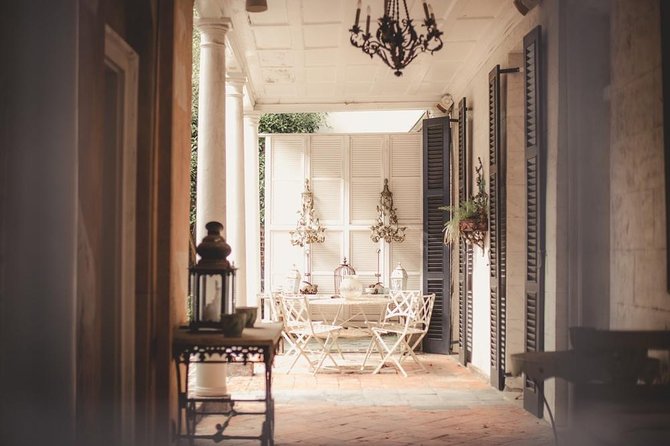
The walk kicks off at Old Exchange & Provost Dungeon, a building dating to around 1771. This is the kind of place where time stacks up: the Declaration of Independence was read here in 1776, and during the American Revolution it also served as a British prison for roughly two years.
You’ll also hear about the U.S. Constitution being ratified in South Carolina in 1788, plus the fact that George Washington was entertained during his week-long visit in May 1791. That’s a lot for one stop, and the guide’s job is to keep it coherent in real time.
A possible drawback: admission is not included for this stop. If you want to fully take it in, budget extra time for any ticketed entry you may do separately.
Rainbow Row: More Than Pretty Color on the Waterfront
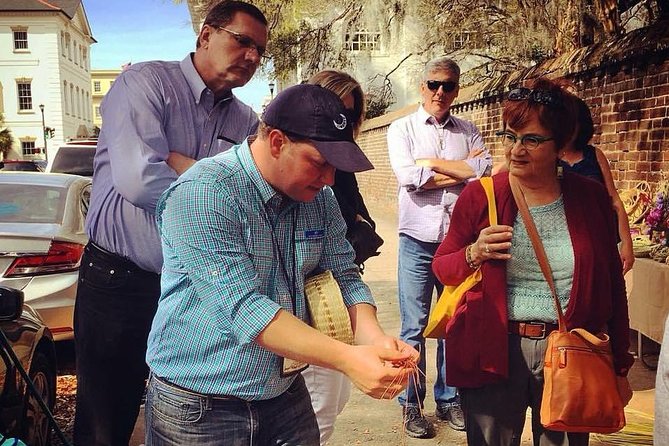
Next comes Rainbow Row, the famous stretch of attached Georgian row houses. You’ll see the longest row of its kind in the country, and the story behind the buildings is better than the photo.
In the 18th and 19th centuries, these were mariner’s stores. That means Charleston’s river life wasn’t just ships and sailors—it was commerce, goods, and tight-packed businesses that needed storefront space right along the street.
Today, the facades are restored in a bright Caribbean color scheme, a result of preservation efforts in the 1930s. I like this stop because it shows how Charleston protects its past without leaving it frozen. You’re looking at history through the lens of restoration choices, not just original stone.
Rainbow Row is free to enjoy from the sidewalk, so it’s a great energy reset in the middle of the walk.
Old Slave Mart Museum: A Serious Stop With Boundaries (You’ll Stay Outside)
Then you reach Old Slave Mart Museum, a building known as Ryan’s Slave Mart in the 1850s. This site was an auction location tied to the interstate slave trade, and the guide will cover Charleston’s role in that system.
Here’s the key detail: this tour does not enter the building. So what you get is context from the outside—meaning you should expect a discussion focused on meaning and history rather than a museum walkthrough.
This approach can be powerful, especially if you want to understand what you’re looking at before you decide whether you want additional, ticketed access later. The downside is obvious: you won’t see the interior exhibits on this specific stop, so if you need the full museum experience, you’ll likely want to plan a separate visit.
French Huguenot Church: Gothic Revival and a Rare Living Congregation
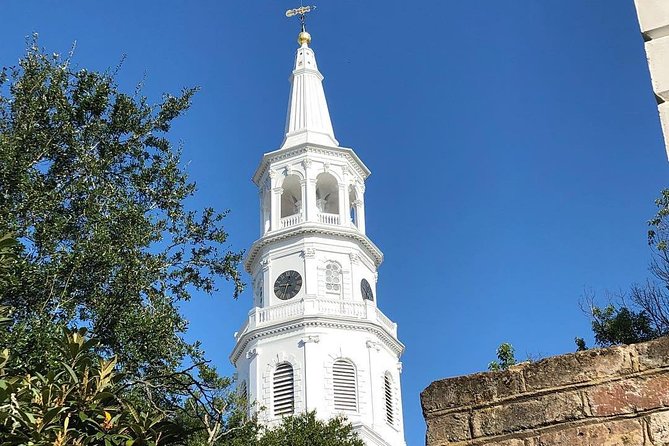
The tour pauses at the French Huguenot Church, a Gothic Revival building built in 1845. It’s notable because it houses one of the only practicing Huguenot congregations in the country, so this is not just architecture on display—it’s faith that continued.
This stop is free, and it’s short by design. You’ll get enough to appreciate the building’s character and to understand why this community mattered in Charleston’s mix of cultures.
If you’re the kind of traveler who loves religious history or minority communities, this is one of the more satisfying quick stops. It doesn’t treat the building like a prop. It treats it like a thread in the bigger story.

Dock Street Theater: Theater History and Charleston’s Cultural Engine
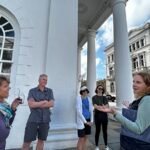
Dock Street Theater is a high point for many people, and the guide makes it make sense. The theater is built on the site of the first theater in the British colonies, and the modern building traces to the 1930s after being restored from the old Planter’s Hotel (dated around 1809).
On the tour, the entrance depends on availability, but the stop itself is free. Even if you can’t get inside during your time slot, you’ll still connect the place to Charleston’s cultural history and its role as a professional stage center.
One practical fact I’d plan around: Dock Street Theatre is operated by the Charleston Stage company, and the company puts on roughly 120 performances per year. That gives you a sense of why this stop isn’t only historical. It’s active culture in motion.
Charleston City Hall and the Council Chamber: Civic Power in Plain Sight
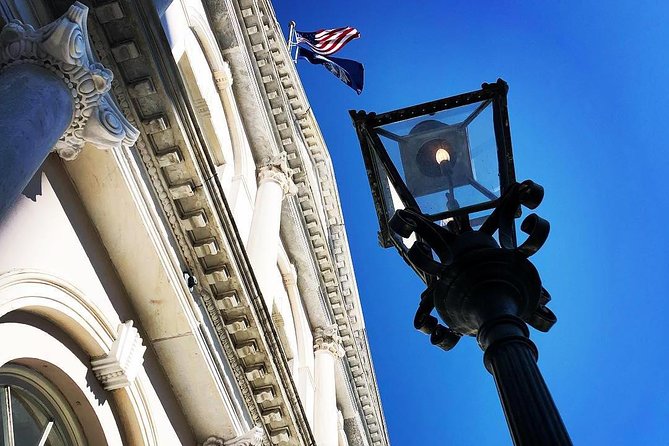
Next is Charleston City Hall, located on one of the Four Corners of Law, a label credited to Robert Ripley. Built in 1801 as a bank and used as a city hall since 1818, it’s one of the oldest continuously run city halls in the country.
This is another free stop, and you may be able to enter the council chamber during weekdays. The tour notes also mention you can see the collection there complimentary, which is a nice bonus if timing lines up.
I like City Hall because it’s easy to underestimate civic buildings. We think of churches and mansions first in Charleston. City Hall reminds you that government and money shaped the city just as much—sometimes more.
St. Michael’s Church: Original Woodwork, Tiffany Glass, and Constitution Signers

St. Michael’s Church is the kind of place that rewards slowing down for a moment. It’s the oldest house of worship in the city, dating around 1761, and the building has much of its original woodwork. If you’re paying attention, that detail alone makes it feel real, not staged.
You’ll also see Tiffany stained glass windows, which turns this into a visual pause after the civic stop. The entrance depends on availability, but the tour includes time to hear about Charleston’s religious history past and present.
And there’s a major historical anchor in the churchyard: John Rutledge and Charles Cotesworth Pinckney, both U.S. Constitution signers, are buried here. This is where the tour’s “context thread” really clicks. Religion, politics, and national founding aren’t separate chapters—they overlap in physical places you can stand in.
Nathaniel Russell House Garden: A Federal Townhouse With Merchant Power
The tour then moves to the Nathaniel Russell House. Instead of rushing through the rooms, you enter the garden of this Federal-style townhouse built in 1808.
The ownership story is part of the lesson. Nathaniel Russell was a wealthy merchant involved in shipping, and the garden setting gives you a different angle on Charleston wealth—less streetfront commerce, more controlled domestic space.
Admission is not included for this stop, so if gardens and houses are your thing, treat it as the one place where you may want to plan a ticketed follow-up depending on what access is offered to you.
Edmondston-Alston House and the High Battery Wall: Fort Sumter in View
The final segment leans into views. You walk up to the High Battery wall to look out toward the waterfront mansions, and you’ll discuss the beginning of the Civil War.
From this spot, Fort Sumter is in view. The guide connects the architecture and location to the moment Charleston and the surrounding area shifted into conflict, including the detail that the Edmonston Alston House has been in the family since 1838. The story includes that Gen. Beauregard watched the bombardment of Fort Sumter from a nearby gathering of onlookers.
This stop is admission-ticket not included, and it’s less about entering a building and more about reading the city’s geography. That’s a smart way to end, because you leave with a mental map: Charleston’s waterfront, its power centers, and the way events unfolded in visible space.
What Makes the Guiding Style Stand Out (Brian and Fin Are the Proof)
A lot of walking tours can name-drop. This one tends to explain.
The strongest theme in the experiences I’ve seen shared around this tour type is the guide’s ability to answer questions and tailor the tour to the group. Brian and Fin come up repeatedly, and both have a style that feels like walking with a history teacher who cares that you get it.
One detail worth noting: Fin has been described as having extensive teaching background and years of guiding experience, which shows up in the way questions get handled and in how the guide keeps the flow moving even when the group asks for more. That’s not just entertainment—it’s what makes the tour useful on a first visit.
Even if you’ve been to Charleston before, this kind of guiding helps you notice what you previously walked past.
Admission, Free Stops, and the Real Value of Your Time
This tour is built so you see a lot without paying at every corner. Several stops are free from the tour’s standpoint, including Rainbow Row, French Huguenot Church, Dock Street Theater (free, though entry depends on availability), Charleston City Hall, and St. Michael’s Church.
On the other hand, admission is not included for Old Exchange & Provost Dungeon, Old Slave Mart Museum, Nathaniel Russell House, and Edmondston-Alston House. So the tour value is partly about paying for interpretation—what the guide helps you understand—while you decide which ticketed sites you want to go deeper into.
That split is often smart. You can treat the walking tour as your orientation, then choose the two or three places that you want to study more. If you’re doing multiple activities in Charleston, this helps you avoid feeling locked into expensive add-ons.
Also, plan on the experience possibly running a bit longer than the headline time. In practice, when questions come easily (and they often do on a history-heavy walk), you might spend more time on certain stops rather than rushing to the next one.
Who Should Book This Charleston Highlights Walk
This is ideal if you want a fast start to your Charleston trip. It’s also great if you’ve visited before and want to understand the why behind the buildings, not just the what.
It fits well for:
- First-time visitors who want a guided overview with major landmarks
- Returning visitors who want sharper context on founding-era Charleston and later events
- Travelers who like asking questions and having them answered on the spot
- People who prefer walking with interpretation rather than sitting in a vehicle
If you hate walking, or if you expect every stop to involve guaranteed indoor access, you may feel mildly annoyed at times—because some entrances depend on availability and some admissions are separate.
Should You Book This Tour?
I’d book it if your goal is to get your bearings fast and leave with a stronger grasp of how Charleston’s architecture ties to big American stories. The guide-driven format, the mix of famous sights and historically serious stops, and the fact that so much is free from the street level make this a strong use of time.
Skip it only if you want a pure museum schedule or if you dislike walking past places without entering them. On this tour, a few stops are intentionally outside or optional for entry. That’s not a flaw—it’s how the experience keeps the pace moving while still giving you meaning.
In short: if you want Charleston explained in real-world walking terms, this is an excellent place to start.
FAQ
How long is the tour?
It lasts about 2 hours.
Where is the meeting point?
The meeting point is 122 E Bay St, Charleston, SC 29401.
Is the tour offered in English?
Yes, it is offered in English.
What group size should I expect?
The tour has a maximum of 20 travelers.
Are admission tickets included for every stop?
No. Some stops are free, and others list admission tickets as not included. Old Exchange & Provost Dungeon, Old Slave Mart Museum, Nathaniel Russell House, and Edmondston-Alston House have admission not included.
Will we enter Old Slave Mart Museum?
No. The tour notes say you do not enter the building.
Does the tour include entrance to Dock Street Theater?
Entrance depends on availability.
What if the experience is canceled due to poor weather?
The tour requires good weather. If it’s canceled because of poor weather, you’ll be offered a different date or a full refund.
Is free cancellation available?
Yes. You can cancel for a full refund if you cancel at least 24 hours in advance.
Are service animals allowed?
Yes, service animals are allowed.