
REVIEW · CHENNAI
British Architecture Walk in Chennai by Wonder tours
Book on Viator →Operated by Wonder tours · Bookable on Viator
Chennai’s British buildings are still doing the work today. This 3-hour British Architecture Walk mixes Gothic Revival, Indo–Saracenic, and colonial-era landmarks into a route that’s easy to follow on foot. I like the practical pacing (short, focused stops) and the fact that you get real context at each site—especially with guides like Rajesh and Nanda. One drawback: you’re not in for long stays, since each stop is timed to keep the walk moving.
What makes this tour genuinely fun is the mix of famous public buildings and the “you’d miss it otherwise” details: railway architecture, memorial symbolism, church history inside Fort St. George, and University of Madras planning details. The price also feels more fair than it looks because it bundles a local guide, a local snack plus coffee or tea, and admission tickets through the stops.
In This Review
- Key highlights you’ll feel on the street
- British architecture in Chennai, minus the museum fatigue
- Price and value: why $49 can actually make sense
- Where you start (and why ending back matters)
- Stop 1: Ripon Building and the idea of local self-government
- Stop 2: Chennai Central Railway Station and Gothic Revival details
- Stop 3: Southern Railway Headquarters with Indo–Saracenic swagger
- Stop 4: Victory War Memorial and the meaning behind the layout
- Stop 5: Fort St. George, St Mary’s Church, and the colonial museum
- Stop 6: Napier Bridge and the quick symbolism of a city landmark
- Stop 7: University of Madras and the architecture of 1874–1879
- How the guide changes the experience (this tour leans on them)
- What to expect from the walking pace and timing
- Who this tour is best for
- Should you book British Architecture Walk in Chennai with Wonder tours?
- FAQ
- How long is the British Architecture Walk in Chennai?
- How much does it cost per person?
- What are the main stops on the walk?
- Is the tour guided?
- Are admission tickets included?
- What’s included in the price besides the guide?
- What is not included?
- Where do I meet, and where do I end?
- Is the tour private?
- What if I need to cancel?
Key highlights you’ll feel on the street
- A guided walk with clear storytelling at each stop, not just photo time
- Admission tickets included for the listed sites, which saves hassle and time
- British + Indian architectural styles in one compact loop
- Stops are well spaced for a 3-hour experience (about 15–30 minutes each)
- Tea/snack included, so you’re not hunting food mid-walk
- Private group setup, so the guide can match your pace
British architecture in Chennai, minus the museum fatigue
Chennai has a British-era layer that still shows up in everyday landmarks. This walk is built for people who want that layer without committing to a full day of ticket lines and indoor exhibits.
You’ll spend about three hours moving between major buildings, mostly on foot. That means you get to connect shapes, materials, and design choices across the city—railway Gothic windows over here, Indo–Saracenic influence there—so the architecture stops feeling random.
And yes, you’re getting a guide who explains what you’re looking at. Multiple past guests called out how friendly and professional the guidance felt. Names that came up include Rajesh and Nanda, both praised for making the history understandable instead of turning it into a lecture.
You can also read our reviews of more tours and experiences in Chennai.


Price and value: why $49 can actually make sense
At $49 per person for roughly 3 hours, this isn’t a “cheap taxi tour,” but it also isn’t just a walk where you pay for someone’s time. The tour includes several cost items that often cost extra on their own: a local guide, a local snack plus coffee or tea, and taxes/fees/handling charges.
Also, the tour is described as having a mobile ticket. That’s a small thing, but it usually means fewer last-minute frictions on the day you arrive.
What you should keep in mind is what’s not included: porterage and tips, camera and video camera fees, and hotel pickup/drop-off. If you need to get to the meeting point from elsewhere, plan your own route. In one account, a driver pickup was mentioned, but the stated option is not included—so it’s smart to ask what will happen for your specific booking.
Where you start (and why ending back matters)
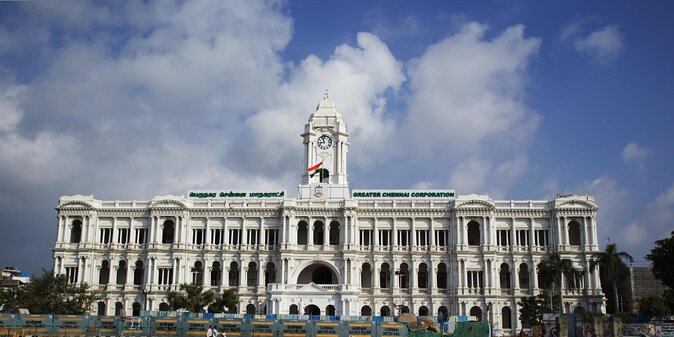
You meet at the Greater Chennai Corporation Office, on Raja Muthiah Rd in Periamet (Kannappar Thidal, Poongavanapuram). The tour ends back at the meeting point, which is a quietly helpful detail. You don’t have to negotiate your way across town at the end while you’re tired and your feet are negotiating for better wages.
It’s also listed as near public transportation. That’s practical if you want to arrive early, grab water, or plan an easy next stop after the tour finishes.
Stop 1: Ripon Building and the idea of local self-government
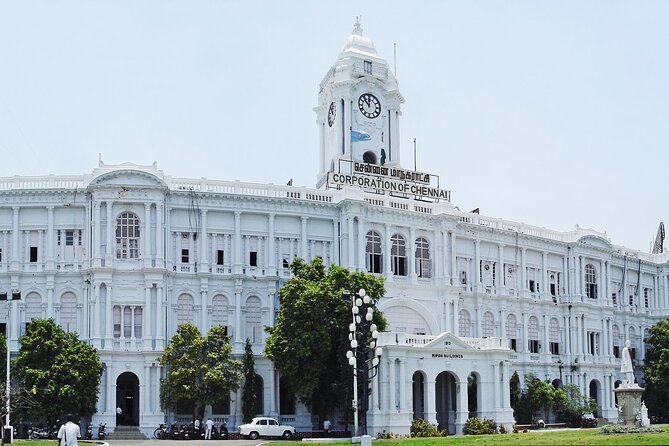
Ripon Building is your first architecture lesson in plain sight. It’s named after Lord Ripon, known as the father of local self-government in British India. So even though this is an architectural stop, you’re really learning how governance influenced public buildings.
The building is designed by G.S.T. Harris and built by Loganatha Mudaliar. Seeing a specific designer and builder named matters, because it turns the site from generic colonial scenery into something you can actually picture: intent, labor, and style all in one structure.
This stop runs about 15 minutes and includes an admission ticket. Quick means you won’t get stuck, but it also means you should come ready to look closely rather than expecting a long sit-down.
Stop 2: Chennai Central Railway Station and Gothic Revival details
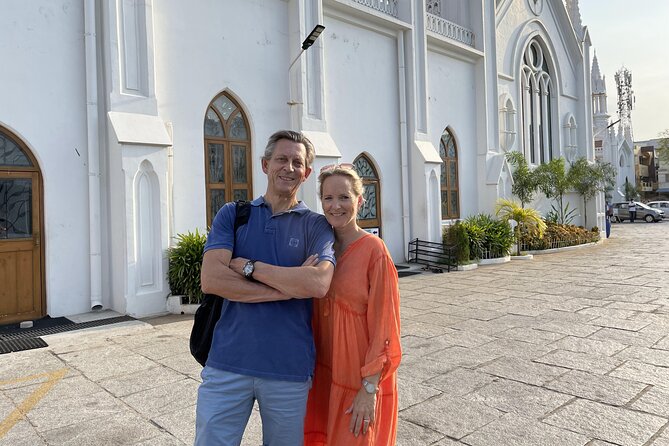
Next you’re at Chennai Central Railway Station, which today serves more than 350,000 passengers every day. Built in 1873, it’s in a Gothic Revival style designed by British architect George Harding, later modified by Robert Chisholm.
This is one of the best stops if you like architecture that looks “serious” even when it’s doing a modern job. The station gives you a chance to notice how British-era design choices can survive into a functioning transport hub.
Like Ripon Building, the visit is short (about 30 minutes) and includes an admission ticket. If you want extra time for photos or to really zoom in on details, you may need to do a bit of that on your own after the tour.
Stop 3: Southern Railway Headquarters with Indo–Saracenic swagger
The Southern Railway Headquarters is built in an Indo–Saracenic style, and it’s dated to 1921. The design is credited to N. Grayson, and it was built by Samynada Pillai.
Indo–Saracenic is where British colonial architecture starts to feel more blended with local forms rather than copied line-for-line. This stop is a good check-in point during the walk: you can compare how the earlier Gothic Revival vibe differs from this fusion approach.
The time here is about 15 minutes with an admission ticket included. Don’t treat it like background scenery. Even in a short window, you can learn to spot the style cues your guide will point out.
Stop 4: Victory War Memorial and the meaning behind the layout
The Victory War Memorial commemorates Allied victories during World War I (1914–1918). At one point, it was also called Cupid’s bow, which is the kind of detail you only learn when someone is guiding the story, not when you’re just walking past.
This stop lasts around 30 minutes with admission included. That duration helps because memorials are meant to be read as much as looked at. You’ll likely spend time linking what the structure represents to how it’s positioned in the city.
If you’re hoping for a purely visual stop, it can still work. Just know that the value here is interpretation—why the memorial exists and what it’s meant to remember.
Stop 5: Fort St. George, St Mary’s Church, and the colonial museum
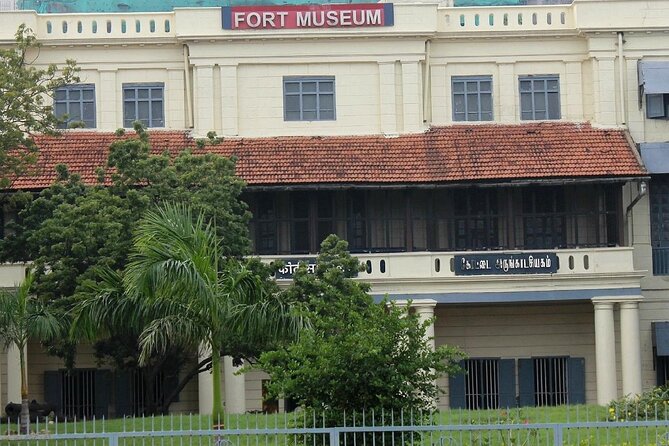
Fort St. George is where the walk turns from public buildings into a more grounded historical zone. At the fort, you’ll visit St Mary’s Church, described as the oldest Anglican Church in India. That alone makes it worth the stop.
You’ll also have time at a quaint museum with relics from colonial times. The pairing works well: church architecture gives you a look at religious colonial presence, then the museum helps you connect objects and context to the larger era.
This stop is listed as about 30 minutes with admission included. That’s enough to see and understand, but not enough to become a deep-dive historian on the spot. If you love museums, you’ll still probably want more time later on your own.
Stop 6: Napier Bridge and the quick symbolism of a city landmark
Napier Bridge is often used by media to represent Chennai, and it has a history that ties it to the city’s visual identity. The bridge was narrowed at first, then broadened and converted into a concrete structure, opened to the general public in July 1943.
This stop is short—about 15 minutes—with admission included. It’s perfect for giving your brain a breather while still keeping the architecture theme alive. Bridges are design, yes, but they’re also movement and public space. You’ll get that sense quickly here.
If you want to photograph the bridge well, plan to do that efficiently. The tour pace is built to keep you on schedule through the remaining stops.
Stop 7: University of Madras and the architecture of 1874–1879
The final stop is the University of Madras building, constructed between April 1874 and 1879. This is the kind of place where you can see how British administration and education goals showed up in stone and layout.
You’ll get time to look for specific elements mentioned in the tour details: a convocation hall, porticos, a parapet, meeting halls, and a library. The Senate House is also described as the administrative center of the University of Madras.
This is another about 30 minutes with an admission ticket included. As a finale, it works because the story shifts from transport, governance, and military remembrance into education and civic structure.
How the guide changes the experience (this tour leans on them)
Several past guests specifically praised the guide’s delivery. I’d take that seriously, because a British architecture walk lives or dies on explanation.
The best moments tend to come when the guide connects style to meaning—why something was built, who influenced it, and how the city uses those buildings now. Reviews mentioning guides like Rajesh and Nanda point to friendly, clear storytelling and a professional pace.
Also, because the tour is private to your group, the guide can adjust to how fast you walk and what you care about most. That’s a real advantage on a city route where outsiders might drag the pace up or down.
What to expect from the walking pace and timing
The entire experience is listed as about 3 hours. Stop times are relatively tight—15 minutes at some sites, up to 30 at others—so you’ll be moving steadily through the route.
For planning: wear comfortable shoes, keep a bottle of water in your daypack, and don’t plan a long museum detour right before the tour starts. You’ll enjoy it more if you treat it like a guided street lesson rather than a hang-out at each building.
The tour includes a local snack and coffee or tea, which helps if you’re worried about getting hungry during those timed stops. Still, you’ll want to be ready for the walk portion.
Who this tour is best for
This is a smart choice if you:
- Like architecture but don’t want to spend a whole day on research
- Want the British-era Chennai story through major public landmarks
- Enjoy guided context (and not just a list of buildings)
- Prefer a private group experience and a straightforward route
It’s also a good fit for first-time visitors who want a “city read” of colonial-era design without turning the day into logistics.
If you’re the type who needs long time inside each site to read everything and take photos slowly, you might find the stop durations a bit short.
Should you book British Architecture Walk in Chennai with Wonder tours?
If you want an organized, value-heavy way to see Chennai’s British architectural footprint, I’d book it. The combination of admission tickets included, a local guide, and even a snack/tea makes it easier to justify than many basic walking tours.
I’d book especially if you enjoy hearing the why behind the buildings—Lord Ripon’s governance legacy, the Gothic Revival choices at the central station, Indo–Saracenic design at Southern Railway HQ, and how memorials and education buildings close the loop.
My main caution is simple: it’s timed. If you’re hoping for long, slow, museum-style visiting, this may feel brisk. But if you want three hours that connect the dots across Chennai in a practical way, this tour is a strong pick.
FAQ
How long is the British Architecture Walk in Chennai?
It runs for about 3 hours (approx.).
How much does it cost per person?
The price is $49.00 per person.
What are the main stops on the walk?
The tour includes Ripon Building, Chennai Central Railway Station, Southern Railway Headquarters, Victory War Memorial, Fort St. George (including St Mary’s Church and a museum), Napier Bridge, and the University of Madras building.
Is the tour guided?
Yes. It includes a local guide.
Are admission tickets included?
Yes. Admission tickets are included for the listed stops.
What’s included in the price besides the guide?
The tour includes a local snack and coffee or tea, plus all taxes, fees, and handling charges.
What is not included?
Porterage & tips, camera and video camera fees, any other incidental charges, and hotel pickup and drop-off.
Where do I meet, and where do I end?
You meet at the Greater Chennai Corporation Office, 53 Raja Muthiah Rd, Periamet, Kannappar Thidal, Poongavanapuram, Chennai, Tamil Nadu 600003, India. The tour ends back at the meeting point.
Is the tour private?
Yes. It’s listed as private, meaning only your group will participate.
What if I need to cancel?
The experience is non-refundable and cannot be changed for any reason. If you cancel or ask for an amendment, the amount you paid will not be refunded.
![[Aomori Prefecture] Tour the history and architecture in Towada City, the art city - Stop 2: Towafuru at the Community Exchange Center by Sou Fujimoto](https://c.architectureexplorer.com/wp-content/uploads/aomori-prefecture-tour-the-history-and-architecture-in-towada-city-the-art-city-400x267.jpg)