REVIEW · CHENNAI
British Architecture Walk, an immersive walking tour in Chennai
Book on Viator →Operated by 5 Senses Walks · Bookable on Viator
British Chennai on foot is surprisingly fun. You’ll trace British influence through landmark buildings and bridges, from Egmore and Central stations to Napier Bridge and the Victory War Memorial. I love how the tour keeps things practical with a small group and a local guide, and I also like that you get snacks and coffee/tea without paying extra. One thing to consider: not every stop includes admission, so you may mostly view a few buildings from the outside or plan around any entry restrictions.
This is a 2 hours 30 minutes walking route that starts at Egmore and ends near the University of Madras. Pickup is optional (only if you choose it), and you’ll get a mobile ticket for the experience. With a maximum of 15 people, you’re not stuck in a loud crowd, which makes it easier to hear the story behind details like clock towers and Indo-Saracenic features.
The guide can really make or break this kind of walk, and past guides such as Hareesh and Satish are praised for sharing lots of building-by-building context. Expect an upbeat pace and enough time at each stop to notice what makes each structure British-influenced, even when it mixes with local design.
In This Review
- Key Things to Know Before You Go
- Why British-Era Chennai Looks Different Up Close
- Price and Value: What $55 Buys in Real Terms
- Meeting Point to Finish Line: Egmore to University of Madras
- Stop-by-Stop: British Landmarks That Actually Matter
- Stop 1: Chennai Egmore Railway Station (Indo-Saracenic with British scale)
- Stop 2: Chennai Central Railway Station (Gothic Revival + Robert Chisholm details)
- Stop 3: Victoria Public Hall (1887 commemoration of Queen Victoria)
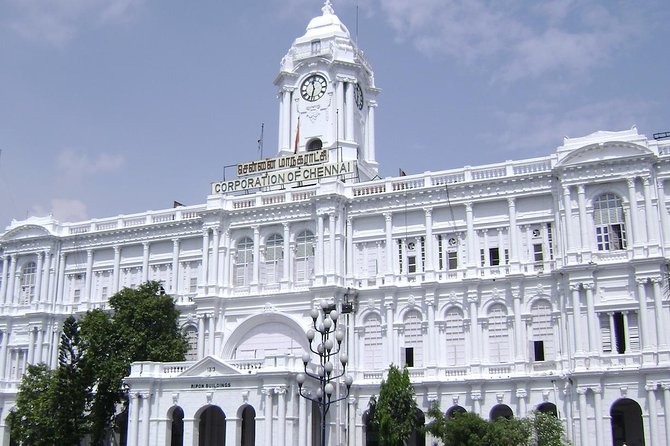
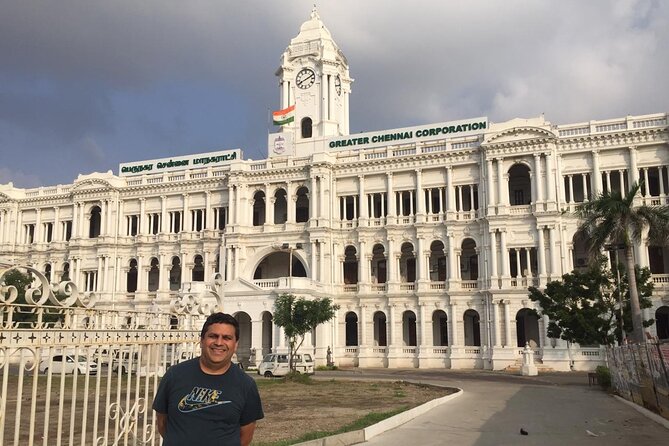
- Stop 4: Greater Chennai Corporation Office / Ripon Building (1913 civic power)
- Stop 5: Southern Railway Headquarters (Indo–Saracenic style, completed 1921)
- Stop 6: Napier Bridge (1869 link between the Marina and Fort St George)
- Stop 7: University of Madras (Senate House on the Marina side)
- Stop 8: Victory War Memorial (formerly Cupid’s bow)
- How the Guide Changes the Whole Walk
- Practical Tips for a 2.5-Hour Architecture Walk
- Who This Tour Fits Best
- Should You Book the British Architecture Walk?
- FAQ
- How long is the British Architecture Walk in Chennai?
- What does the tour cost?
- How big is the group?
- Does the tour include hotel pickup or drop-off?
- Is a mobile ticket provided?
- Are snacks included?
- Is admission included at every stop?
Key Things to Know Before You Go
A max of 15 people keeps the walk personal and easy to ask questions.
Snacks plus coffee/tea are included, which helps on a warm Chennai day.
Several admissions are included, but not every stop has ticket coverage.
The route links major city nodes from Egmore to the Marina area by way of Fort St George connections.
Two famous guides get named often (Hareesh and Satish), suggesting consistently strong storytelling.
Why British-Era Chennai Looks Different Up Close
Chennai’s British-era architecture isn’t just a set of old buildings. Up close, you start seeing the mix: British planning and public-works ambition, plus local building traditions and styles that show up in the shape, ornament, and materials.
The best part is that you’re not just looking at facades. You learn what to look for: rooflines, clock towers, patterned stonework, and Indo-Saracenic details that make the structures feel more than copies of Europe. Even the bridges and stations tell a story about how people moved, where power sat, and how the city presented itself.
You can also read our reviews of more tours and experiences in Chennai.


Price and Value: What $55 Buys in Real Terms
At $55 per person, this walk is priced like a serious guided experience rather than a casual stroll. Here’s where the value comes from:
- You get a local guide for the full 2.5 hours.
- Snacks and coffee/tea are included at no extra cost.
- The price includes taxes, fees, and handling charges.
- Several stops list admission tickets included, including Egmore Station, Chennai Central Station, Napier Bridge, and the Victory War Memorial.
That combination matters. Paying for a guide plus entry fees adds up fast in many cities. This tour bundles enough of the cost that you’re not constantly wondering what’s included on arrival.
Meeting Point to Finish Line: Egmore to University of Madras
The walk starts in Chennai Egmore at Gandhi Irwin Rd, Egmore, Chennai. You’ll finish near the University of Madras in Navalar Nagar, Chepauk, Triplicane.
You don’t need to solve complicated transit logistics on your own because the tour is near public transportation. If you want the low-stress option, optional hotel transfers are available, but you’ll only get pickup/drop-off if you choose that add-on.
Also keep in mind the format: it’s a walking tour, and it runs roughly 2 hours 30 minutes. That’s long enough that comfortable shoes are not optional. If you’re planning dinner after, I’d build in a little buffer because you’ll likely end your tour in the busy Marina-side area.
Stop-by-Stop: British Landmarks That Actually Matter
This itinerary is designed like a story: transportation power (stations), civic authority (public buildings), rail administration (Southern Railways HQ), and the city’s memorial and ceremonial spaces (war memorial and major institutions). Here’s what each stop is for and what to watch.
Stop 1: Chennai Egmore Railway Station (Indo-Saracenic with British scale)
Egmore Station is over 100 years old and among the early buildings in Indo-Saracenic style. It was designed by Henry Irwin, and one detail that really helps you understand the ambition is that it was intended to be larger than London’s Charing Cross station.
When you’re standing there, look past the “wow, it’s old” feeling. Focus on how the station’s grandeur communicates status—this was never just a transport shed. Admission ticket is included here, so you should treat it as one of the key paid stops.
Consideration: stations can still be operational, so expect crowd flow and noise. The trick is to listen for what your guide points out, not to try to take in every angle alone.
Stop 2: Chennai Central Railway Station (Gothic Revival + Robert Chisholm details)
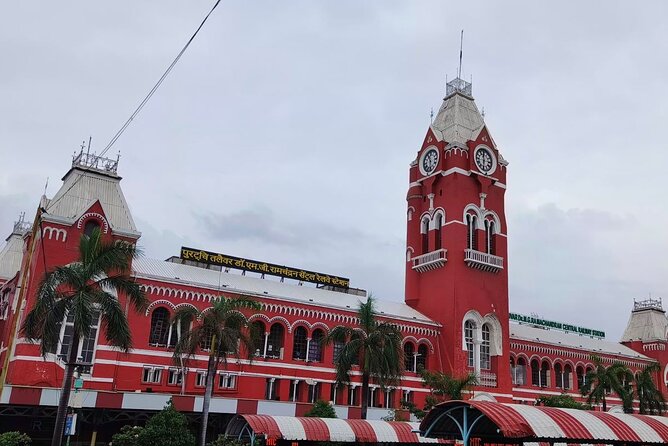
Next you move to Chennai Central Railway Station, built in 1873 in Gothic Revival style by British architect George Harding. It was later modified by Robert Chisholm, who added the central clock tower and Travancore caps on the main structure.
If you’re someone who likes architecture as a puzzle, this stop is ideal. The Gothic Revival influence gives you the vertical drama, while Chisholm’s additions help explain why the building doesn’t feel like a pure European import. Admission ticket is included, so this is another moment where you can slow down and really read the form of the building.
What to notice: clock tower shape, symmetry, and those regional cap details that can be easy to miss unless someone tells you what they are.
Stop 3: Victoria Public Hall (1887 commemoration of Queen Victoria)
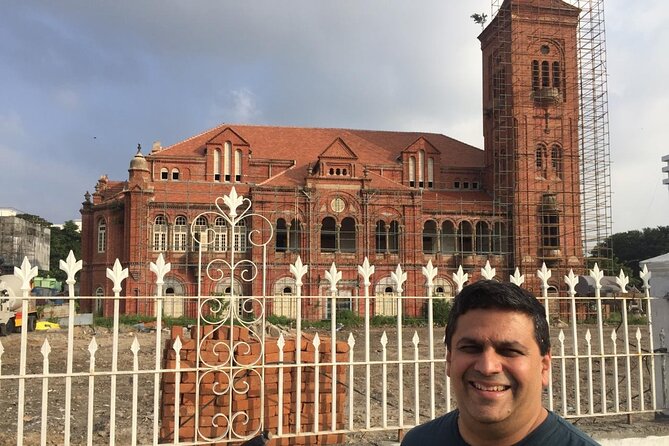
Victoria Public Hall opened in 1887 to commemorate the Golden Jubilee of Queen Victoria. The building is named after the queen and hosted events like public meetings and other civic gatherings.
Here’s the value of this stop: it connects architecture to a political timeline. You’re seeing how Britain marked major milestones through public-facing buildings. Admission ticket is not included, so you may not go inside. Still, it’s worth using this stop to practice “facade reading”—your guide can point out which elements tie it to that Victorian-era purpose.
Stop 4: Greater Chennai Corporation Office / Ripon Building (1913 civic power)
The walk continues to the Ripon Building, commissioned in 1913. It was designed by G.S.T. Harris and built by Loganatha Mudaliar, and it’s named after Lord Ripon, a Governor-General.
This is where the tour really shows you civic architecture as authority. Ripon Building isn’t meant to be cute—it’s meant to project permanence and governance. Admission ticket is not included, so again, you’ll likely focus on exterior views and details your guide highlights.
Tip for enjoying this stop: if you like context, ask your guide what kind of civic institution would have used a building like this during the British period. You’ll get more out of it than just taking photos.
Stop 5: Southern Railway Headquarters (Indo–Saracenic style, completed 1921)
Then you reach the headquarters of Southern Railways, built in Indo–Saracenic style. The design is credited to N. Grayson, built by Samynada Pillai, and completed in 1921.
Even if you don’t know the terminology, you’ll feel what’s going on here: railways were the engine of movement and commerce, and the headquarters had to look like power. This stop’s admission ticket is not included, so plan to observe from outside and pay attention to the blend of styles.
What makes it interesting: it’s British-era administration, but expressed through Indo-Saracenic design choices—so the architecture becomes a record of cultural mixing, not just a one-way influence.
Stop 6: Napier Bridge (1869 link between the Marina and Fort St George)
Napier Bridge was built in 1869 across the Coovum river and named after Francis Napier, the British governor of Fort St George. The bridge connects the Marina to Fort St George area.
This stop works because you’re seeing a piece of infrastructure with political naming power. Bridges are functional, but naming them ties them to people and eras. Admission ticket is included here, so use the time to cross with your guide and take in the river-and-city relationship.
Photo tip: you’ll get better results by looking for lines—how the bridge frames the shore and how it connects two key neighborhoods.
Stop 7: University of Madras (Senate House on the Marina side)
The tour stops at the University of Madras, specifically the Senate House area, which is the administrative center of the university. The building sits along the Marina Beach and was constructed by Robert Chisholm. It’s considered a strong example of Indo-Saracenic style.
Admission ticket is not included, but this is still a valuable stop because a university doesn’t just represent education—it represents institutional ambition. Chisholm is the connecting thread again, which helps you see his influence across multiple landmark buildings.
Consideration: it’s a working area, so your best approach is to stay flexible, follow your guide’s cues, and keep the focus on architectural details rather than expecting a museum-like experience.
Stop 8: Victory War Memorial (formerly Cupid’s bow)
The final stop is the Victory War Memorial, which was formerly called the Cupid’s bow. It commemorates the victory of the Allied Armies during World War I (1914–1918).
Admission ticket is included, and the stop’s value is emotional and historical in a different way than stations and offices. You’re shifting from infrastructure and administration to remembrance—how a city marks global conflict in local space.
What to look for: how the memorial’s design creates a sense of ceremonial presence. Even if the details aren’t fully obvious at first glance, the guide can connect the naming and purpose to the broader story.
How the Guide Changes the Whole Walk
A walking tour lives or dies on interpretation, not just on where you go. This one leans hard on your guide’s ability to make the buildings feel understandable.
In particular, named guides like Hareesh and Satish show up in strong reviews for being enthusiastic and detailed without turning it into a lecture. One of the practical perks is the way they keep the group comfortable—Hareesh is specifically associated with adding an extra touch like buying an Indian coffee on the way. That’s not required information, but it signals a mindset: keep the experience lively, not dry.
When you’re on the tour, you can get more out of it by doing two simple things:
- Ask questions that tie design choices to the era, like why a station would look like a statement building.
- Let your guide direct your attention—architecture details can be subtle if you don’t know what you’re hunting for.
Practical Tips for a 2.5-Hour Architecture Walk
Chennai weather and urban pacing can be the difference between a great walk and a tiring one. Here are smart, non-dramatic ways to set yourself up.
Wear shoes you trust. You’ll move between multiple landmarks across the city side, and you want grip and comfort. Bring a hat or something for sun if you’re sensitive to heat. The tour includes snacks and coffee/tea, but you should still plan to bring water if you like to sip throughout.
For photography, don’t rely only on wide shots. Look for specific design cues your guide can point out—clock tower elements, Indo-Saracenic patterns, and how buildings meet the street. Station exteriors can look dramatic from one angle and plain from another, so be ready to reposition.
Finally, if you’re using a map app, let your guide set the pace. This is the kind of route where the story matters, not just the geography.
Who This Tour Fits Best
This British Architecture Walk is a strong fit if you want:
- A focused intro to British influence in Chennai without wandering on your own.
- Architecture with a story, not just a photo stop list.
- A small-group experience with personal attention.
It’s also a good choice for first-time visitors who want a fast, guided understanding of how the city’s major institutions shaped what you see today.
If you’re only in Chennai for a short time and you care about design, this walk gives you a lot of “connect-the-dots” in one outing. If you prefer fully inside-the-building access at every stop, you may want to temper expectations since admission coverage isn’t listed for every site.
Should You Book the British Architecture Walk?
I’d book it if you want a guided, story-first route through some of Chennai’s most recognizable British-era architecture. The included snacks and coffee/tea make it more comfortable than many paid walks, and the fact that several stops include admission means you’re paying for real access, not only sightseeing from the sidewalk. Add in the small-group size (max 15), and you get a format that’s built for questions and slower noticing.
Skip it only if you strongly prefer a fully indoors experience at every stop, since several stops list admission as not included. Also, if walking 2.5 hours is a hard limit for you, you might look for a shorter or less intense option.
If you can handle a proper walking tour, this is a smart way to see Chennai’s British footprint in a way that feels connected, not random.
FAQ
How long is the British Architecture Walk in Chennai?
The tour lasts about 2 hours 30 minutes.
What does the tour cost?
The price is $55.00 per person.
How big is the group?
The tour has a maximum of 15 travelers.
Does the tour include hotel pickup or drop-off?
Pickup and drop-off are optional. You’ll need to select the hotel transfer option to get it.
Is a mobile ticket provided?
Yes, the tour provides a mobile ticket.
Are snacks included?
Yes. Snacks are provided at no extra cost, and coffee and/or tea is included as well.
Is admission included at every stop?
No. Admission ticket is included for some stops (Egmore Station, Chennai Central Station, Napier Bridge, and the Victory War Memorial), while other stops list admission ticket as not included.