REVIEW · BELGRADE
Private 4 Hours Space Architecture Tour in Belgrade
Book on Viator →Operated by Belgrade Walking Tours · Bookable on Viator
Belgrade has a rare kind of architecture lesson, and this tour is the teacher with a driver. You get a private 4-hour route through the city’s bold postwar designs and engineering, mixing viewpoints, towers, and big conference-era statements.
I especially like two things: the way the guide connects buildings to the story of Yugoslavia and the fact that this is a hands-on, drive-between-spots format that covers a lot without making you figure out transport.
One consideration: if you prefer old-town walking and church interiors, this is a different flavor. It’s focused on modernism and space-age ideas, so expect more exterior viewing and design commentary than classic sightseeing.
In This Review
- Key Highlights I Think Are Worth Your Time
- The Real Deal: A Private 4-Hour Architecture Route That Actually Works
- Avala Tower: The War-Rebuilt Viewpoint From Belgrade’s Tallest Mountain
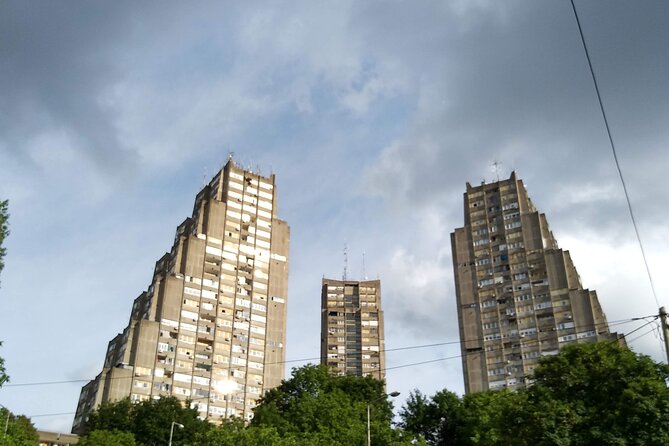
- Rudo (Eastern City Gate): Brutalist Socialism in Three 85-Meter Apartment Towers
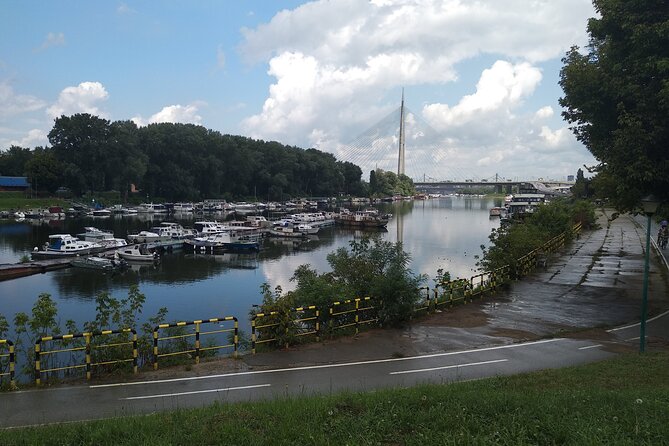
- Ada Bridge: A High-Pylon Engineering Moment Over the Sava River
- Sava Center: Polyhedral Design Built for the 1977 Security Conference
- Palace of Serbia: Late Modernism and a Government-Era Identity
- Genex Tower (Western City Gate): Mihajlo Mitrović’s Brutalist Skyline Connector
- Price and Logistics: Why $175 Per Group Can Be Fair Value
- Who This Tour Suits Best (and Who Might Skip It)
- Should You Book This Private Space Architecture Tour?
- FAQ
- How long is the Private 4 Hours Space Architecture Tour?
- Is this tour private?
- What group size is allowed?
- Do you get pickup and drop-off?
- Is the tour offered in English?
- Are entrance fees included?
- What stops are included in the tour?
- Does the 4-hour duration include travel time between stops?
- What is the operating time window?
- What’s the cancellation policy?
Key Highlights I Think Are Worth Your Time
- Avala Tower observation deck included, with a war-and-rebuild backdrop
- Private vehicle with pickup and drop-off, so you’re not stitching together transit
- Brutalist landmarks like Rudo (Eastern City Gate) and Genex Tower (Western City Gate)
- Ada Bridge engineering crossing over the Sava, with a standout design claim
- Sava Center polyhedral structures tied to the 1977 European security conference
- English-speaking professional guidance from architects and history-minded storytellers
The Real Deal: A Private 4-Hour Architecture Route That Actually Works
This is the kind of tour that makes Belgrade’s modern architecture easy. You get picked up from your address in an air-conditioned vehicle, ride between locations, then drop off back where you started. Since transportation time is included in the 4-hour total, you’re not losing the afternoon to logistics.
The group size is up to 3, which matters. With a small group, the guide can pace the stops, answer questions, and steer you toward what’s worth seeing up close. It also helps if you’re picky about details, like why these buildings look the way they do and what they tried to say to the world.
There are also practical wins built into the plan: most stops include short on-site time (often around 5–20 minutes). That means you get variety without feeling stuck at one spot too long. The tour runs every day during opening hours (9:00 AM–5:00 PM), so you can slot it between other city plans.
If you’re hoping for an easy “greatest hits” architecture day, this delivers. If you’re expecting deep museum time and long indoor visits, you might find the pacing a bit brisk—though the focus is on major landmarks and what you can learn from them.
You can also read our reviews of more tours and experiences in Belgrade.

Avala Tower: The War-Rebuilt Viewpoint From Belgrade’s Tallest Mountain
Avala Tower is where the day gets dramatic. The ride from the city center takes about 30–45 minutes, and once you arrive you climb into one of Belgrade’s most iconic viewpoint moments. Admission to the observation deck is included, and it’s not just about the view.
Here’s the key detail that makes it hit harder: the tower was destroyed in NATO bombing in 1999, and it was resurrected from the ruins in 2010. That history changes the way you look at it. You stop seeing a single landmark and start seeing a symbol—reconstruction as a statement.
What I’d pay attention to:
- How the tower’s height changes the city’s “geometry” in your head.
- The way you can scan neighborhoods and rivers and understand the scale of the places you’ll visit later.
- The sense that this is a Belgrade story written in concrete, fire, and rebuilding.
Practical tip: wear something warm enough for windy viewpoints. Even if Belgrade feels mild, towers can feel colder at the top. And bring your camera—you’ll want to frame the skyline, not just snap random shots.
Rudo (Eastern City Gate): Brutalist Socialism in Three 85-Meter Apartment Towers
Next you head to the Eastern City Gate, officially called Rudo. This stop is short (around 20 minutes), but it has serious visual power. The complex is made of three large residential buildings that rise to 85 meters, built in a brutalist style.
Brutalism can feel blunt if you don’t know what to look for. That’s where a good guide changes everything. You learn to read the buildings like sentences: the massing, the repeated forms, and the plain confidence of materials. This complex is considered one of Belgrade’s symbols and also tied to Yugoslav Socialism more broadly, which gives context for why it looks the way it does.
What makes this stop valuable for you:
- It shows how ideology can become architecture—without subtlety.
- You get a real “modern Belgrade” landmark in a short time window.
- You can compare it in your mind to other stops later in the day, especially the skyline statement of Genex.
If you like architecture that’s more about form and message than ornament, Rudo is a strong match.
Ada Bridge: A High-Pylon Engineering Moment Over the Sava River
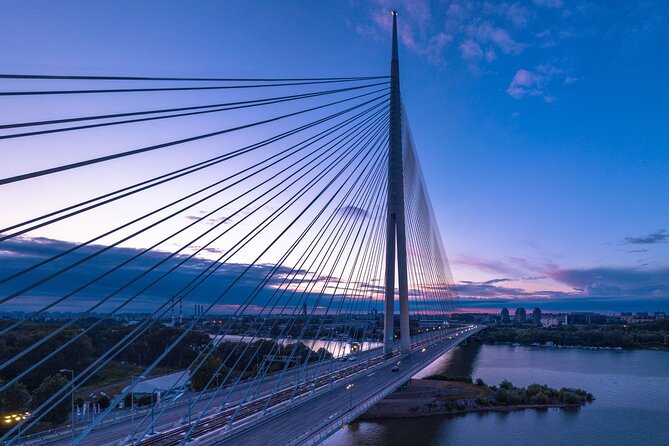
Ada Bridge is quick to reach—about 10–15 minutes from Rudo—and that short drive makes the stop feel like a clean break. You cross the bridge over the Sava River, and it’s notable for two reasons.
First, it’s presented as a standout engineering achievement, including a claim that its construction was shown on Discovery Channel. Second, it’s described as the highest single-pylon bridge in Europe. Even if you don’t care about stats, the bridge design is easy to read: the structure dominates your view as you move across it.
Why this stop works inside an architecture tour:
- It adds engineering to the mix, not just buildings.
- It lets you experience structure in motion, which changes how it feels.
- It ties the day’s “modern future” theme together.
Practical tip: if you want photos, have your camera ready before the bridge portion starts. You often get only brief windows to shoot angles, and the best shots come when you’re already moving.
Sava Center: Polyhedral Design Built for the 1977 Security Conference
Sava Center is where the tour gets really “space architecture” in spirit. The complex was built for the 1977 Conference on European Security and Cooperation in Belgrade, and it’s described as the first and biggest conference center in former Yugoslavia. That’s not trivia; it shapes how you understand why the buildings look futuristic.
You’ll spend about 15 minutes here, including time to examine the structural design of its polyhedral buildings. This is the kind of architecture where geometry becomes the message. The shapes aren’t just decorative—they’re part of how the structures are conceived.
What to look for:
- How the polyhedral forms create a “designed complexity” instead of a simple box.
- The way conference architecture tries to look official, modern, and internationally credible.
- How a complex like this feels different from residential brutalism.
If you’re the type of traveler who likes to connect dates to buildings, Sava Center is made for you. The year alone turns the stop into a historical anchor: a city presenting itself to the international stage.
Palace of Serbia: Late Modernism and a Government-Era Identity
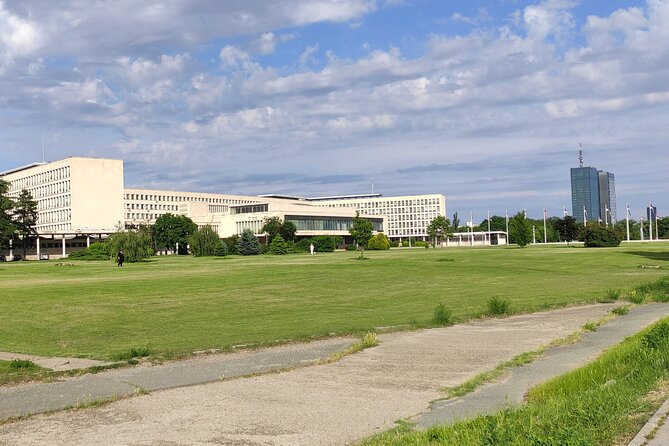
From Sava Center, you reach the Palace of Serbia in just about 5 minutes. This is an exterior stop of around 15 minutes, but it’s packed with meaning if you let the guide walk you through it.
The building is the former Federal Executive Council. It’s described as late modernism that shows how design can represent ruling ideology. It’s enormous but still elegant, and it was the first project of New Belgrade after WWII—so it’s not only about aesthetics, it’s about the city’s postwar direction.
What makes this stop click:
- You’re seeing how political power wanted to look: big, confident, modern.
- You’re connecting “New Belgrade” development to specific architecture choices.
- You get a strong contrast with the brutalist apartment blocks you saw earlier.
If you’re worried this will feel abstract, don’t. Palace of Serbia is visually persuasive on its own—you just need context to read it properly.
Genex Tower (Western City Gate): Mihajlo Mitrović’s Brutalist Skyline Connector
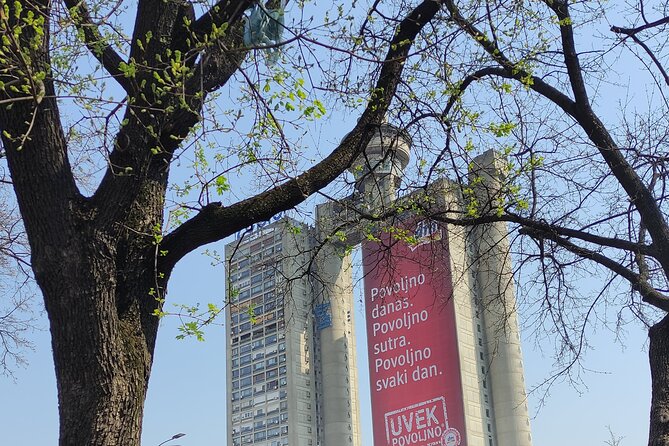
The last major architectural statement is Belgrade Western Gate, also known as Genex Tower. You get there in about 10 minutes, then spend around 15 minutes at the landmark.
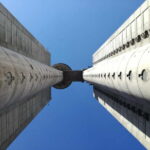
Genex Tower is a 36-story skyscraper designed in 1977 by Mihajlo Mitrović in a brutalist style. The structure is formed by two towers connected with a two-story bridge. That “bridge between the towers” is what makes it more than two separate slabs—it’s a whole composition.
This is the stop that often leaves people with a satisfied feeling of closure. By the time you see Genex, you’ve already learned to spot brutalism’s logic: mass, repetition, and the confidence of visible structure. Now you see that logic expanded into a skyline centerpiece.
Practical tip: try to angle your photos so you capture both towers and the connection. It’s the detail that explains the design, and it’s easy to miss if you only shoot a straight-on shot.
Price and Logistics: Why $175 Per Group Can Be Fair Value
At $175.14 per group (up to 3), this tour can feel like a splurge—until you price it correctly. You’re paying for a private guide, air-conditioned transport, pickup and drop-off, and entrance fees included. That matters because several stops are not just “quick photo stops.” One location (Avala Tower) includes an admission ticket, and the rest of the day is structured around sites spaced out enough that DIY logistics get annoying fast.
Also, the tour is paced for learning. A good guide doesn’t just narrate. They explain why these buildings exist, how Yugoslavia wanted to project modernity and power, and what design choices meant socially. On previous versions of this experience, guides like Stefan (with history degrees) and Novica (story-driven and energetic) are the kind of people who make you look longer, not just pass through faster. Drivers like Milos are also praised for calm, safe handling.
So who gets value?
- A small group of friends who want a shared “architecture lesson.”
- Couples who like private tours more than crowded group buses.
- Anyone who hates the hassle of getting to far-flung modern sites on public transport.
Who might think twice?
- If your budget is tight and you’re fine spending extra effort on transit and finding your own routes, DIY can be cheaper.
- If you only want old-town highlights, you may feel the tour is “too modern.”
But for what you’re buying—time saved, entry included, and a guide who connects design to context—this is often a solid deal.
Who This Tour Suits Best (and Who Might Skip It)
I’d put this tour at the top of your list if you care about any of these themes:
- Brutalist architecture and Yugoslav-era modernism
- Engineering and conference-era “future” building design
- A structured way to see Belgrade beyond churches and river promenades
- A day with a small group where your questions get real answers
It’s also a great choice if you’re already interested in architecture, but you want it explained in plain language. The guiding style here tends to be friendly and story-forward. Some guides you might get include people like Nemanja, Mihailo, and Milos, and the common thread is strong enthusiasm for how Serbia and Yugoslavia shaped these spaces.
If you’re traveling with kids or older family members, it can work well because the itinerary is short per stop and the ride between places is handled for you. Still, wear comfortable shoes. Even 5–20 minutes of standing and walking around a viewpoint or plaza adds up.
Should You Book This Private Space Architecture Tour?
I’d book it if you want Belgrade to feel modern, political, and engineered in one focused day. The mix of Avala Tower’s rebuilt history, brutalist symbols like Rudo, the Sava River engineering of Ada Bridge, and the structured geometry of Sava Center is exactly the kind of combo that makes a city feel like more than a postcard.
Skip it only if your must-see list is purely medieval or museum-based, or if you’re not interested in learning why architecture can carry ideology. Otherwise, this is one of the smartest ways to spend half a day on Belgrade’s 20th-century “shape” and meaning.
FAQ
How long is the Private 4 Hours Space Architecture Tour?
It lasts about 4 hours.
Is this tour private?
Yes. It’s a private experience, and only your group participates.
What group size is allowed?
The price is per group up to 3 people.
Do you get pickup and drop-off?
Yes. Pickup is offered from your address, and you’ll be dropped off back at your accommodation.
Is the tour offered in English?
Yes, it’s offered in English.
Are entrance fees included?
Yes. Entrance fees are included in the tour price.
What stops are included in the tour?
You’ll visit Avala Tower, Eastern City Gate of Belgrade (Rudo), Ada Bridge, Sava Center, Palace of Serbia, and Belgrade Western Gate (Genex Tower).
Does the 4-hour duration include travel time between stops?
Yes. Transportation time is already included in the total duration.
What is the operating time window?
The tour runs daily, Monday through Sunday, from 9:00 AM to 5:00 PM.
What’s the cancellation policy?
You can cancel for a full refund up to 24 hours in advance of the experience start time. If you cancel less than 24 hours before, the amount paid is not refunded.