
REVIEW · NEW DELHI
New Delhi: Mughal’s architecture tour with transfers
Book on Viator →Operated by Go City Adventures · Bookable on Viator
Morning can feel wild. This day turns chaos into a clean route of Mughal landmarks and major Delhi sights. You’ll go from Old Delhi’s grand mosque energy to Mughal mausoleum gardens, with air-conditioned transfers and a guide adding context as you travel.
I like that the tour is built around real must-sees—Jama Masjid at the start, then the Red Fort complex, followed by two more UNESCO stops that show off different eras and styles. I also like that the company provides hotel pickup and drop-off, plus an AC vehicle with WiFi, so you’re not just stuck in traffic guessing what to do next. Guides can include English support, and some groups have been led by Suraj, who’s been described as organized and great at handling special requests.
One drawback to plan for: entry tickets aren’t included (and lunch is only included if you choose the optional upgrade). Also, pickup details can depend on your hotel info, and one past experience flagged that they didn’t get all the expected pickup specifics in advance—so it’s smart to confirm pickup time and vehicle details the day before.
In This Review
- Key highlights you’ll feel right away
- A well-run Mughal route: how the day stays organized
- Price and tickets: what you’re really paying for
- Stop 1: Jama Masjid first thing in the day
- Red Fort next door: where Mughal power feels physical
- Humayun’s Tomb: Mughal architecture you can slow down with
- Qutub Minar: finishing strong with Delhi’s tallest brick minaret
- Transfers, timing, and how to avoid the common Delhi fatigue
- Lunch, food, and shopping: where you get real Delhi energy
- The guide matters: what to expect from the human side
- Who should book this tour (and who should skip it)
- Should you book? My practical verdict
- FAQ
- What’s the duration of the New Delhi Mughal architecture tour with transfers?
- Does the tour include hotel pickup and drop-off?
- Are entrance tickets included in the price?
- Is lunch included?
- How much walking should I expect?
- Can I cancel for free?
Key highlights you’ll feel right away
- AC transfers + WiFi make the long ride days easier on your feet and patience.
- A guide in your chosen language helps you make sense of Mughal architecture instead of just taking photos.
- Hotel pickup and drop-off saves time, especially when Delhi traffic is doing its own thing.
- The route hits UNESCO sites in a tight sequence: Jama Masjid, Red Fort area, Humayun’s Tomb, and Qutub Minar.
- You’ll have time for a nearby lunch break and optional shopping once the main sights wrap up.
- It’s a private experience for your group, so you can go at a pace that works for you.
A well-run Mughal route: how the day stays organized
This is a full-on sightseeing day that’s designed to cover a lot without you needing to map, bargain, or second-guess logistics. The idea is simple: you get a private guide, an AC vehicle with WiFi, and a plan that moves you between Old Delhi and New Delhi efficiently.
Expect a mix of heavy-stare architecture moments and practical pause points. There’s a morning start at Jama Masjid, a large historic stop at the Red Fort, then Humayun’s Tomb, and finally Qutub Minar. Between those blocks, you get transfer time plus room for lunch or shopping.
The tour also lists a smart casual dress code and notes you should have moderate physical fitness since there’s a moderate amount of walking. Translation: wear shoes you can walk in for a couple hours total, not your “pretty but painful” pair.
You can also read our reviews of more tours and experiences in New Delhi.


Price and tickets: what you’re really paying for
The headline price is $32 per person for roughly 6–7 hours, which is good value for what’s included: pickup and drop-off, an AC car with WiFi, and a guide.
But here’s the key catch. Entrance tickets are not included, listed as INR 2150 per person. There’s also an optional upgrade that can include lunch and entrance fees (depending on what you select). So the best way to think about the cost is: you’re paying for the guided route and transfers, and then you’ll budget for site entry separately.
If you want the smoothest day with fewer payments and less decision fatigue, the optional upgrade can be worth it. If you prefer to control lunch choices and keep flexibility, you can skip it and use the free time for your own meal plan.
Stop 1: Jama Masjid first thing in the day
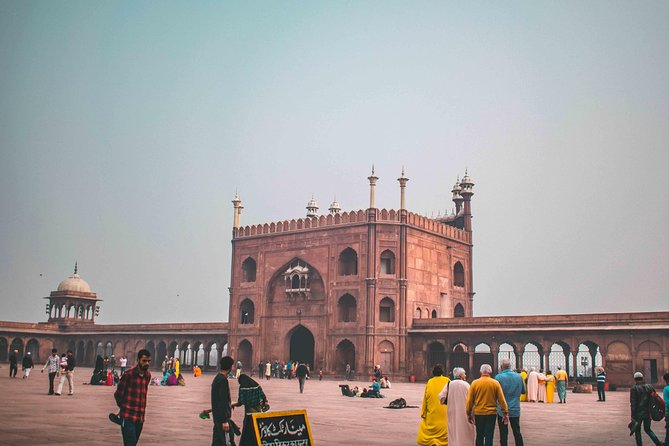
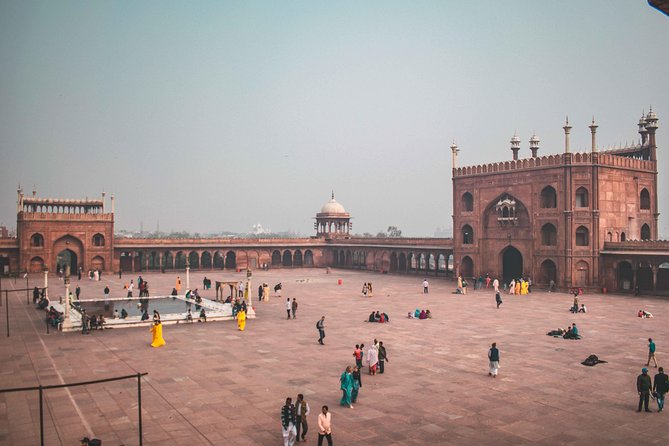
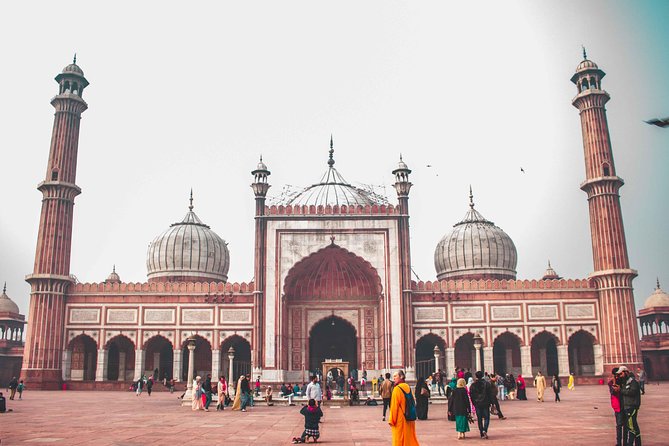
Starting at Jama Masjid in Old Delhi is smart. The mosque is described as one of India’s biggest and best-known, built in the 17th century by Emperor Shah Jahan. Going early also helps you catch a calmer atmosphere before the crowds build too much.
What you’ll do here is more than “look at a building.” This stop is time to:
- admire the scale and craftsmanship,
- look closely at architectural details,
- watch daily life and prayer in a working religious space.
You’re given about 1 hour for Jama Masjid. Admission tickets are listed as not included here, so keep that in mind for your budget. The dress code note matters more at religious sites like this. Plan on clothing that’s comfortable but appropriate, and you’ll be able to focus on the architecture instead of adjusting your outfit all day.
Red Fort next door: where Mughal power feels physical
From Jama Masjid, you head to the adjacent Red Fort, a UNESCO World Heritage Site and a major symbol of India’s long historical arc under Mughal rule. The Red Fort is also strongly tied to Shah Jahan, and it served as the Mughal rulers’ main home for nearly two centuries.
You’ll get around 2 hours here. That’s enough time to see:
- opulent interior rooms (as you’re guided through what to look for),
- fine marble work and carvings,
- expansive gardens and the fort’s overall layout.
One thing I like about placing this stop after the first mosque moment is contrast. Jama Masjid is about religious grandeur and community life; Red Fort is about royal presence and state power. A good guide helps you read those differences in real time instead of treating everything as “old stuff you’ll forget later.”
As for food, the plan builds in a lunch break at a nearby restaurant in the area. You’ll have time to sample street food or true Mughlai cuisine in the neighborhood. Just remember: lunch is not automatically included unless you choose the optional upgrade.
Humayun’s Tomb: Mughal architecture you can slow down with
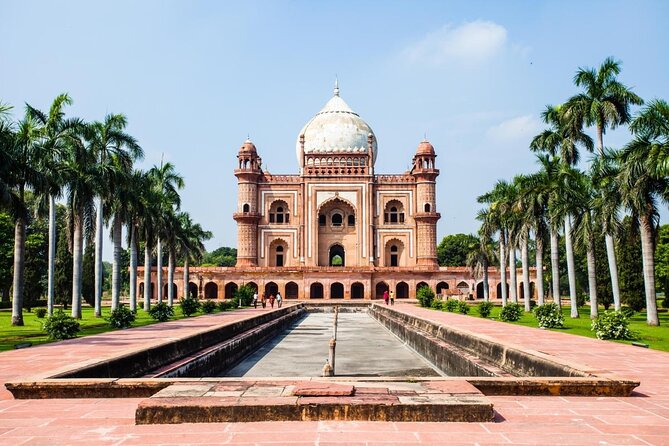
After lunch, you travel to Humayun’s Tomb, another UNESCO site and one of the most well-known Mughal monuments in Delhi. The story attached to the place is clear: it was commissioned by Empress Bega Begum in the 16th century as a mausoleum for Humayun.
This is where the tour leans into “take your time.” You’re scheduled for 1 hour 30 minutes, and the experience is meant to be quietly impressive:
- detailed marble work,
- water features and a calmer feel,
- the broader garden setting that helps you understand the Persian-inspired Mughal style.
The tour highlights Charbagh—the Four Quadrant Garden concept—so you’re not just walking through a pretty enclosure. You should use the guide to understand how the garden layout shapes the whole experience. It’s a great stop if you like architecture that’s designed for both viewing and breathing room.
If you’re sensitive to heat, midday timing matters, so bring water and wear breathable layers. The walking is still “moderate,” but tomb and garden areas mean you’ll be on your feet for stretches.
Qutub Minar: finishing strong with Delhi’s tallest brick minaret
To wrap up the day, you go to Qutub Minar, a UNESCO World Heritage Site and the world’s highest brick minaret. This is the moment where Delhi’s architectural timeline feels layered.
The tower is tied to Qutb-ud-din Aibak, the first ruler of the Delhi Sultanate, and the minaret’s construction is dated to the 12th century. That matters because it adds context: you’re seeing something that predates the Mughal era even as the rest of the day focuses heavily on Mughal design.
You’re allocated about 2 hours for this final stop. That time is useful because Qutub Minar isn’t just one object. The area has enough to look at that a guide can point out what to notice without rushing you through.
Once the main sites end, the plan includes flexibility: you can return to your lodging or take in local markets for shopping and dining. If you’re the type who likes to buy one or two useful things (spices, small souvenirs, a light scarf for later), this is a good slot.
Transfers, timing, and how to avoid the common Delhi fatigue
This kind of day can be exhausting only if you prepare wrong. Here’s what helps:
- Use the car time: AC with WiFi is included, so you can rest between stops instead of burning energy on directions.
- Plan for moderate walking: the tour explicitly calls for moderate fitness. Wear comfortable shoes and keep an extra layer handy if you’re sensitive to sun or AC blasts.
- Dress smart casual: it’s mentioned for the tour, but it also helps you fit in at religious and historic sites.
- Bring your entry-ticket budget: since entrances are not included, you don’t want to reach a gate and start panicking over currency.
Also, because the tour is private (only your group participates), you can ask your guide questions as you go. Some guides are better than others at slowing down for non-native listening, and one past experience noted needing the guide to speak a bit slower at first. If you have any listening preferences, it’s totally fair to ask early.
Lunch, food, and shopping: where you get real Delhi energy
Lunch is a built-in break in the middle of the day, and it’s connected to the Old Delhi area near the Red Fort. The plan encourages trying street food or Mughlai options nearby.
Here’s the practical way to handle it:
- If you have dietary restrictions, you should inform the provider when booking.
- If you skip the optional upgrade, you’re choosing lunch yourself, so you can match your food comfort level.
- Don’t overpack your lunch with “spicy experiments” if you’re heading to more walking right after.
Once Qutub Minar is done, the tour offers time to shop and snack. Delhi markets can be fun but overwhelming. Going with a guide for the architecture first means you’ll spend that extra time more intentionally.
The guide matters: what to expect from the human side
A tour like this rises or falls on the guide’s ability to explain what you’re seeing. This experience includes a private guide and you can pick your language.
Some groups have mentioned Suraj specifically for being knowledgeable, kind, and very organized. Others have praised how professional and well-executed the day felt, especially when the guide adds extra details beyond basic site explanations.
So what should you do? Use the guide as your translator, not just your selfie stick. Ask what architectural feature you’re looking at and why it’s important. That’s where the architecture tour stops being “pretty stones” and becomes a story of power, faith, and design choices.
Who should book this tour (and who should skip it)
You’ll likely love this tour if you want:
- a structured day covering multiple major sights,
- guided context for Mughal and earlier Delhi architecture,
- comfortable transfers with pickup/drop-off and an AC vehicle.
It might be less ideal if you:
- hate walking or time outdoors in the middle of the day,
- strongly dislike paying separate site entry fees,
- want totally free-form wandering with no schedule at all.
If you’re traveling with a group and prefer a private plan, this fits well because it’s not a mixed large group where you’re waiting for the slowest person to find their shoe.
Should you book? My practical verdict
If your goal is to see the “Delhi big four” of historic architecture in one day—Jama Masjid, Red Fort, Humayun’s Tomb, and Qutub Minar—this is a strong option. The value comes from the combo of AC transfers, hotel pickup/drop-off, and a guide. The route is efficient, and the stops are chosen so you get both religious grandeur and Mughal state monument design.
Just treat entry tickets (INR 2150 per person) as part of your real budget, and consider the optional upgrade if you’d rather avoid splitting lunch and payments into separate decisions. If you do book, I’d also recommend you confirm pickup time and vehicle details in advance so your morning stays smooth.
FAQ
What’s the duration of the New Delhi Mughal architecture tour with transfers?
The tour runs for about 6 to 7 hours.
Does the tour include hotel pickup and drop-off?
Yes. Pickup and drop-off in Delhi are included.
Are entrance tickets included in the price?
No. Entrance tickets are not included and are listed as INR 2150 per person.
Is lunch included?
Lunch and entrance fees are available as an optional upgrade. Without the upgrade, food and drinks are not included.
How much walking should I expect?
The tour notes a moderate amount of walking, so a moderate physical fitness level is recommended.
Can I cancel for free?
Yes, you can cancel for free up to 24 hours in advance for a full refund.