REVIEW · BARCELONA
The wonders of architecture 2 hours on foot in Barcelona
Book on Viator →Operated by Barcelona Autrement · Bookable on Viator
Barcelona’s buildings tell real stories.
This 2-hour architecture walk is built for people who like color, contrast, and details without a museum day. I love how the guide (often Florence, and also Valérie) keeps Barcelona’s architecture understandable and fun, with lots of street-level context and even practical tips for your stay. I also love the small group setup (max 10), which makes it feel relaxed instead of rushed through photo stops.
One thing to consider: the tour is fast and on foot, and many stops say admission tickets are not included. If you want to go inside everything, you’ll likely need to plan extra time and tickets separately.
In This Review
- Key highlights at a glance
- Barcelona architecture, explained for people who just want to see more
- Where the walk starts: Plaça de Ramon Berenguer el Gran to the modern city edge
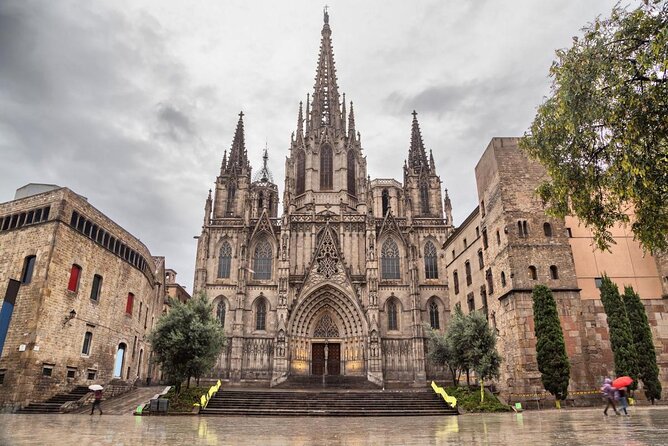
- Barcelona Cathedral: details and construction stories without a ticket
- Palau de la Música Catalana: myth-making and architecture you can read
- Placa Catalunya: the city switch you can feel
- The Champs-Élysées vibe in Barcelona: a grand boulevard moment
- Casa Lleó i Morera: one of the Apple of Discord challengers
- Casa Amatller: another Apple of Discord house with a different attitude
- Casa Batlló: Gaudí’s imagination in full view
- The 2-hour structure: quick stops done the smart way
- Value check: what you’re paying $29.67 for (and what you’re not)
- Guide style matters: Florence and Valérie bring the city down to earth
- Accessibility and who should join this walk
- Should you book this Barcelona architecture walk?
- FAQ
- How long is the architecture tour?
- Where does the tour start and end?
- What time does it start?
- Are admission tickets included?
- Is the tour done in a small group?
- What kind of ticket do I need?
- What language are the guides using?
- Do I need good weather?
Key highlights at a glance
- Small group feel (up to 10 people) so you can ask questions and keep pace together
- Architecture spans eras, from medieval-looking Barcelona Cathedral to the Gaudí era
- Catalan culture storytelling, including references and even founding myths tied to Catalonia
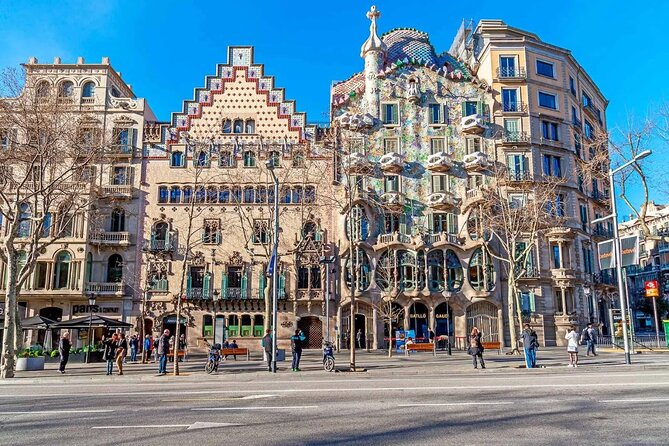
- Apple of Discord houses: Casa Lleó i Morera, Casa Amatller, and Casa Batlló side-by-side
- Easy plan for a half-day, with a route that moves from old city to the modern boulevard area
Barcelona architecture, explained for people who just want to see more
Barcelona does not do architecture politely. It does it loudly: sharp lines, playful shapes, and facades that seem to argue with each other. This tour matches that energy with a simple format: you walk, you stop, you look closely, and your guide turns what you see into a story you can actually remember.
You’re not stuck staring at buildings for hours. Instead, you get a quick hit of context at each stop—medieval times, then the Catalan cultural revival vibe, and finally the modernism era that includes Gaudí. The best part is that you’re learning while you’re still moving through the city, so the architecture starts feeling like part of Barcelona’s everyday life, not something sealed behind ropes.
You can also read our reviews of more tours and experiences in Barcelona.


Where the walk starts: Plaça de Ramon Berenguer el Gran to the modern city edge
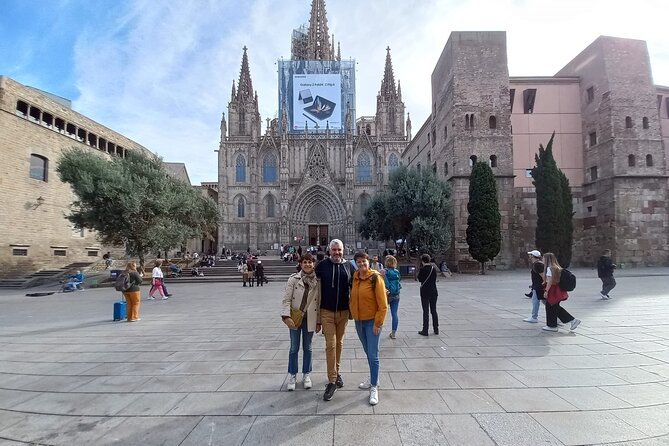
You begin near Plaça de Ramon Berenguer el Gran in Ciutat Vella. That matters because it sets the mood: you’re in the old-city zone first, where the streets feel built for walking and where architecture tends to crowd in close.
The tour also has a built-in “before and after” feeling. It pauses at Placa Catalunya, described as a border between old and modern Barcelona. In practice, it works like a mental reset: you’ve been looking at older forms and then you get guided toward the more showy modernist side of the city.
The ending point is Casa Batlló on Pg. de Gràcia, so you finish where the city’s modernism spotlight is brightest.
Barcelona Cathedral: details and construction stories without a ticket
The first major stop is Barcelona Cathedral. You get about 15 minutes here, focused on details and the anecdotes tied to its construction. Admission isn’t included, so this is a “learn by looking” stop rather than a full interior visit.
Why I like this approach: cathedral interiors can be stunning, but they can also swallow your time. By keeping the emphasis on the cathedral’s surrounding details and its build-story, you still leave with a clear sense of why it matters, without turning your whole morning into one long ticket line.
Practical tip: if you want to go inside, treat the guided stop as a pre-game. You’ll know what to pay attention to when you return.
Palau de la Música Catalana: myth-making and architecture you can read
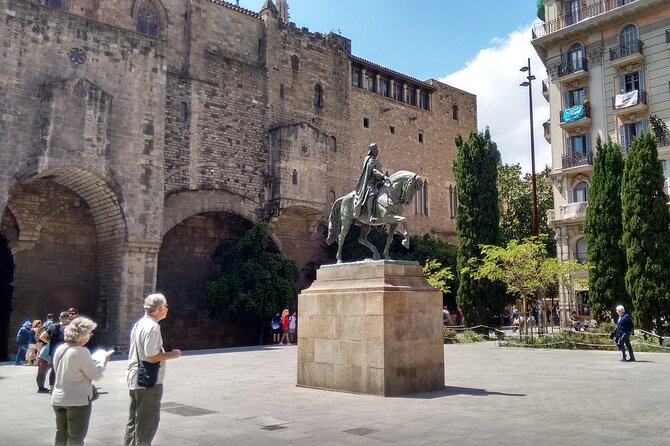
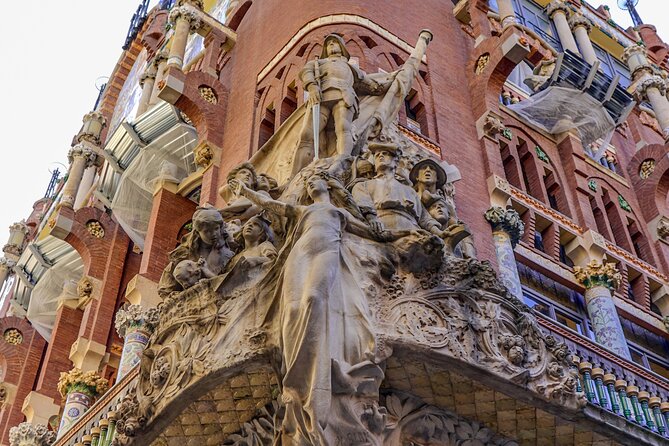
Next is the Palace of Catalan Music (Palau de la Música Catalana). Again, you get about 15 minutes and admission is not included. The focus is on the architecture itself—plus anecdotes and the founding myths connected to Catalonia.
This stop is valuable because it connects buildings to identity. You’re not just learning shapes. You’re learning why people in Catalonia wanted their culture to look a certain way in stone, ornament, and public space. That context makes the place feel more meaningful than a quick photo.
If you’re the kind of person who likes to understand what a place represents, you’ll enjoy this part. If you mainly want interiors, plan a separate visit later, since this tour keeps you moving.
Placa Catalunya: the city switch you can feel
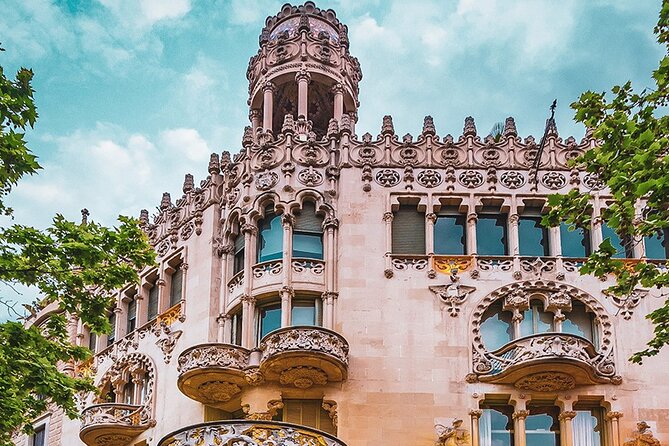
Then you hit Placa Catalunya—free, about 15 minutes. The tour treats this square like a dividing line between old and modern Barcelona.
Even without going deep on any single landmark, this stop is a smart travel tool. You pause at the point where Barcelona’s character shifts. It helps you connect the earlier medieval-focused sights with what comes next on the modernist stretch.
Think of it as: pause, reset your eyes, and prepare for a different style language.
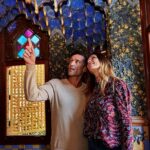


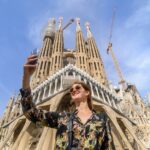
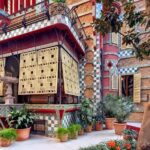

The Champs-Élysées vibe in Barcelona: a grand boulevard moment
There’s a stop described as The Champs Elysees in Barcelona. The idea here is simple: you get a sense of the grand boulevard energy where modernist facades sit in a row and the city feels more staged, more confident.
You’re moving toward the cluster of the most famous modernism addresses, so this segment works like a corridor. You’re mentally walking into the “competition” era of Barcelona architecture—when designers weren’t just building homes or landmarks, they were putting ideas on display.
Casa Lleó i Morera: one of the Apple of Discord challengers
Now you get to the famous trio people call the Apple of Discord, and the tour starts with Casa Lleó i Morera. This is a quick 10-minute stop, with admission not included.
The benefit of seeing it this way is that you’re not trying to process one building in isolation. You’re training your eye for the comparisons—how one facade answers another, how each one pushes a different look, and how the street turns into a kind of open-air design debate.
You also get the theme the tour highlights: architecture as part of the social story. The overview talks about the eccentricities of the bourgeoisie and the cultural attitude behind these buildings. Even in a short stop, the guide’s framing helps you look at the houses like statements, not just pretty shells.
Casa Amatller: another Apple of Discord house with a different attitude
Next is Casa Amatller. Same basic format: about 10 minutes, admission not included, but enough time to notice how the house participates in the same architectural conversation.
This is where I think the tour really shines for first-timers. Seeing all these facades close together means you don’t have to memorize technical design terms. Your brain starts doing the work of comparison naturally: what feels playful here, what feels bold there, and how the trio creates a whole “street experience.”
If you’re traveling with someone who loves architecture, this is the point where you’ll both start talking about details after the guide points them out.
Casa Batlló: Gaudí’s imagination in full view
Finally, you end with Casa Batlló, a 15-minute stop and the finish point at Pg. de Gràcia, 43. This one is clearly the centerpiece, since it’s tied to Antoni Gaudí.
The tour frames Casa Batlló as a “wonder,” which matches how it feels on the street: it doesn’t try to blend in. Even without entering, it’s designed to pull your gaze and keep it there. And because the tour has just compared it to the other Apple of Discord houses, it lands with extra impact—you can see it as both its own creation and part of that modernism lineup.
Admission isn’t included, so this is likely an exterior-focused experience. Still, exterior study is the right move on a walking tour. You get the building’s personality without needing to spend extra time managing tickets.
The 2-hour structure: quick stops done the smart way
This experience is about 2 hours on foot, with multiple stops. The timing per stop is fairly tight: roughly 10 to 15 minutes at each place.
That can sound like a drawback, but it’s also the secret to good value. You get the highlights of several major addresses without exhausting yourself. And because you’re stopping at the right points—cathedral, cultural palace, city border, then modernist houses—the route helps you understand the shift from one architectural era to the next.
If you’re planning the rest of your day, this format helps a lot. You can follow up with a longer interior visit to the one building that grabbed you most.
Value check: what you’re paying $29.67 for (and what you’re not)
At about $29.67 per person for roughly two hours, you’re paying for a guided walk with storytelling and time-saving context. That value gets even better because a tour like this can easily turn into “just walking around” if you don’t have direction.
What you are not paying for: admissions. Multiple stops explicitly note that admission tickets are not included. So the “all-in” budget depends on whether you want interiors.
Here’s how I’d think about it:
- If you want guided orientation plus exterior attention: the price feels fair.
- If you want to enter several of these places during the same trip: expect extra costs and extra time.
The good news is you finish at Casa Batlló, so if you decide you want more, you’re already there.
Guide style matters: Florence and Valérie bring the city down to earth
The overall vibe from real experiences is that the guides make Barcelona feel human, not like a textbook. Florence is repeatedly described as passionate and capable of telling the story in a natural, understandable way. There’s also a theme of humor and adaptability—your route can fit requests, and the guide doesn’t stop at buildings.
One standout detail: guides also offer practical suggestions beyond the architecture, like restaurant tips. That’s not just a nice extra. It helps you turn the tour into a better day, because you’re not left wandering around hungry later.
And weather happens. One experience notes the tour continued with good humor despite rain. For you, that means pack like a local for shoulder-season weather: a light rain layer and shoes that handle wet sidewalks.
Accessibility and who should join this walk
The tour says most travelers can participate, and it allows service animals. It’s also near public transportation, which is great for a morning start.
This is best for people who:
- like architecture but don’t want a slow, ticket-heavy itinerary
- want context quickly and then keep exploring on your own
- enjoy small-group guidance and conversation
It may be less ideal if you strongly prefer long indoor visits at each stop. This is designed as a street-focused architecture story, not a sit-and-stay museum plan.
Should you book this Barcelona architecture walk?
I’d book it if you want a clean, high-impact way to connect Barcelona Cathedral and modernism-era icons like Casa Batlló into one story. The route is short, but the thinking is smart: you learn to see comparisons, not just collect photos.
I’d hesitate only if your top priority is entering multiple buildings during the same 2 hours. Since admissions are not included at several stops, you’ll need extra planning if you want interiors.
If your goal is to get your bearings fast and leave with a better eye for what Barcelona is saying with its buildings, this tour is a solid choice.
FAQ
How long is the architecture tour?
It runs for about 2 hours on foot.
Where does the tour start and end?
It starts at Plaça de Ramon Berenguer el Gran in Ciutat Vella and ends at Casa Batlló on Pg. de Gràcia, 43 in L’Eixample.
What time does it start?
The start time is 10:30 am.
Are admission tickets included?
No. Several key stops list admission as not included, including Barcelona Cathedral, the Palace of Catalan Music, Casa Lleó i Morera, Casa Amatller, and Casa Batlló.
Is the tour done in a small group?
Yes. The group size is capped at a maximum of 10 travelers.
What kind of ticket do I need?
You use a mobile ticket.
What language are the guides using?
The tour description says guides provide the experience in French.
Do I need good weather?
Yes. The tour requires good weather. If it’s canceled due to poor weather, you’ll be offered a different date or a full refund.