
REVIEW · OXFORD
Oxford: 90 minute Architectural & Historical Highlights Tour
Book on Viator →Operated by Oxford History Tours · Bookable on Viator
Oxford has a way of making history feel personal. This 90-minute Architectural & Historical Highlights Tour gives you the fast, story-driven route that ties the buildings to the people. I like how the walk mixes big-name landmarks with lesser-spot details you’d otherwise miss, and you get a complimentary map and guidebook to keep exploring after the tour.
My second big plus: the guide makes the university feel understandable, not academic fog. Sophie (often referenced as Sophie D.) leads with clear storytelling, good humor, and practical recommendations for where to eat and drink. The main drawback to plan for is that you cover a lot on foot in about 1 hour 30 minutes, so you’ll want comfortable shoes and good weather.
In This Review
- Key highlights you’ll feel right away
- How a 90-minute Oxford route gives you real orientation
- Martyrs’ Memorial and St Michael at the North Gate
- Exeter College chapel, Lincoln College faces, and St Mary’s spire views
- Oriel and Corpus Christi: rowing pride and animal carvings
- Merton College gates and the Examination Schools
- Queen’s College and Oxford High Street: marmalade and early coffee culture
- New College gates, the Bridge of Sighs, and Sheldonian Theatre
- Libraries stacked on layers: Divinity School, the Bodleian, and Radcliffe Camera
- Balliol, and a quick look toward Christchurch
- What you get beyond the stops: map, guidebook, and food advice
- Pace, comfort, and the one realistic trade-off
- Who should book this Oxford highlights tour
- Should you book this Oxford Architectural & Historical Highlights Tour?
- FAQ
- How long is the Oxford Architectural & Historical Highlights Tour?
- Is pickup included?
- What does the tour cost?
- What language is the tour offered in?
- How big is the group?
- Is there any college entry included?
- Can you climb the spire at St Mary the Virgin?
- What happens if the weather is bad?
Key highlights you’ll feel right away
- A free walking tour with serious payoff: university architecture, history, and a medieval college stop
- Small group size (max 15) keeps the pace friendly and questions manageable
- Stained glass, chapels, spires, libraries: you see Oxford’s look and learn the why behind it
- Specific stories connect sites like Halley, Wren, the Bodleian, and the Bridge of Sighs to the city
- Real-world help: map, guidebook, and direct eat-and-drink recommendations
How a 90-minute Oxford route gives you real orientation
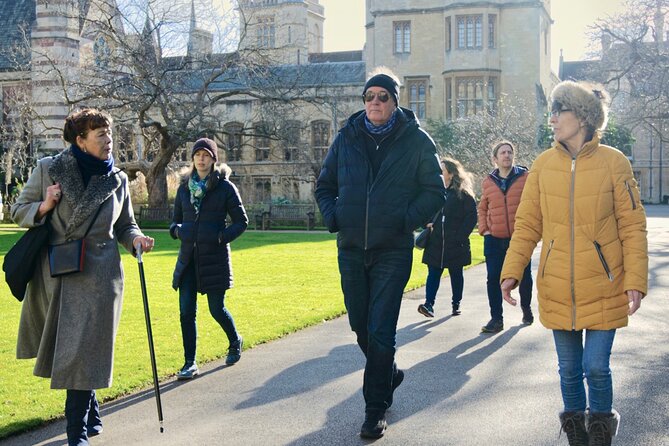
This is the kind of tour you take early in your Oxford stay—because it helps you read the city. In 1 hour 30 minutes, you’ll go from Reformation-era symbolism to Anglo-Saxon stonework, then into the living center of university life.
The value is unusual for two reasons. First, the price is listed as $0.00 per person, which makes this a budget-friendly way to see major sights without committing to a paid museum route. Second, you’re not just looking at facades. You’re getting the human thread: who lived here, what shaped the colleges, and why certain buildings were built the way they were.
The tour also stays practical. It uses a mobile ticket, offers pickup, and runs in English. The group stays small (up to 15), which matters in Oxford because the best points of view are often right on narrow streets and gates.
Martyrs’ Memorial and St Michael at the North Gate
You start with Martyrs’ Memorial, a Victorian monument tied to the Protestant martyrs of the 1500s. It’s a strong opening because it sets a theme: Oxford wasn’t only about scholarship. Religion, power, and conflict shaped what the city built and which ideas it carried forward.
Next is St Michael at the North Gate, an Anglo-Saxon tower that was part of the medieval city gate. Even if you’ve seen photos of Oxford towers, this one lands differently because you’re standing at a survival piece—something that likely represents the oldest building standing in Oxford today.
What I like about this opening sequence is the contrast. You get Victorian commemoration, then you step into very old stone. That contrast gives you a sense of time depth fast—Oxford isn’t old in a vague way. It’s old in specific layers.
Exeter College chapel, Lincoln College faces, and St Mary’s spire views
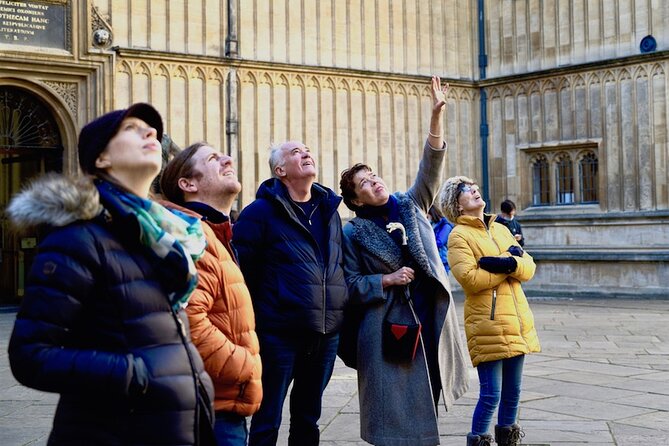
Exeter College is where architecture starts talking back through symbolism. You’ll learn about the college chapel and its inspiration, including the connection to the Oxford Movement and modeling on Paris’ St Chapelle. The point isn’t just style. It’s how ideas traveled and got adapted into Oxford’s religious world.
Then you pause at Lincoln College, with attention on its original face onto Turn Street. This stop is about origin stories—how the university’s early relationship with the city showed up in the buildings themselves. There’s also a lot of modern interest tied to Lincoln’s current fame, which helps you connect past to present without losing the thread.
After that, you reach the University Church of St Mary the Virgin. This is Oxford’s first university building, and it’s listed in the Doomsday Book. You’ll admire famous stained glass, hear how it connected to CS Lewis’s world, and you’ll also learn that it’s possible to climb the magnificent spire.
A quick planning note: spire climbs can be time-dependent, so if you care about that view, wear shoes you’re comfortable with and be ready for stairs.
Oriel and Corpus Christi: rowing pride and animal carvings
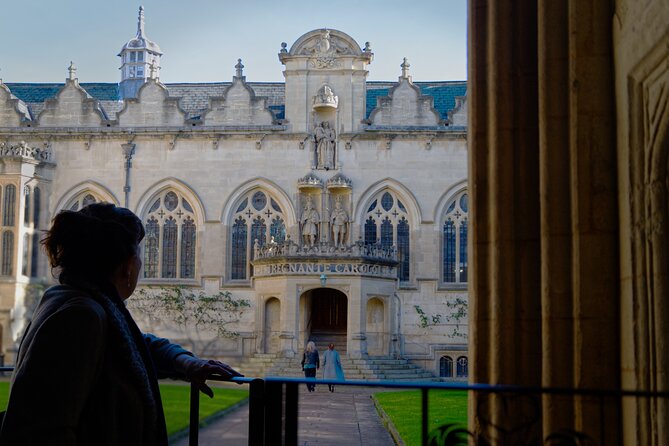
Oriel College brings a lighter, lively Oxford angle. Oriel is known for rowing, and the front Quad with Oriel windows is the kind of scene that makes you stop without needing to be told to. You also get a feel for the college’s neighborhood—Oriel is next to Corpus Christi, which hosts an annual tortoise race. That’s the sort of quirky tradition Oxford loves, and it makes the academic environment feel human.
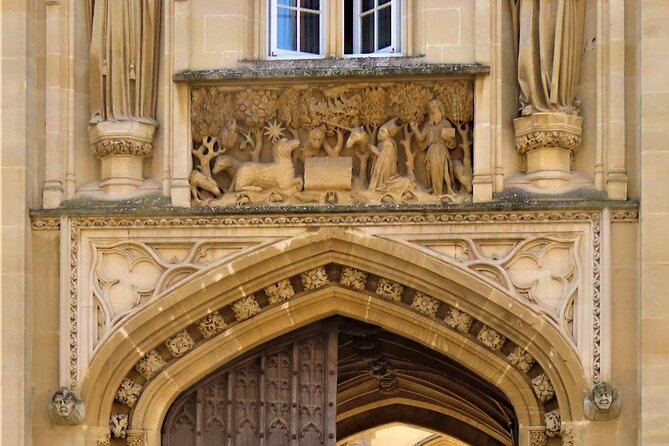
Corpus Christi gives you one of the more memorable visual moments: animal figures carved in its early 1500s architecture, including a pious pelican. This stop also highlights a cobbled street associated with the college, described as a national treasure. In other words, the charm isn’t only inside gates. It’s also in the approach.
If you like architecture that tells stories, this section is a win. Oxford does symbolic carving the way some cities do murals. You just need someone to point out what you’re looking at.
Merton College gates and the Examination Schools
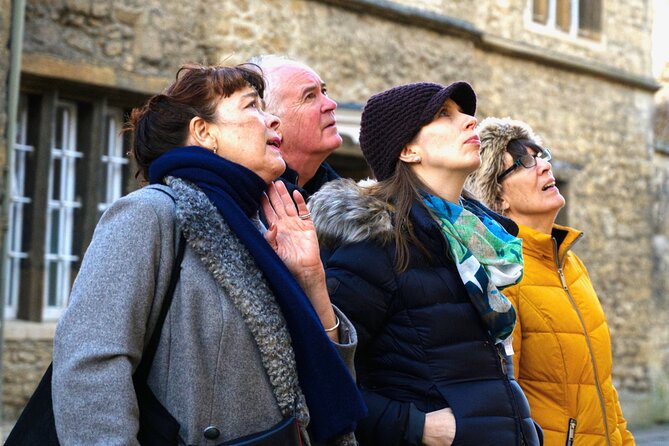
Merton College is a favorite stopping point because the gatehouse frieze tells the tale of how earlier colleges were founded. You’ll see a 15th-century frieze that frames the idea of building a university like a craft project passed down over time. It’s also one of those moments where a short stop feels like you saw something bigger than the time allowed.
From there, the Examination Schools marks Oxford’s shift toward organized learning as a public institution. You’ll learn about written exams starting in the early 19th century and how the Victorian building blends Jacobean and Tudor architectural styles. The tour frames it as a modern spirit of making education more available.
This section works especially well for first-timers. It connects the romantic college images with the real mechanics: how the university ran tests, how it formalized education, and how buildings reflected those changes.
Queen’s College and Oxford High Street: marmalade and early coffee culture
Queen’s College brings a story of education shaped by class and geography. You’ll hear it was founded for poor scholars from the north of England, and that a former student became wealthy enough to fund an 18th-century rebuilding with designs attributed to Christopher Wren and Nicholas Hawksmoor.
Then the tour turns toward Oxford High Street, the road to London, and points out details that help you “read” the street. Frank Cooper’s Marmalade was first made here and later became a worldwide fad. The tour also mentions England’s first coffee house tied to the return of Jewish people to the UK after earlier bans under the Cromwell period.
I like that this isn’t a dry list of famous names. It shows you how everyday Oxford commerce and global trends once started from ordinary city corners.
New College gates, the Bridge of Sighs, and Sheldonian Theatre
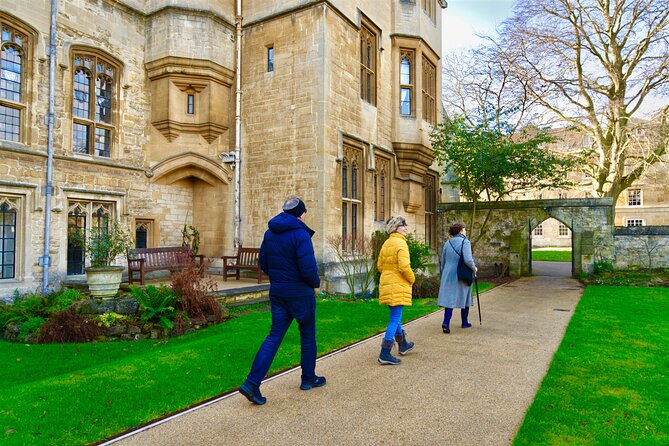
New College is about rebirth and resilience. You’ll learn how its gates tell the foundation story after the plagues of the 14th century. Even in a brief exterior stop, you can feel why gates matter here: they’re not just decorative. They’re statements about survival and order after chaos.
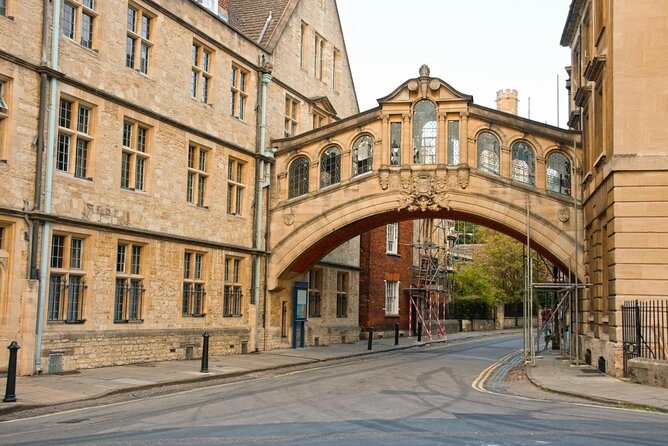
Next is the Bridge of Sighs, the iconic Hertford College bridge. It looks Venetian from a distance, but the tour notes it was built in the 20th century. That detail is key: Oxford borrows visual language, but the timing and context are its own.
Right nearby is also the connection to Edmund Halley, whose comet naming is linked to his house location in the area. Then you’ll reach the Sheldonian Theatre, a 17th-century setting for university ceremonies and believed (by the tour’s teaching) to be the first building by Christopher Wren. The guide also connects Wren to astronomy work at Oxford through the tour’s framing.
This part of the walk is great if you like “how did this come to be” stories. You see the famous silhouettes and learn the real timeline underneath them.
Libraries stacked on layers: Divinity School, the Bodleian, and Radcliffe Camera
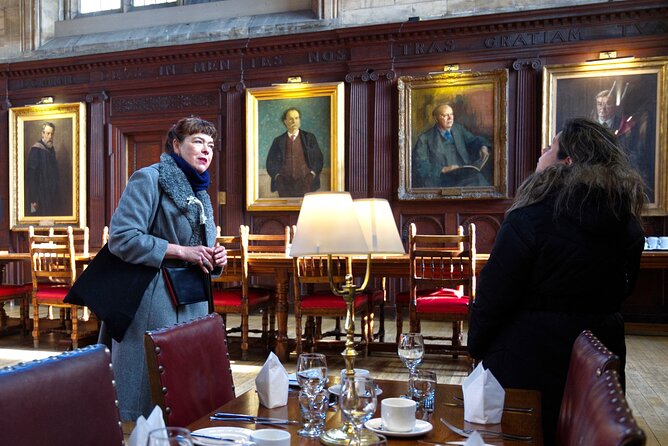
Oxford’s libraries are where the city’s seriousness shows up in stone. You’ll stop at Oxford Central Library, built on top of the medieval perpendicular Divinity School. The tour references the Duke Humphrey Library as a 15th-century home for a gift of over 200 books, and it notes that these rooms were selected for Harry Potter scenes.
Then comes the Bodleian Library. The tour frames what it is today—over 13 million books—while also explaining the origins and how it still functions. Even when you can’t take your time like you would inside a paid museum, this kind of storytelling helps you understand why the building matters to Oxford culture, not just to bibliophiles.
After that, Radcliffe Camera takes you into the science-library angle. The tour calls it Oxford’s first science library and tells you about one of its most eccentric and generous benefactors, Royal Physician Sir John Radcliffe. This stop is a reminder that Oxford’s research tradition isn’t a modern invention. It has older roots you can see.
Balliol, and a quick look toward Christchurch
Balliol College helps close the loop on how access to the university changed. You’ll learn that undergraduates started to have access to the university and its colleges, which is a big social shift, not just an administrative one.
The route also passes east of Christ Church. You won’t linger there for long, but you’ll get a nudge toward the Christchurch Picture gallery tucked behind the imposing eastern entry. If you’re the type who wants one extra indoor stop after the tour, this is a smart direction.
Taken together, these final minutes leave you with a feeling of momentum. You’ve seen the architecture, but you’ve also learned the pattern: Oxford changes access, changes ideas, and then puts those changes into buildings you can walk up to.
What you get beyond the stops: map, guidebook, and food advice
Two of the most practical extras matter more than they sound.
First, the tour includes a complimentary map and guidebook. In Oxford, a map is only useful if it helps you connect spots into a route. This one is designed for you to keep going after the walk ends.
Second, you’ll receive personal recommendations on where to eat and drink. That’s not just “check these places.” It’s help choosing based on what you’ve just seen—so you can plan a meal that matches your day, not your guide’s imagination.
If you’re short on time, these extras can be the difference between a random meal and a great one near the places you’ve actually learned to care about.
Pace, comfort, and the one realistic trade-off
This is a fast walk. The stops are brief and stacked close together, which is exactly what makes it ideal for first-time orientation. It’s also the trade-off.
If you want long interior visits, deep reading of tomb inscriptions, or extended time in one chapel, you’ll need to come back or add a separate visit. For many people, that’s fine—this tour sets you up with the context so your next visit isn’t just sightseeing.
Also, the tour requires good weather. If it’s canceled due to poor weather, you’ll be offered a different date or a full refund, so build your Oxford schedule with a little flexibility if you can.
Who should book this Oxford highlights tour
This tour fits best if you:
- Want a quick first look at Oxford’s most iconic university architecture
- Like stories behind buildings (not just facts read aloud)
- Are traveling with mixed ages and need a pace that stays interesting
- Appreciate practical guidance like food and drink recommendations
- Prefer a small group format (max 15)
It may not be ideal if you want a slow, museum-style day with long stops. In 90 minutes, you won’t “conquer” Oxford—you’ll learn how to navigate it.
Should you book this Oxford Architectural & Historical Highlights Tour?
If your goal is to get your bearings fast and leave with a stack of context you can use later, I’d book it. The free price combined with college entry and major library stops is strong value, even if you know you’ll return for deeper visits.
I especially recommend it if you’ll be in Oxford only briefly or if you want the city’s architecture explained with real-world connections—religion, education, famous figures like Halley and Wren, plus Oxford’s everyday culture like the Marmalade and early coffee house reference.
FAQ
How long is the Oxford Architectural & Historical Highlights Tour?
It runs for about 1 hour 30 minutes.
Is pickup included?
Pickup is offered.
What does the tour cost?
The price is listed as $0.00 per person.
What language is the tour offered in?
The tour is offered in English.
How big is the group?
The tour has a maximum of 15 travelers.
Is there any college entry included?
Yes, the tour includes entry to a medieval college.
Can you climb the spire at St Mary the Virgin?
The tour says it is possible to climb its spire.
What happens if the weather is bad?
This experience requires good weather. If it’s canceled due to poor weather, you’ll be offered a different date or a full refund.