REVIEW · BARCELONA
Gaudi’s Modernist Legacy: Small Group Walking Tour
Book on Viator →Operated by In Out Barcelona Tours · Bookable on Viator
Gaudí is everywhere, but this walk makes him readable. You follow the modernist trail from Passeig de Gràcia to the Sagrada Familia, with a guide turning architecture into something you can actually spot and understand.
I especially like the small group size (max 12), which makes it easier to ask questions and keep the pace human. I also love that you get clear explanations of the modernist movement as you go, not just a list of buildings. One possible drawback: if you’re expecting to enter everything (especially Sagrada Familia), you’ll want to match your expectations to what this walking format typically covers, and you should plan for time.
In This Review
- Key points you’ll care about
- Gaudí’s modernist storyline, told on foot
- Price and value: why $22 feels like a deal
- The route basics: from Carrer de Fontanella to Sagrada Familia
- Small group limits (max 12) make a real difference
- Stop 1 on Passeig de Gràcia: luxury street, modernist attitude
- Domènech i Montaner and the teacher-student thread
- The chocolate-makers house: where food and architecture intersect
- Casa Batlló: fantasy, color, and UNESCO-level private-house thinking
- The contrasting neighbor effect: Amatller and Lleó Morera
- Casa Milà (La Pedrera): nature, organic forms, and social needs
- A legend stop: St George and why Barcelona loves symbols
- The Sagrada Familia finale: light, emotion, and what to watch for
- Guide quality: the people you’re likely to meet
- Pacing and start times: how to plan around 2.5 hours
- Who should book this Gaudí modernism walk
- Quick practical tips before you go
- Should you book this tour?
- FAQ
- How long is the Gaudí’s Modernist Legacy small group walking tour?
- How much does the tour cost?
- How big is the group?
- Is the tour offered in English?
- Where does the tour start and end?
- What’s included in the price?
- Are food and drinks included?
- Do I need hotel pickup or drop-off?
- Is cancellation free?
- Are service animals allowed?
Key points you’ll care about
- Max 12 people keeps questions flowing and photos easier without constant crowd pressure.
- Passeig de Gràcia is the “main stage” for modernisme, so you see the contrast between neighboring façades.
- You learn the modernist movement while you walk, which helps you read Gaudí instead of memorizing facts.
- Casa Batlló and La Pedrera are key stops, tied to the story of Gaudí’s growth.
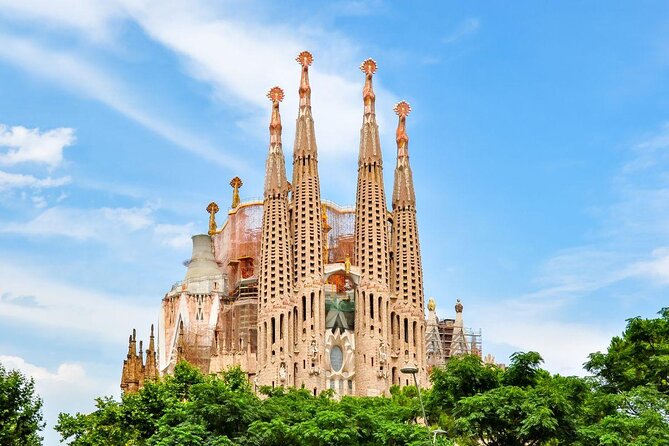
- Sagrada Familia is the emotional finish line, with lighting and symbolism explained as you admire it.
- Guides get praised for stories and practical tips, including restaurant recommendations in the feedback.
Gaudí’s modernist storyline, told on foot
This 2.5-hour walking tour is built for one thing: getting your bearings in Barcelona’s modernist architecture. Instead of jumping randomly between landmarks, you walk a connected route, so each stop answers the question, Why does this building look like that?
You’ll start on the classic elegance of Passeig de Gràcia, where the city shows off its best façades side by side. Then you move into the larger modernist story—how the movement formed in Barcelona, how Gaudí learned, and how he pushed forms toward nature, fantasy, and symbolism. The tour ends at Sagrada Familia, which is where the whole theme clicks: organic shapes, sculpted meaning, and light doing the heavy lifting.
If you like architecture but you don’t want a heavy textbook approach, this kind of guided walk is ideal. You’ll leave with mental “hooks” to recognize what’s modernist versus what’s just fancy. And you’ll have enough context to turn later visits—on your own—into something more satisfying.
You can also read our reviews of more tours and experiences in Barcelona.


Price and value: why $22 feels like a deal
At about $22.01 per person for roughly 2 hours 30 minutes, the value is less about buying entries and more about buying interpretation. You’re paying for a professional guide, a focused route, and explanations that make the buildings easier to understand quickly.
Here’s how I’d judge the cost: if you were to do this unguided, you might still see beautiful façades. But you would likely miss the connections—who influenced whom, why certain shapes were used, and how modernisme showed up across different buildings on the same avenue. That’s the part the tour sells.
Also, the group size matters here. You’re not paying a premium for “exclusive” access in a museum sense, but you are getting a guide-to-group ratio that helps you ask follow-up questions. When guides are sharp and the group stays small, $22 can feel like you’re cheating.
The route basics: from Carrer de Fontanella to Sagrada Familia
The tour starts at Carrer de Fontanella, 2 in Ciutat Vella and ends at Sagrada Família in Eixample. It’s a walking route, so you’ll want to wear shoes you’d actually walk in for a couple hours. This isn’t a “ride in comfort, look for 20 seconds” type of experience.
What’s nice: the meeting point is near public transportation, so you can connect it easily with the rest of your day. And the ending point at Sagrada Familia means you’re not left stranded across town; you’re dropped right where you’ll likely want to continue exploring.
If you’re trying to schedule the rest of the afternoon, treat this as a guided lead-in. You’ll see the major modernist landmarks, but you’ll also learn what to pay attention to later—details like façade symbolism, organic forms, and how the buildings relate to each other along the boulevard.
Small group limits (max 12) make a real difference
A max group size of 12 isn’t just marketing. On a street like Passeig de Gràcia, crowding can ruin your ability to see façade details. With a smaller group, you’re more likely to pause long enough to look instead of just keep moving.
That small size also helps with a more human pace. In the feedback, guides like Jose Carlos, Antonio, Montse, and Roberto are mentioned as friendly and passionate, and that usually goes hand in hand with a group that can actually ask questions. It’s one thing to get a standard script; it’s another to get a conversation where the guide can adjust to the group.
One more practical note: the better the guide, the more time they may spend on the “why.” That’s good for learning. But it can occasionally affect timing if the route runs long. Keep that in mind if you have a tight plan later.
Stop 1 on Passeig de Gràcia: luxury street, modernist attitude
Your walk begins where Barcelona turns fashionable and dramatic. Passeig de Gràcia is famous for beautiful houses and upscale shopping, and the modernist buildings along it are part of why the street feels like a fashion show.
This stop is about orientation. You’re not just looking at pretty façades; you’re learning how modernisme expresses itself in urban form—how individuality shows up in stone, ironwork, balconies, and ornament. You’ll also get inspiration for your own trip, including practical advice like where to eat nearby. Several guides in the feedback are praised for restaurant recommendations, which is a nice bonus after the walking portion.
If you’re into street-level Barcelona—the kind where you can watch daily life while studying architecture—this is the right opener. You get energy from the avenue and immediate visual context for what comes next.


Domènech i Montaner and the teacher-student thread
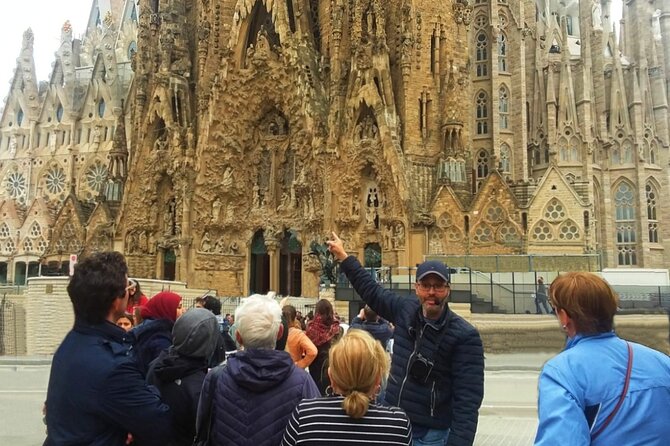
Next, you visit a house connected to Domènech i Montaner, described as Gaudí’s teacher at university. That connection matters because it changes how you see Gaudí.
Instead of treating Gaudí like a lone genius who appeared fully formed, you get a sense of intellectual lineage. Montaner’s influence helps you understand that modernisme wasn’t only about style; it was about ideas spreading through education, debate, and experimentation. Seeing that thread on the ground makes the story feel less theoretical.
Practical takeaway for you: when you spot more structured or academically minded design elements in modernist buildings, you can remember that Gaudí wasn’t working in a vacuum. He was adapting the tools he inherited, then pushing them into his own organic, symbolic direction.
The chocolate-makers house: where food and architecture intersect
You also stop at a modernist building tied to one of Barcelona’s chocolate-makers. This is the kind of stop that keeps the tour from feeling like a pure architecture lecture.
There’s a simple value here: you’re reminded that modernisme wasn’t only for palaces and grand monuments. It showed up in commercial and daily-life spaces too. A house associated with chocolate is an easy way to connect design to culture. Plus, there’s a practical opportunity at this point: you can buy good chocolate to take home.
If you like souvenirs that don’t feel like tourist clutter, this is a strong moment to shop. Just don’t wait until the end of your day; you’ll enjoy it more when you still have time to wander afterward without rushing.
Casa Batlló: fantasy, color, and UNESCO-level private-house thinking
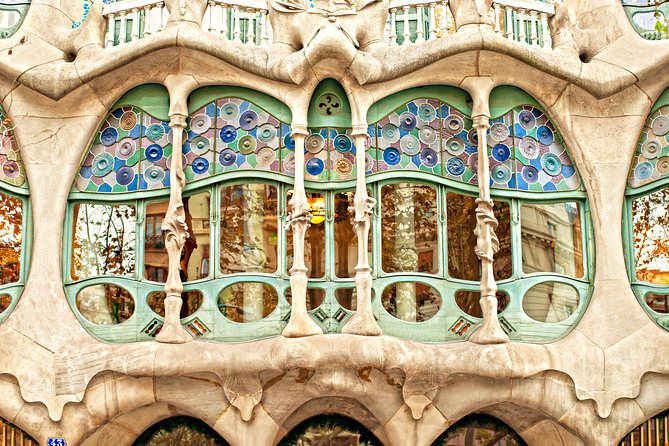
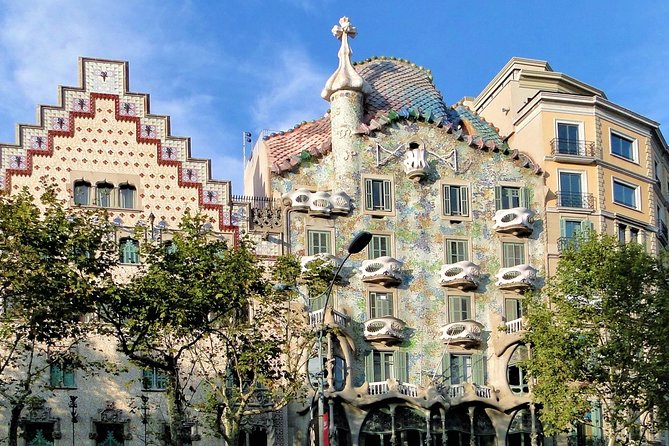
Then comes Casa Batlló on Passeig de Gràcia, one of the most eye-catching buildings in Barcelona. This stop is where the tour’s tone turns from introduction to “wow, okay, I get it.”
Casa Batlló captivates for a reason: it looks like it’s playing with form. You’re not meant to read it like a normal building. Instead, you’re meant to notice how imagination shows up in details—curves, textures, and façade elements that feel mythic rather than purely architectural.
You’ll also hear about how Casa Batlló sits in a strongly contrasting position compared with neighboring modernist houses. That contrast is part of the lesson. Modernisme in Barcelona isn’t a single look; it’s a set of languages that different architects spoke differently. Seeing Batlló in context helps you spot what makes Gaudí’s work distinct.
One thing to think about as you go: don’t just glance. Take a moment, especially if you care about visual details. The tour format gives you brief pauses, but you still need to choose what you want to notice.
The contrasting neighbor effect: Amatller and Lleó Morera
Passing by the neighboring houses mentioned alongside Casa Batlló (including Casa Amatller and Casa Lleó Morera) matters more than most people expect. This is where you learn to see modernisme as a competition of styles—different architects using the same avenue as a canvas.
When buildings are side by side, the differences jump out. You’ll likely notice changes in façade rhythm, ornament style, and how balconies and windows behave. These comparisons are one of the fastest ways to train your eye, even if your architecture knowledge is basically zero.
For me, this is where the walking tour becomes more than sightseeing. It becomes a guided exercise in noticing.
Casa Milà (La Pedrera): nature, organic forms, and social needs
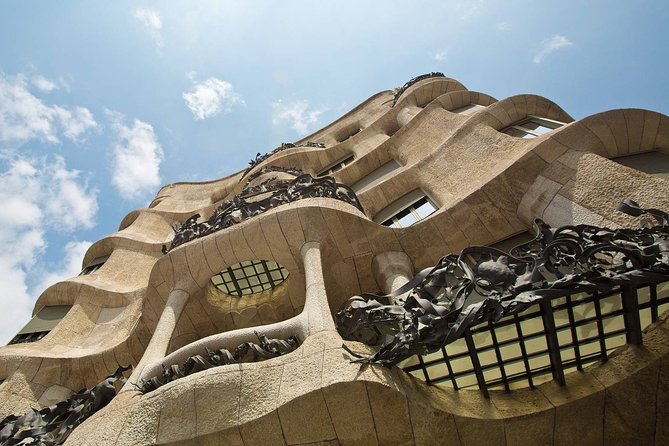
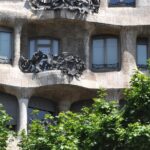
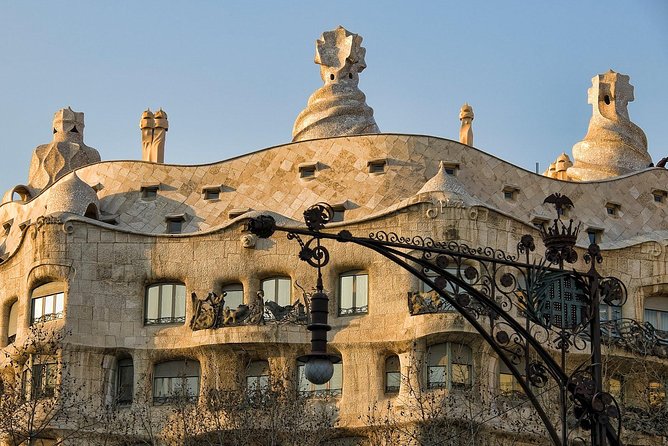
Next is Casa Milà, also known as La Pedrera, another UNESCO-listed modernist milestone. If Casa Batlló feels like fantasy, Casa Milà feels like a mature argument. It’s the culmination of Gaudí’s career, designed for changing social needs while still drawing inspiration from nature and organic forms.
The phrase “tailored to new social needs” is worth paying attention to. Modernisme wasn’t only about appearance. It also reflected changing life—how people lived, worked, moved, and expected space to function.
So at La Pedrera, you’ll want to think less about it as one idea and more as multiple ones: living patterns, building form, and that organic language Gaudí uses across his work. Even when you’re just seeing it from the outside, the tour’s guidance helps you recognize the logic behind the weirdness.
A legend stop: St George and why Barcelona loves symbols
Along the way, you pass by a modernist architectural detail tied to the legend of St George, the patron saint of Barcelona and many other places. This is one of those stops that feels small in time but big in meaning.
Symbols like St George are part of how Barcelona’s modernists built stories into architecture. If you understand that, you stop treating façades like decoration and start reading them like structured messages.
Even if you don’t remember the details afterward, you’ll carry the habit of looking for meaning—what the façade is trying to communicate and why it might matter to the city’s identity.
The Sagrada Familia finale: light, emotion, and what to watch for
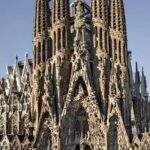
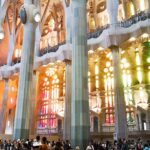
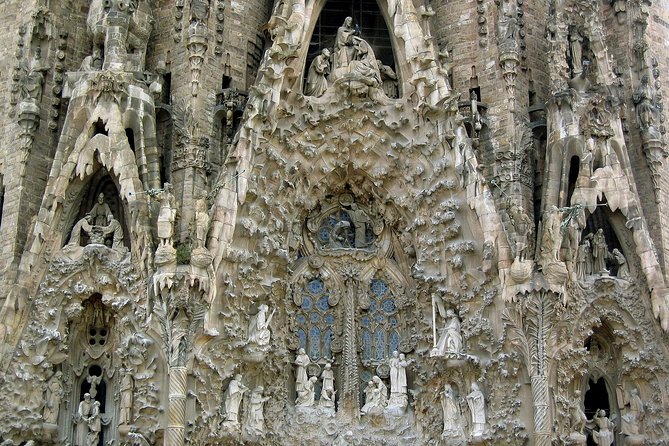
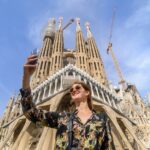
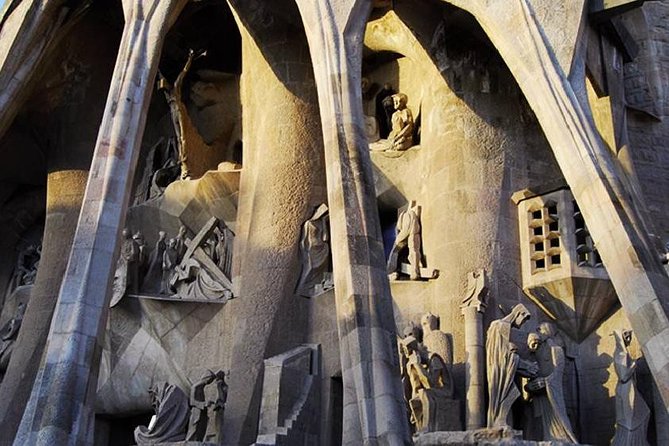
The tour ends at Sagrada Familia, and it’s supposed to leave a lifelong impression. This is where you get the emotional high note: organic shapes, sculpted symbolic details, and stained glass light filtering into the experience.
What makes Sagrada special isn’t only its reputation. It’s how it behaves visually. The forms don’t look designed to be “flat.” They feel designed to be alive, with structure that seems to bend toward nature.
Timing matters here. In the feedback, there’s at least one note that the tour ran long and left less time at Sagrada. That doesn’t mean it’s always a problem, but it does mean you should be ready to adjust your expectations. If Sagrada is your top priority, keep your next plans flexible enough to let the moment breathe.
Also, since the tour format is a walking tour, confirm what you’re actually doing at Sagrada—standing close for viewing versus entering. The tour description emphasizes admiration and explanations, so treat it as an on-site experience that may or may not include full interior time depending on how the day runs.
Guide quality: the people you’re likely to meet
A big part of the success of this tour is the guide. In the feedback, names like Antonio, Jose Carlos, Montse, Alfredo, Roberto, Jordi, Miguel, and Laura show up with consistent praise for being passionate, friendly, and very good at explaining what you’re seeing.
Here’s what to look for in a strong guide on a modernist walking tour:
- They explain the modernist movement in plain language.
- They connect each building to the next step in the story.
- They point out what most people miss when they just take photos.
If you get that kind of guide, you’ll come away with the ability to “read” the avenue yourself later. That’s the real prize.
Pacing and start times: how to plan around 2.5 hours
One of the tour’s selling points is that you can choose from many start times. That’s useful because Passeig de Gràcia can get busy, and Sagrada Familia is a place where you’ll want at least some mental space.
Still, plan smart. If your day is packed, you’ll feel the strain when a tour runs long. In one piece of feedback, the schedule ran about an hour over and the group didn’t have as much time at Sagrada as expected. That’s not a reason to skip the tour—it’s a reason to keep your commitments light afterward.
Practical planning idea: treat this as a “spend most of your morning or late afternoon here” activity. Pair it with lunch or dinner nearby rather than scheduling another timed attraction immediately after.
Who should book this Gaudí modernism walk
Book it if you:
- Want a guided introduction to Barcelona’s modernist architecture.
- Like learning through walking, not sitting in a classroom.
- Prefer seeing multiple major landmarks in one route.
- Want small-group attention with a maximum of 12 people.
Skip it or adjust expectations if you’re:
- Hoping to do full, timed interior visits at every major stop during the same 2.5 hours.
- Extremely schedule-driven and unable to absorb minor timing slips.
This works especially well for first-timers who want context fast, and for repeat visitors who want a better framework for seeing what they already recognize.
Quick practical tips before you go
- Wear comfortable shoes. You’re walking between major points on a famous avenue.
- Bring a way to capture details. The architecture rewards close viewing.
- If Sagrada Familia is the main goal, consider planning your day so you’re not rushing off immediately afterward.
- Expect explanations at each stop. The tour is built around stories that help you notice patterns.
If you do these basics, you’ll get more out of the walk than just a photo trail.
Should you book this tour?
Yes, I’d book it if you want a fast, friendly, small-group route that turns Gaudí and Barcelona modernisme into something you can recognize on your own afterward. The price is low enough that you’re not taking a big financial risk, and the guide-led storytelling is what turns impressive buildings into an actual understanding.
My main caution is expectation management around time and entrances. If you’re very strict about entering specific places (especially Sagrada Familia), double-check what’s included for access and build a little buffer. If you’re open to a walking-focused experience with lots of seeing and learning, this tour is a strong buy for your Barcelona first pass.
FAQ
How long is the Gaudí’s Modernist Legacy small group walking tour?
It runs for about 2 hours 30 minutes (approx.).
How much does the tour cost?
The price is $22.01 per person.
How big is the group?
The tour has a maximum of 12 travelers.
Is the tour offered in English?
Yes, it is offered in English.
Where does the tour start and end?
It starts at Carrer de Fontanella, 2, Ciutat Vella, 08002 Barcelona and ends at Sagrada Família, Eixample, Barcelona.
What’s included in the price?
Included items are a professional guide, a modernist walking tour covering Casa Batlló and La Pedrera, and thorough explanations of modernist architecture and Sagrada Familia.
Are food and drinks included?
No, food and drinks are not included.
Do I need hotel pickup or drop-off?
No, there is no hotel pickup and drop-off.
Is cancellation free?
Yes. You can cancel for free up to 24 hours in advance for a full refund.
Are service animals allowed?
Yes, service animals are allowed.