REVIEW · HOUSTON
Walking Tour of Houston: History, Architecture, Street Art
Book on Viator →Operated by John Gu · Bookable on Viator
Downtown Houston moves fast, and this walk helps you read it. I like how the route stitches together history, architecture, and street art in a tight loop, with a local guide calling out details you’d likely miss if you wandered solo. I also love the photo-friendly stops, especially the Market Square mural and the Gulf Building’s Art Deco lobby glow.
The main thing to consider is timing: most stops are brief, with about 5 minutes per landmark, so you’ll want to keep your camera ready and plan for your own water/snacks if you need them.
In This Review
- Key things I’d plan around
- Entering downtown Houston on foot: a $25 orientation that actually saves time
- Lyric Market to Market Square: the start that immediately tells you the city’s story
- Art Deco power: the Gulf Building and City Hall in one day’s worth of style
- A practical note on quick exterior stops
- Theater District walk: Alley Theater’s Brutal look and Jones Hall’s marble interior
- Tranquility Park and NASA: a short stop with a long connection
- Niels Esperson Building and the 1910 courthouse: two “golden age” landmarks
- Why ending with civic architecture feels right
- John Gu’s guide style: the reason this tour scores so high
- Price and value: what $25 covers, and what you still need to bring
- Weather-proofing and photo timing: how to get the shots without slowing the group
- Where it ends: Lynn Wyatt Square, then you can keep wandering
- Should you book this Walking Tour of Houston?
- FAQ
- How long is the walking tour?
- How much does the tour cost?
- Where does the tour start and where does it end?
- Is the tour in English?
- Is the tour stroller accessible and are service animals allowed?
- Are snacks or bottled water included?
- What’s the cancellation policy?
Key things I’d plan around
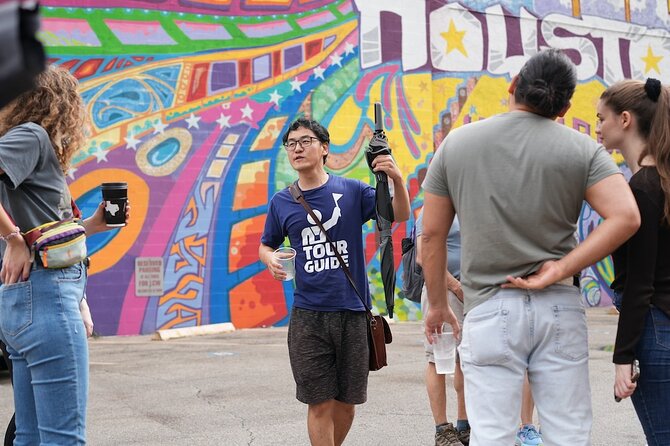
- Market Square’s Houston is inspired mural is a quick, high-impact photo stop.
- The Gulf Building (1929) hits hard even from the sidewalk, with Art Deco setbacks and a landmark lobby.
- The Theater District pairing of the Alley Theater and Jones Hall makes the walk feel like a mini-culture circuit.
- Tranquility Park connects Houston to NASA in a short, memorable pause.
- Two big “golden age” civic/office landmarks (the Niels Esperson Building and the 1910 courthouse) keep the architecture theme going.
Entering downtown Houston on foot: a $25 orientation that actually saves time
At $25 per person for about 2 hours, this tour is built for one job: give you an efficient sense of Houston’s center of gravity. You’re paying for a local guide and a structured route, not for museum tickets or a long sit-down experience. The good news is that the stops along the way are set up for free admission, which keeps the cost predictable.
This is also a nice fit for short visits. If you’ve got one afternoon, a meeting, or you just want to get oriented fast, you’ll get a readable “map” in your head by the end: murals here, Art Deco there, civic buildings nearby, and space-industry nods woven in.
And you’re not walking with a giant crowd. The group max is 25, and the pacing is designed to keep everyone moving between downtown landmarks.
Lyric Market to Market Square: the start that immediately tells you the city’s story
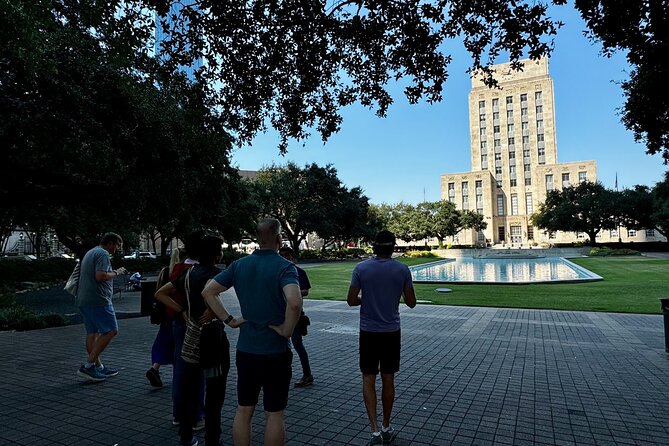
The walk begins at Lyric Market, 411 Smith St, in downtown. Right away, you’re in the part of town where Houston’s origin story feels tangible—because the route starts in the Downtown Historic District, at Market Square.
Stop 1 is Market Square, framed as a starting point for Houston’s beginnings. You’ll pass by some of the oldest buildings in the city, and the guide keeps it practical: not a lecture dump, but a way to understand why these blocks matter.
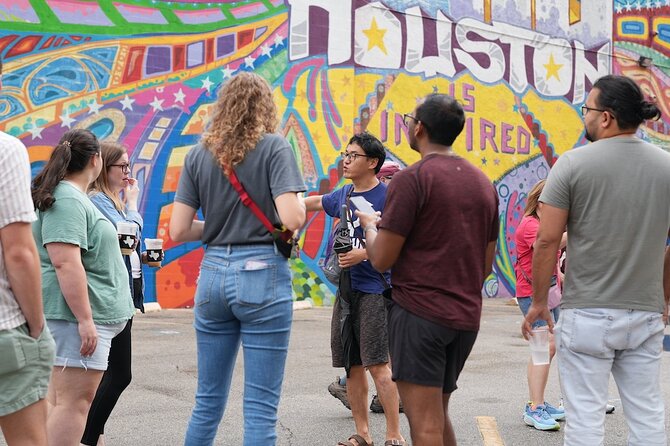
Then comes the most photo-friendly moment of the whole loop. You’ll get a chance to pose at the Houston is inspired mural, described as the city’s most popular Instagram photo. It’s a quick stop, but it works because it gives you something visual to anchor the rest of the architecture talk.
Art Deco power: the Gulf Building and City Hall in one day’s worth of style
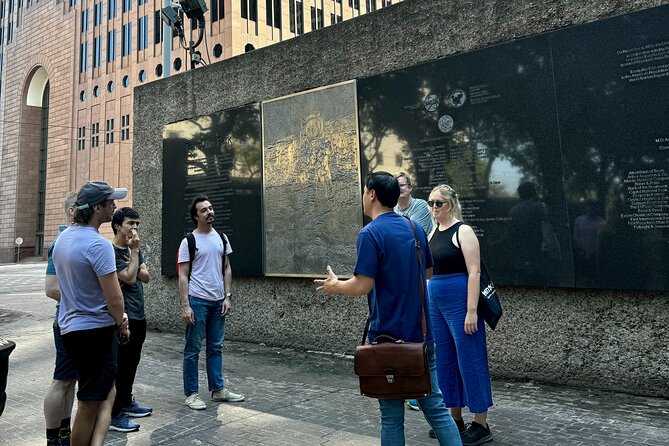
If Houston had a signature look, it might be Art Deco with confidence. Stop 2 at The Gulf Building is the kind of sight that makes people stop walking, even if they don’t want to admit it.
Completed in 1929, it’s a 37-story skyscraper with intricate setbacks and a stepped crown that’s known for glowing at night. Up close, the details matter: the building features gleaming marble, and the lobby is mural-covered, adding street-art energy to a classic high-rise setting.
From there, you pivot to Stop 4: City Hall. Completed in 1939, it’s an Art Deco landmark with limestone cladding, bold geometric forms, and intricate friezes. The guide’s goal here is to help you see the building as more than a backdrop. It’s a civic statement from the 1930s, and the “why” behind the architecture becomes part of the city’s personality lesson.
A practical note on quick exterior stops
Both of these stops are brief (about 5 minutes each), which is great for keeping momentum. The trade-off is that you’ll need to handle your own pace—skim the details first, take photos second, and don’t get stuck trying to study every carving like it’s a full museum visit.
Theater District walk: Alley Theater’s Brutal look and Jones Hall’s marble interior
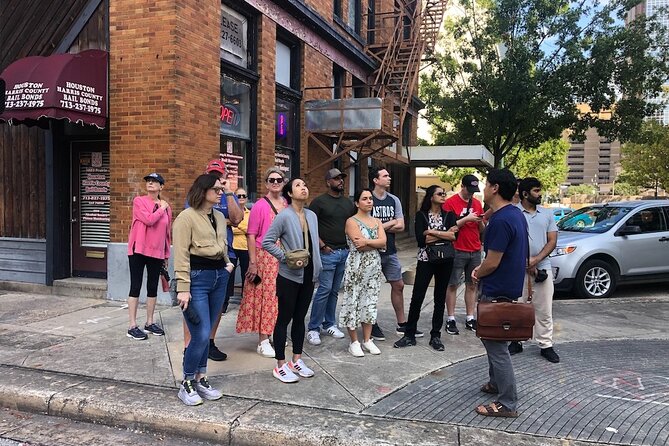
Next you’ll hit the Theater District, where Houston leans into live performance. Stop 3 focuses on major venues, including the Alley Theater and Jones Hall.
The Alley Theater is highlighted for its Brutalist design and for the fact that it’s known for productions that push boundaries. Even if you’re not a theater-season person, the building’s presence gives you a sense of how Houstonians see the arts: bold enough to be its own style, not just decoration.
Then Jones Hall enters the picture as a contrast. The tour points you toward its iconic marble interior and mentions acoustics—basically, the idea that this isn’t only about looks. It’s also a place designed to carry sound, which is a useful detail if you’re curious about why certain venues become crowd magnets.
This stop also helps you understand downtown beyond business and government. You’re still in a tight downtown radius, but the vibe shifts toward culture and public life.
Tranquility Park and NASA: a short stop with a long connection
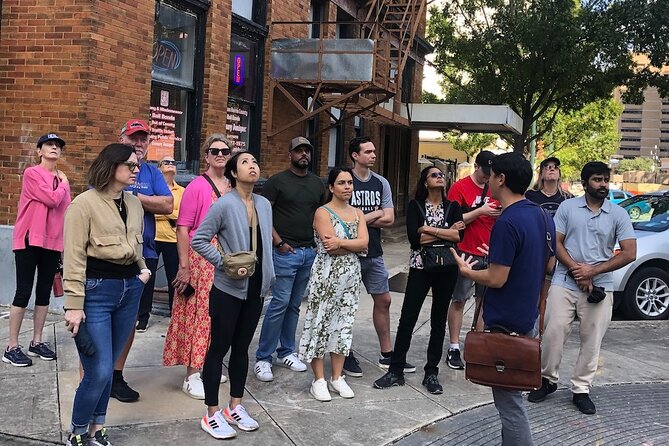
Stop 5 is Tranquility Park, where the tour explains Houston’s relationship with NASA. This is one of those stops that feels small on paper—just a short pause—but it adds an important layer to the city’s identity.
Houston isn’t only skyscrapers and murals. The city’s story includes the space program, and the park gives you a way to connect that thread without needing a longer detour. If you’re planning to spend time in Houston beyond downtown, this stop can help you choose what you prioritize next.
Niels Esperson Building and the 1910 courthouse: two “golden age” landmarks
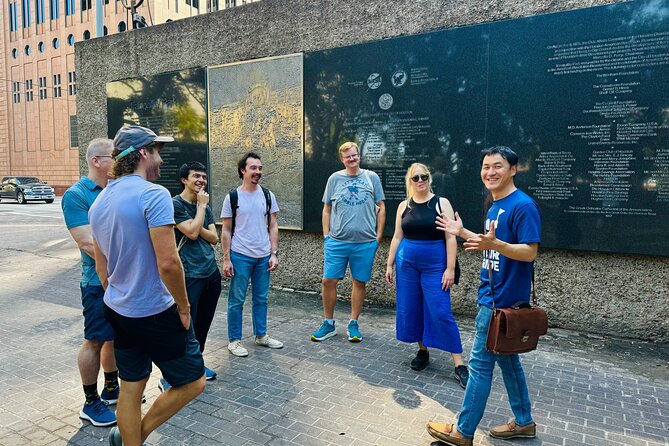
Stop 6 brings you to one of Houston’s early skyscraper icons: the Niels Esperson Building, completed in 1927. It’s described as Italian Renaissance-style, built as a tribute by Niels Esperson’s wife, Mellie, and it shows the kind of ambition Houston had as it grew.
The features you’ll want to notice include the terracotta details, grand columns, and a temple-like crown. It’s the kind of architecture that feels ceremonial rather than purely functional, which makes it a strong stop if you’re trying to see how Houston used buildings to project civic and economic confidence.
Stop 7 is the 1910 Harris County Courthouse. It’s framed as a high point of civic architecture, and that matters because you’re ending with a building that represents law and governance, not commerce or performance. If you’ve been thinking about downtown as a “where people work and watch things” district, this final civic stop helps correct that.
Why ending with civic architecture feels right
This ending choice sticks the landing. You’ve moved from murals and towers into arts and space connections, and then you finish with the courthouse, which puts the whole route into a bigger frame: a city organized around institutions, not just skyline views.
John Gu’s guide style: the reason this tour scores so high

The tour is led by John Gu, and his approach shows up in the kind of comments people write after. One recurring theme is how he keeps everyone in the loop, including larger groups.
In one of the standout notes, the guide spoke loud enough for a group of around 20, and he handled questions with patience. That kind of “no one gets left behind” energy matters on a walking tour, because if people can’t hear you or feel awkward to ask, the whole thing gets less useful.
There’s also a human touch in the pacing. In at least one experience note, John made a point to check in with a solo participant during a longer pause for restroom, snack, and beverage needs. That’s a practical detail worth remembering: even if the core stops are short, there’s still room to reset.
And if you’re a stroller user, the route is listed as stroller accessible, with service animals welcome. Since downtown sidewalks can be uneven, that planning note is genuinely useful.
Price and value: what $25 covers, and what you still need to bring
Here’s the honest value calculation. You pay $25, and the tour includes a local guide plus the walking route connecting major downtown landmarks. You do not pay extra for snacks or water, and the itinerary notes admission ticket free at the listed stops.
So what will you likely spend on your own? Food and drinks along the tour are not included. You’ll also want to plan for the basics: if the weather is warm, you’ll want water; if it’s cool or rainy, you’ll want layers or an umbrella. The point is simple: the tour keeps costs low, but it doesn’t replace personal supplies.
In terms of “am I getting enough for two hours?”—the format is tight enough to feel productive, but not so frantic that you’d need special training. Since most stops are around five minutes, you get the architecture highlights without losing the thread to long waits.
Weather-proofing and photo timing: how to get the shots without slowing the group
The tour can run in rain. One note specifically mentioned enjoying it even when it was raining. That doesn’t mean you should ignore weather, but it does suggest the route works in less-than-ideal conditions because it’s built around short exterior stops.
For photos, think in layers:
- Take the “big building” shot first.
- Then grab the close-up detail your guide points to.
- Finish with the mural pose when you reach Market Square.
Since you’re dealing with short windows, it helps to have your camera ready before you arrive at each stop. Keep your phone charged too. Downtown streets add up fast, and you’ll be taking more pictures than you expect once the landmarks start stacking up.
Where it ends: Lynn Wyatt Square, then you can keep wandering
The tour ends near 601 Capitol St, Houston, TX 77002, and the conclusion point is Lynn Wyatt Square park in the heart of the theater district. That’s a smart finish because it leaves you close to more food options and more things to look at without needing to transfer across town.
One practical detail from an experience note: the start and end points are close—about a block apart and near a tram line. Even if you don’t use transit, it helps you feel less “stuck” at the end of the walk.
From Lynn Wyatt Square, you can grab a bite at nearby cafes, take a short walk back, or keep exploring downtown at your own pace.
Should you book this Walking Tour of Houston?
I’d book it if you want a fast, structured way to learn downtown Houston in about two hours, especially if you like Art Deco architecture, public landmarks, and street-art moments like the Houston is inspired mural. The price feels fair because stops are free and you’re paying mainly for the guide’s route knowledge and interpretation.
I’d think twice if you want long stays at each building or you’re expecting lots of indoor time. The tour is set up with short stop durations, so it’s best for people who enjoy seeing key sights, getting context, and moving on.
If you’re planning a first trip to Houston or you’re short on time, this walk is a strong way to get your bearings fast and leave downtown with a clearer sense of what kind of city Houston is. And with an overall 5/5 score and strong recommendation history, it’s one of the easier choices for a “do something meaningful in a short window” afternoon.
FAQ
How long is the walking tour?
The walking tour lasts about 2 hours (approx.).
How much does the tour cost?
It costs $25.00 per person.
Where does the tour start and where does it end?
It starts at Lyric Market, 411 Smith St, Houston, TX 77002 and ends at 601 Capitol St, Houston, TX 77002, concluding at Lynn Wyatt Square park in the theater district.
Is the tour in English?
Yes, it’s offered in English.
Is the tour stroller accessible and are service animals allowed?
Yes. The tour is listed as stroller accessible, and service animals are allowed.
Are snacks or bottled water included?
No. Snacks and bottled water are not included, and the cost of food and drinks along the tour is not covered.
What’s the cancellation policy?
You can cancel for a full refund if you cancel at least 24 hours in advance of the experience start time. Free cancellation is available up to that cutoff.