REVIEW · SANTA BARBARA
Santa Barbara Historical and Architectural Private Tour
Book on Viator →Operated by Opatrip.com USA · Bookable on Viator
Three hours, one town, zero guesswork. This private Santa Barbara Historical and Architectural tour strings together early Spanish-era sites and Spanish Colonial Revival details in a tight route that actually makes sense on foot.
I like that it gives you hands-on context at the first stop, El Presidio de Santa Barbara State Historic Park, where you can see 1782-era adobe-brick rooms, gardens, and 18th-century artifacts up close. One thing to consider: the Presidio entry fee is listed separately (plan around a $5 per-person cost), and several stops are brief, so you’ll get breadth more than long sit-down time in each place.
In This Review
- Key highlights worth your time
- Santa Barbara’s Spanish and Adobe Story, Built for a 3-Hour Walk
- El Presidio de Santa Barbara State Historic Park: The Adobe Anchor
- Santa Barbara Historical Museum: Courtyard Photos and Easy-to-Like Exhibits
- City Hall and Casa de la Guerra: Plaza de la Guerra Details You’ll Actually Spot
- City Hall (Built 1923)
- Casa de la Guerra (Built 1819)
- The Courthouse and Arlington Theatre: Spanish Revival Meets City Drama
- Historic Courthouse Stop
- Arlington Theatre
- Alameda Park and Alice Keck Park Gardens: When History Turns Green
- Alameda Park
- Alice Keck Park Memorial Gardens
- The Santa Barbara Post Office: Streamline Moderne Meets Spanish Style
- Price and Value: What $488.97 Buys (and What It Doesn’t)
- Who This Private Architecture Tour Is Best For
- Should You Book This Santa Barbara Historical and Architectural Tour?
- FAQ
- How long is the Santa Barbara Historical and Architectural Private Tour?
- Is this a private tour?
- What language is the tour offered in?
- Where do we meet for the tour?
- Where does the tour end?
- What admission costs should I expect?
- What’s included in the tour price?
- Is Casa de la Guerra open to visitors?
- What if the weather is poor?
- Can I cancel for free?
Key highlights worth your time
- El Presidio’s 1782 adobe-brick buildings, with original rooms and period artifacts
- Adobe-brick Santa Barbara Historical Museum (built 1964), plus a courtyard that’s great for photos
- Plaza de la Guerra landmarks, including 1923 City Hall with hand-painted tiles and arches
- Alameda Park to Alice Keck Park Gardens, where downtown history turns into shaded paths and ducks
- A Spanish-meets-Modern post office look, mixing Streamline Moderne and Spanish styling
Santa Barbara’s Spanish and Adobe Story, Built for a 3-Hour Walk

Santa Barbara can feel like three different towns in one day: mission-era and adobe, the formal downtown plaza world, and then the green-lawn, tree-lined downtown parks. This tour is designed to connect those dots quickly. You start at El Presidio and then work your way through civic buildings, theatres, courtyards, and public spaces—so by the end, you understand why the architecture looks the way it does, not just what it looks like.
I also like the pacing for first-timers. It’s not one long slog to a single museum. Instead, you get a series of short “look closer” moments—tiles, arches, courtyards, and garden details—that add up.
The private setup matters too. You’re not stuck listening through someone else’s pace. If you care about architectural details—porches, arches, tilework, adobe brick—your guide can steer the conversation toward what you notice.
You can also read our reviews of more tours and experiences in Santa Barbara.
El Presidio de Santa Barbara State Historic Park: The Adobe Anchor
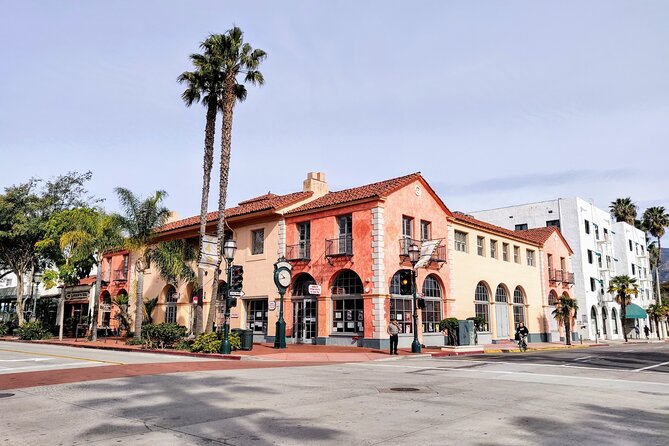
Your tour starts at El Presidio de Santa Bárbara State Historic Park at 123 E Canon Perdido St. This is where the story begins in a very physical way. The site is built around a structure dating to 1782, described as an adobe-brick property, and you’ll spend about an hour exploring the original rooms, gardens, and 18th-century artifacts.
What I like about this opening is that it gives you an architectural baseline. Once you’ve seen adobe construction and learned what everyday buildings looked like in the Spanish Empire era, the later stops—especially the Spanish Colonial Revival styles—start to click. You’re not just touring fancy façades. You’re seeing how Santa Barbara’s later builders echoed earlier design language.
Practical note: this part includes walking time, and the Presidio entry fee is not included in the base price (it’s listed as about $5 per person). If you’re trying to budget tightly, this is the one cost you’ll likely plan for upfront.
Santa Barbara Historical Museum: Courtyard Photos and Easy-to-Like Exhibits
From the Presidio, the tour moves to the Santa Barbara Historical Museum. The museum building is described as adobe brick, built in 1964—an interesting twist. Santa Barbara isn’t trying to hide tradition or copy older materials; it’s choosing them on purpose.
You’ll get around 35 minutes here, with admission listed as free. The highlights for your time are the local history exhibits (including paintings and etchings) and the courtyard. The courtyard is the star for quick photography: it includes two adobe structures dating to 1817, plus a gift shop.
A quick caution: because the time is short, this stop works best if you browse with a plan. If you’re the type who reads every label and wants to linger, aim to spend extra time after the tour when you’re done with the route.
City Hall and Casa de la Guerra: Plaza de la Guerra Details You’ll Actually Spot
Next you’ll be facing Santa Barbara’s ceremonial center, the Plaza de la Guerra. This part is less about long interior visits and more about observing the design language in the open.
City Hall (Built 1923)
You’ll stop at City Hall, built in 1923 and described as Spanish Colonial Revival. Look for the hand-painted tiles, the arches, and the overall sense of ceremonial grandeur that fits right into the plaza setting. There’s also a California Pepper Tree noted in front—worth a quick glance if you like landmarks you can recognize later.
Admission here is listed as free, and the stop time is short (about 5 minutes). That’s enough for spotting details but not for a deep architectural study.
Casa de la Guerra (Built 1819)
Then you’ll move to Casa de la Guerra, erected in 1819 by Don Jose de la Guerra. This place is described as a hub in early Santa Barbara, and today it remains a focal town spot. It’s also tied to annual Fiestas and is open for weekend visits.
This is another short stop (about 5 minutes), but it’s the kind of location where a guide’s context really helps. Without background, it can look like another historic adobe structure. With context, it starts to feel like a real operating center from a past era.
The Courthouse and Arlington Theatre: Spanish Revival Meets City Drama
Downtown Santa Barbara has its formal side, and this segment leans into architecture that feels built for public life.
Historic Courthouse Stop
One of the tour’s stops is the Superior Court of California, County of Riverside—referred to as the Riverside Historic Courthouse in the tour info. Regardless of naming confusion you might see on confirmations, the architectural description is specific: the building is linked to the Spanish Colonial Revival movement and includes a grand Roman arch and detailed tilework. You’ll also have a chance to visit the mural room and take in panoramic views from the clock tower.
Time here is about 20 minutes. That’s a solid window for this kind of place because the views and interiors take a few minutes to appreciate.
Arlington Theatre
Next comes the Arlington Theatre. The exterior is noted for a tall structure and shaded arched paseo. Inside, you’ll see it described like a Spanish Village square, with 3D façade effects and a starry vaulted roof.
This is brief on paper (about 5 minutes), but theatres tend to leave strong impressions fast. Even if you can only take in a quick look, the interior concept—public square style plus sky-like ceiling—usually makes people slow down on their own.
Alameda Park and Alice Keck Park Gardens: When History Turns Green
After the hard architecture stops, the tour shifts into softer, livable downtown spaces.
Alameda Park
Alameda Park has been central since 1850. You’ll get around 20 minutes here, and admission is free. The tour info highlights a few things that make this more than “a park stop”: it hosts events like Summer Solstice and Earth Day, it has an 1880s bandstand, and it includes the Kids’ World playground.
There’s also a more personal environmental detail. After a 1966 fire, the third block (once the Mirasol Hotel) became a botanical garden, including a duck pond. If you’re thinking about the story of Santa Barbara as a cycle of use, loss, and rebuilding, this part helps you feel that arc instead of just reading it.
Alice Keck Park Memorial Gardens
Then you’ll reach Alice Keck Park Memorial Gardens, formerly the site of the El Mirasol Hotel. The garden setup is described in vivid detail: a monarch-attracting butterfly meadow, a creek, stepping stones, and a large Australian Fig tree shading a turtle-populated duck pond.
This is about 25 minutes, so you’ll have time to slow down, look around, and actually enjoy the small ecosystem details. It’s also a nice reset for your feet after the civic and theatre stops.
The Santa Barbara Post Office: Streamline Moderne Meets Spanish Style
You’ll end this downtown stretch with the United States Postal Service building. The architecture is described as combining Streamline Moderne with Spanish styles, and there are sculptures both inside and out.
This last stop is short (about 5 minutes). But it gives you one more “why” to carry home: Santa Barbara didn’t pick one style and stick forever. Instead, it mixes eras and aesthetics in ways that feel local, not random.
Price and Value: What $488.97 Buys (and What It Doesn’t)
The price listed is $488.97 per person for an approximately 3-hour private tour. That’s not cheap, so you’ll want to understand what you’re paying for.
Here’s the value math as it’s described:
- You get a professional local guide, working with your group only.
- Many stops are free to enter (museum, city hall, Casa de la Guerra, parks, theatre, post office).
- Only El Presidio has a separate entry fee, listed at about $5 per person.
In other words, you’re paying mainly for the guide’s time and the “put it in order for me” route planning. If you like learning architecture without doing homework first, that’s where the money earns its keep.
One note from past feedback: guests praised the guide for being well informed. One review mentions a guide named Joseph and calls out that there was a lot of information packed into the 3-hour window. The only downside hinted in that same feedback: it would be nice to have a treat during a long walk.
Who This Private Architecture Tour Is Best For
I think this tour fits best if you’re:
- New to Santa Barbara and want a fast, coherent framework for how the city’s architecture connects
- Interested in adobe-era roots and later Spanish Colonial Revival styling
- The kind of traveler who enjoys short observation stops—tiles, arches, courtyards, fountains of detail—more than marathon museum time
- Traveling as a group that benefits from private pacing and a guide who can answer questions on the fly
If you want a single museum-style deep dive or you hate walking between multiple exterior stops, you might find the route a bit fast. But if your goal is to understand the look and feel of Santa Barbara in a few hours, the structure is smart.
Should You Book This Santa Barbara Historical and Architectural Tour?
I’d book it if you want a guided route that turns scattered downtown landmarks into a readable story—adobe basics, civic Spanish revival details, theatre drama, then down into the parks where the city breathes.
Skip or rethink it if you’re budgeting hard beyond the listed Presidio entry fee, or if you strongly prefer long, unscheduled time inside museums and buildings. The tour time is short at several stops on purpose.
If your ideal day is: walk, look closely, take photos, learn the names and the design logic, then I think you’ll be happy with this format—especially in good weather, since the experience is noted as weather-dependent.
FAQ
How long is the Santa Barbara Historical and Architectural Private Tour?
The tour lasts about 3 hours.
Is this a private tour?
Yes. It’s private, meaning only your group participates.
What language is the tour offered in?
The tour is offered in English.
Where do we meet for the tour?
The meeting point is El Presidio de Santa Bárbara State Historic Park, 123 E Canon Perdido St, Santa Barbara, CA 93101.
Where does the tour end?
The activity ends back at the meeting point.
What admission costs should I expect?
El Presidio de Santa Barbara State Historic Park has an admission cost listed at $5. Other stops in the tour are listed as free.
What’s included in the tour price?
A professional local tour guide is included. A mobile ticket is also part of the experience.
Is Casa de la Guerra open to visitors?
The tour information says Casa de la Guerra is open for weekend visits.
What if the weather is poor?
The experience requires good weather. If it’s canceled due to poor weather, you’ll be offered a different date or a full refund.
Can I cancel for free?
Yes, free cancellation is available. You can cancel up to 24 hours in advance for a full refund.