REVIEW · TBILISI
Brutal Tbilisi — Night Edition: Dark Side of Soviet Architecture
Book on Viator →Operated by Friendly.ge: Transfers & Tours in Georgia · Bookable on Viator
Night Tbilisi hits different after dark. This 3–4 hour walk-and-drive tour stitches together the brutalist side of Soviet architecture with a guide who gives you real meaning, not just names. I especially like the photo coaching for low-light shots and angles you can actually recreate with your phone, and I like how the route balances famous landmarks with darker, unfinished stories. The one drawback to plan for: this tour can feel heavy—plus there’s some uneven terrain and a couple spots that are not friendly if you fear heights or feel claustrophobic.
I’ve also noticed how smoothly this kind of night tour works for logistics: you get a central meeting place that’s easy to find, with door-to-door pickup in central Tbilisi and WhatsApp coordination on the day. You’ll see several illuminated buildings where shadows do half the work, so even short stops feel like full scenes. Still, you should go with comfortable clothing and shoes, because rain or cold doesn’t stop the show.
One more thing: this is a private group experience, so the pace can stay human. And yes, the admission tickets at the stops are listed as free, which helps the value when you’re comparing night tours.
In This Review
- Key things that make this Brutal Tbilisi night tour work
- How the night route turns Soviet concrete into a story
- Price and value: what $100 buys in six dramatic stops
- Arashenda Building: the unfinished Hotel Odishi that became shelter
- Chronicles of Georgia after dark: golden light and deep shadows
- The Former Archaeology Museum on Digomi Hill: lost ambition made visible
- The Ministry of Highways of the Georgian SSR: concrete blocks like floating bridges
- Nutsubidze Skybridge: aerial walkways, a still-running elevator, and big city views
- Arcadia Georgia (Wedding Palace): Soviet ideology meets Georgian ritual
- Who should book this night architecture tour
- Logistics that matter for a smooth night
- Should you book Brutal Tbilisi — Night Edition?
- FAQ
- How long is the Brutal Tbilisi night tour?
- Is pickup available in Tbilisi?
- What’s included in the $100 per person price?
- Is the tour language English?
- Are there any safety or comfort concerns to know about?
- Does the tour run in bad weather?
Key things that make this Brutal Tbilisi night tour work
- Low-light photo tips built for your phone so you stop guessing in the dark
- A real photographer’s eye guiding your angles at night, not just a quick snapshot
- Six Soviet-era stops with strong contrasts: glory vs. loss, planning vs. abandonment
- Quiet nighttime viewpoints where monuments feel more powerful and less crowded
- Free admission tickets for the key sites on the route
- Private pacing for your group only, with optional pickup in central areas
How the night route turns Soviet concrete into a story
This tour is designed around a simple idea: Soviet architecture looks different at night. Daytime can make concrete feel flat and ordinary. After dark, lights skim edges, shadows carve shapes, and you start reading buildings like characters.
What you’re really paying for here is guidance plus composition. A guide helps connect each site to what was happening in Georgia—politics, war, ideology, and later re-use. Then the photo element turns that understanding into something you can remember visually. You’re not just looking; you’re learning how to see.
You’ll also get a practical mindset for photographing at night. Even if you think your phone camera is “just okay,” the tour’s photo tips and photographer support are aimed at showing what low-light modes, framing, and steady timing can do.
Finally, a heads-up: some stops are emotionally intense. You’ll be standing in places tied to unfinished projects and displacement. If that kind of atmosphere affects you strongly, you should think twice.
You can also read our reviews of more tours and experiences in Tbilisi.
Price and value: what $100 buys in six dramatic stops
At $100 per person for about 3 to 4 hours, the value mostly comes from three things: the guide, the transport/pickup, and the number of locations packed into a short window.
You get:
- a live local guide
- photo tips plus photographer help
- private transportation (and door-to-door pickup within central Tbilisi)
Admission is listed as free at the stops, so you’re not hit with separate ticket costs for the major sites. Meals are not included, which matters because the tour doesn’t promise a break for food. Plan to eat before you go, or bring something you can eat quickly on your own schedule.
Compared with day tours that scatter across the city, this one is concentrated. That’s a real plus for a short trip, especially if you want the night skyline but don’t want to spend hours figuring out transit.
Arashenda Building: the unfinished Hotel Odishi that became shelter
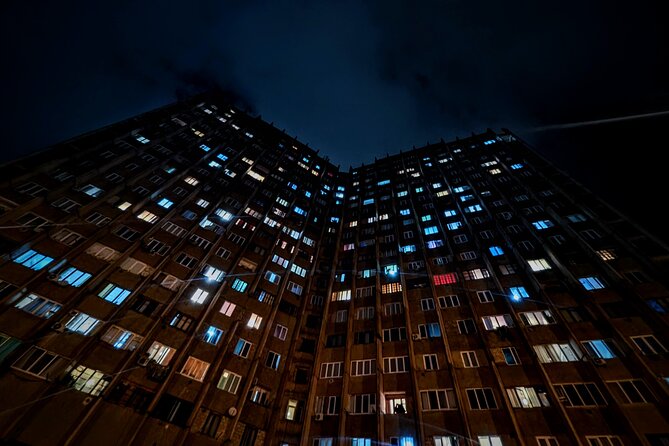
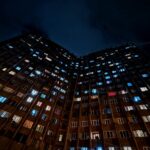
The Arashenda Building is the kind of place that changes your mood fast. At night, the early-1980s concrete frame feels half dream, half ruin. Construction stopped after political change and civil conflict, so the 17-storey project was never completed.
What makes it powerful is what happened next. Later, families displaced by war used the structure for shelter—turning a stalled monument into a vertical neighborhood of survival. Your guide explains how the building went from planned luxury (Hotel Odishi) to improvised life.
Two things to watch for when you’re there:
- The “folded wing” shape, which looks like open pages from certain angles.
- The cracked surfaces and improvised balconies that catch dim light and create a haunting texture.
Photo-wise, this is where night photography becomes less about gear and more about position. Expect the guide to steer you toward angles where the building’s geometry lines up with the street-level glow. It’s also close enough to the area where you can connect the visuals with nearby monuments, so the story of Georgia’s endurance stays in view.
Potential drawback: because this is an abandoned, uneven-feeling site, you’ll want a careful step and a calm head. If you’re uncomfortable in dark, gritty surroundings, this stop may feel intense.
Chronicles of Georgia after dark: golden light and deep shadows
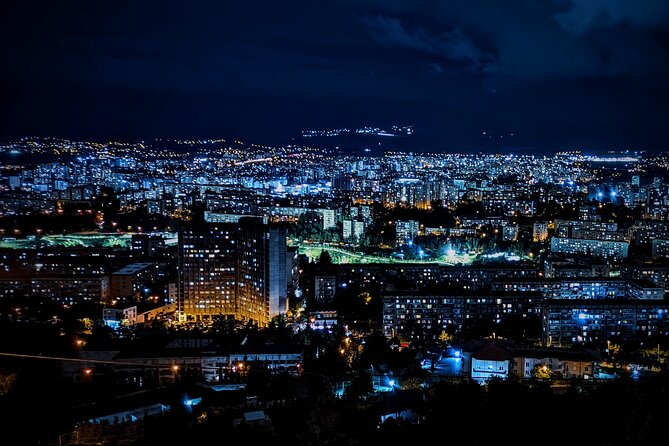
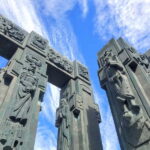
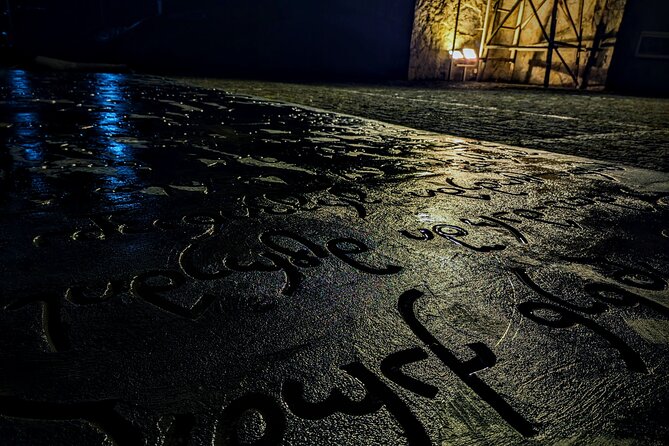
The Chronicles of Georgia monument is one of those places that quietly takes over the whole skyline once the sun goes down. At night, it’s illuminated with soft golden light while the surrounding area slips into shadow, so the carved figures read like they’re emerging from darkness.
Your guide will move you among the towering columns and explain the legends and meanings behind the stone sculptures. This is where the tour stops being just architectural sightseeing and becomes cultural storytelling—kings, saints, and ancient faith are part of what the monument is designed to convey.
The experience is especially effective at night because it tends to feel quieter. That makes it easier to focus on details like:
- how the illumination changes the look of faces and armor-like forms
- how columns create depth when you shift your viewpoint
- how the top platform gives you a clean panoramic night view over the city
And the view isn’t one-note. You’ll see the contrast between the lit monument and the darker city below, including the Tbilisi Sea area. It gives you a sense of scale: history perched above you, while modern Tbilisi keeps moving.
Practical note: this stop includes time for photos and looking around, so treat it like your main “camera stop” even if you have other big sights later.
The Former Archaeology Museum on Digomi Hill: lost ambition made visible
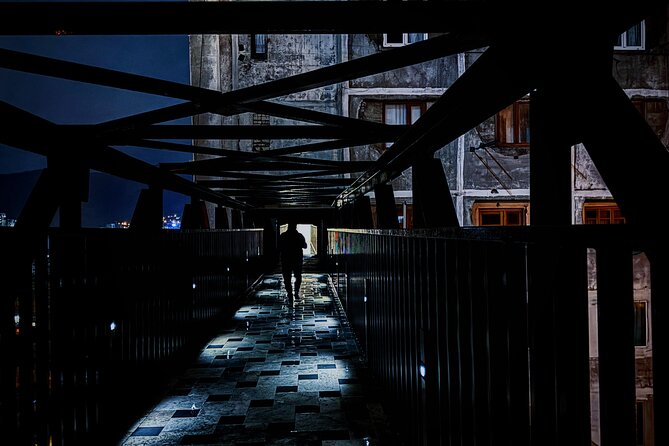
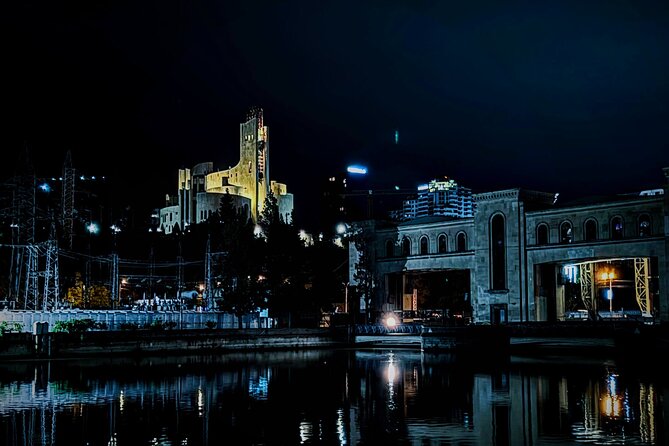
If you want a Soviet-era structure with a heavy sense of unfinished intent, the Former Archaeology Museum is it. It rises above Tbilisi on Digomi Hill, built in 1988 with the idea of preserving Georgia’s ancient treasures. It never fully opened.
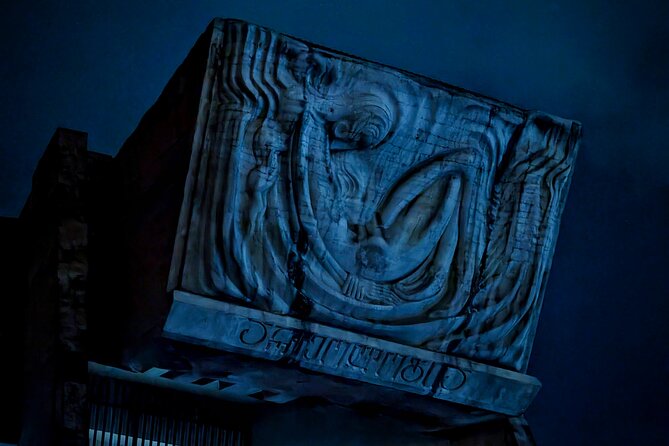
At night, the atmosphere turns even more ghostlike. Dim city light catches carved bas-reliefs, and the cracked stone makes the figures look like they’re fading in and out. The wide stairway can feel like an entrance to an ancient temple—even though it’s clearly part of a newer, failed plan.
Your guide’s job here is to link the architecture to the shifting fate of Georgian archaeology: what the building was meant to protect, and why politics and timing disrupted that goal. That context turns the place from “abandoned building photos” into something more meaningful.
Photo-wise, this is a great location for silhouettes and strong perspective lines. The stairs and large surfaces help your phone camera capture drama without needing professional lighting.
Potential drawback: it can feel very cold and empty at night, even if the streets are lively nearby. If you don’t like echoing, closed-off spaces, give yourself permission to take breaks and keep the visit short on the moments that feel best for you.
The Ministry of Highways of the Georgian SSR: concrete blocks like floating bridges
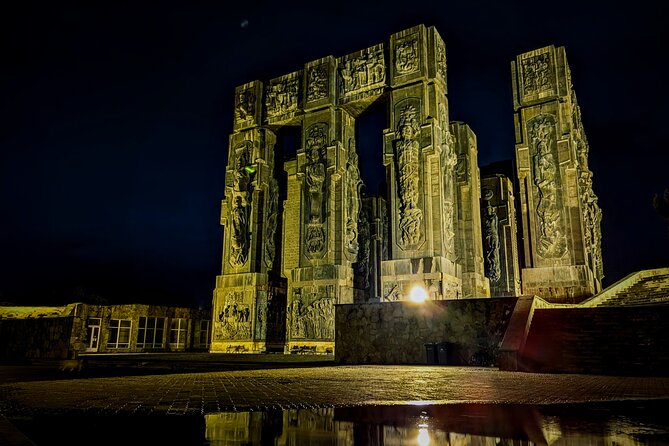
Next up is a building that looks like a sculpture under the night sky. The former Ministry of Highways of the Georgian SSR was designed in the 1970s, and its massive concrete blocks stack in a way that resembles floating bridges. The design theme is unity—Georgia’s mountain roads and the idea of connected travel.
Later, the building’s purpose shifted. It now houses the Bank of Georgia Headquarters, so you get an unusual blend: Soviet-era ambition inside a functional, modern setting.
At night, the illuminated corridors create a futuristic-yet-ancient effect. You can see voids and layered spaces where darkness becomes part of the design. Your guide will help you find the best angles for photos, because the shape reads best when you shoot from the right position, not from wherever your feet stop.
One more detail that’s practical for your planning: this stop is relatively short. Use the time to focus on one or two angles rather than trying to photograph everything. The building rewards patience.
Nutsubidze Skybridge: aerial walkways, a still-running elevator, and big city views
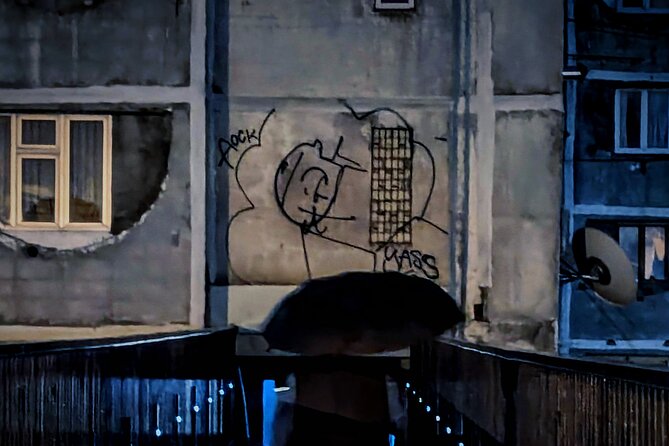
Nutsubidze Skybridge is the stop where the architecture starts to feel like it’s moving. Built in the 1970s, three massive residential blocks sit on steep slopes and are connected by suspended bridges high above the city.
At night, the corridors glow faintly, giving you that floating walkway feeling. From below, city lights flicker, while the concrete towers fade into darker silhouettes. It’s eerie, but in a good way—like the city is laid out in layers for you to study.
A detail you’ll remember: you ride an old elevator to get up there, and it’s still operated by a lift lady. That quiet, human element—the steady rhythm of the elevator and someone who’s been part of the building’s life—adds warmth to what could otherwise feel like pure concrete.
Once you’re out on the bridges, you get one of the tour’s best panoramic spreads. You’ll see modern glass towers, darker edges of the old city, and the hills beyond. It’s a real reminder that Tbilisi is built in layers, not timelines.
Potential drawback: if heights make you nervous, this is the stop to treat carefully. The viewpoint is part of what you came for, but it’s also where your nerves can start talking.
Arcadia Georgia (Wedding Palace): Soviet ideology meets Georgian ritual
Arcadia Georgia, also known as the Wedding Palace, is Soviet Georgia’s wedding monument—architecture, ideology, and emotion all tangled together. Built in 1984 by architect Victor Jorbenadze, it replaced the traditional church wedding ritual with a civic ceremony.
The building’s form is striking. It rises like a spiraling tower or a futuristic temple, with arches that echo Georgian churches, but framed in raw concrete. Some people see an influence from Le Corbusier’s sculptural modernism, but this one doesn’t feel copied. It feels Georgian, just pushed through Soviet style.
Your guide will explain the human side: in Soviet times, couples lined up here to start their lives in a space meant to sanctify love without religion. That idea is what turns the building from “cool photo” into “thought-provoking architecture.”
At night, the building glows softly from within. Window light casts curved shadows, and the whole place starts to feel romantic in spite of the concrete control behind it. It’s one of the most visually cinematic stops on the route.
Potential drawback: the emotional tone depends on your perspective. If you dislike buildings associated with forced ideology or you’re not in the mood for symbolic history, keep your expectations realistic and your mind open to ambiguity.
Who should book this night architecture tour
This is a strong match if you:
- love architecture and want Soviet-era Tbilsi without the usual daylight crowds
- want photo help for night shots with your phone
- enjoy guides who explain meaning behind shapes and materials
- like routes built around viewpoints and contrasts
Skip it if you:
- are afraid of heights (Nutsubidze Skybridge is the obvious concern)
- deal with claustrophobia (some interior corridors and stair areas may feel tight in the dark)
- get emotionally overwhelmed by stories connected to displacement, unfinished projects, or heavy historical context
- prefer a relaxed, scenic-only tour with no difficult background
Also, you’ll want a practical mindset. You’ll be out for a few hours in mixed terrain, and the tour runs in all weather conditions. Comfort matters more than style.
Logistics that matter for a smooth night
This is offered in English. Pickup is offered door-to-door within central Tbilisi, and if your accommodation is outside the pickup area, you’ll be suggested a nearby meeting place, usually around Liberty Square or Europe Square by the vintage tram-café.
You’ll also get WhatsApp contact on the day of the tour to confirm pickup time and details, which helps reduce the usual travel-day stress. The itinerary and sequence of stops can shift due to traffic, weather, or special events, but the tour still includes the key highlights and viewpoints described.
No meals are included, so don’t plan on this tour as your dinner plan. Wear shoes that you trust on uneven terrain, and bring layers because night air can turn colder than you expect.
If you’re the type who cares about saving time, the free admission at stops helps. It’s one less thing to manage in the dark.
Should you book Brutal Tbilisi — Night Edition?
If you like your travel with texture—real stories, strong design, and night lighting that makes concrete look almost alive—book it. The combination of a local guide, guided photo tips, and a route that moves from quiet monument to abandoned shell to aerial bridges gives you a lot of impact for the money.
I’d only hold back if heights or tight spaces make you uncomfortable, or if you know heavy historical atmosphere can hit you hard. For the right traveler, this is one of the most memorable ways to understand modern Tbilisi: not by looking away from the past, but by letting it show.
FAQ
How long is the Brutal Tbilisi night tour?
The tour lasts about 3 to 4 hours.
Is pickup available in Tbilisi?
Yes. Door-to-door pickup is offered within central Tbilisi. If you’re outside the pick-up area, you’ll be directed to a convenient nearby meeting point, usually around Liberty Square or Europe Square near the vintage tram-café.
What’s included in the $100 per person price?
The price includes a live local guide, photo tips, and private transportation. Admission tickets at the listed stops are free. Meals are not included.
Is the tour language English?
Yes, the tour is offered in English.
Are there any safety or comfort concerns to know about?
The tour is not suitable for emotionally sensitive individuals and is not suitable for travelers with fear of heights or claustrophobia. The tour also includes uneven terrain and may involve long drives.
Does the tour run in bad weather?
Yes. It operates in all weather conditions, including rain or snow, so comfortable shoes and appropriate clothing are recommended. Free cancellation is available up to 24 hours in advance for a full refund.